Giriraj Singh: FTAs to push leather exports to $14 bn by 2030
Synopsis
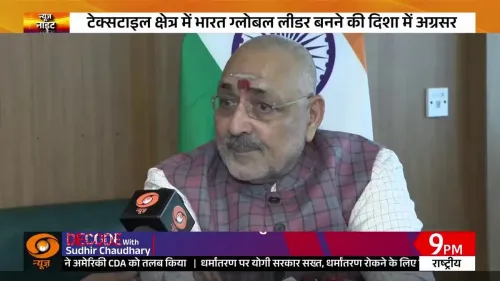
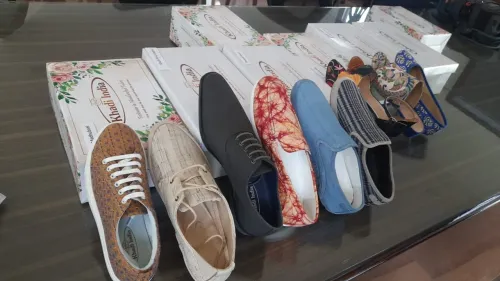
Union Textiles Minister Giriraj Singh has amplified a Council for Leather Exports projection that Free Trade Agreements will propel India's leather goods and footwear exports to $14 billion by 2030, underscoring the government's FTA-led trade strategy for labour-intensive sectors.
Key Takeaways
The Council for Leather Exports (CLE) projects India's leather goods and footwear exports will reach $14 billion by 2030 , driven by Free Trade Agreements.
Union Textiles Minister Giriraj Singh amplified the CLE projection on 8 July 2026 , signalling ministerial endorsement of the FTA-led growth strategy.
The India-UAE CEPA and India-Australia ECTA , both signed in 2022 , already provide preferential tariff access for Indian leather and footwear exporters.
The Foreign Trade Policy 2023 and the PLI scheme for textiles (2021) provide the domestic policy framework complementing FTA-driven market access.
Leather and footwear are classified as priority labour-intensive sectors, with major export clusters in Agra, Kanpur, Chennai , and Kolkata .
Ongoing FTA talks with the UK and the EU are the next critical milestones for the sector's export ambitions.
Union Textiles Minister Giriraj Singh on Wednesday, 8 July 2026 shared projections from the Council for Leather Exports (CLE) indicating that Free Trade Agreements will help India's leather goods and footwear exports reach $14 billion by 2030, signalling the government's confidence in FTA-led trade growth for the sector.
Context
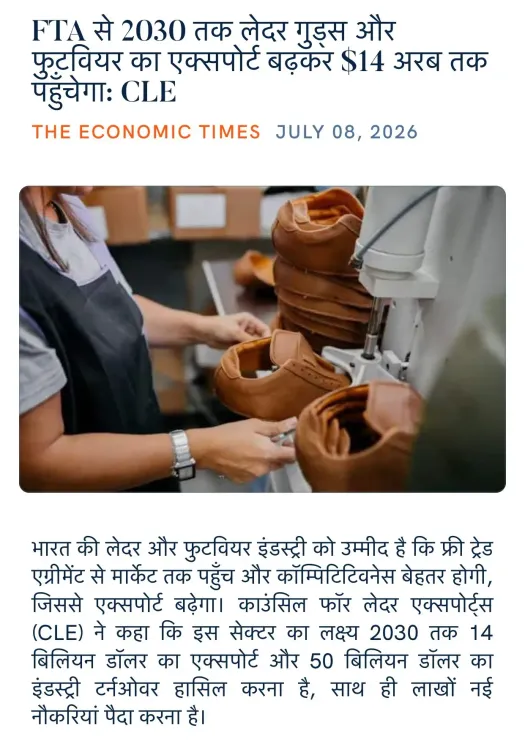
Singh shared the CLE projection via the NaMo App, citing the apex export body's assessment that ongoing and concluded FTAs will be the primary driver of growth in leather and footwear shipments. The post, written in Hindi, states: 'FTA se 2030 tak leather goods aur footwear ka export badhkar $14 arab tak pahunchega: CLE' — ('FTAs will help leather goods and footwear exports grow to $14 billion by 2030: CLE'). The minister's amplification of the CLE estimate signals that the Ministry of Textiles views FTA-driven market access as central to its export strategy for the sector.
Policy Backdrop
India has signed several significant trade agreements in recent years that include concessions for leather and footwear. The India-UAE Comprehensive Economic Partnership Agreement (CEPA), signed in 2022, reduced tariffs on a range of leather and footwear lines, while the India-Australia Economic Cooperation and Trade Agreement (ECTA), also signed in 2022, opened duty concessions for select leather goods into the Australian market.
The Foreign Trade Policy 2023, a five-year framework launched to guide India's merchandise export ambitions, explicitly identified leather and footwear as priority labour-intensive sectors. These policy instruments, combined with the Production Linked Incentive (PLI) scheme for textiles introduced in 2021, have layered domestic production incentives on top of improved market access abroad. Ongoing FTA negotiations with the United Kingdom and the European Union are closely watched by the leather industry for their potential to unlock two of the world's largest consumer markets.
Stakeholders and Impact
India's leather and footwear sector is dominated by MSMEs and is highly employment-intensive, making export growth in this segment a direct lever for job creation. The CLE, as the apex body under the Ministry of Commerce that tracks and promotes leather exports, has consistently flagged preferential market access as the single biggest enabler for Indian exporters competing against established players such as China, Vietnam, and Bangladesh.
Leather goods and footwear exporters stand to benefit most directly from reduced import duties in partner countries, which can make Indian products price-competitive in markets where they currently face higher tariff walls. Cluster-level modernisation programmes and infrastructure upgrades in traditional leather hubs such as Agra, Kanpur, Chennai, and Kolkata are expected to complement the demand-side gains from FTAs.
What's Next
The trajectory of the $14 billion target by 2030 will be tracked through quarterly CLE export data releases, which will indicate whether actual shipment growth is keeping pace with projections. The outcome of active FTA negotiations — particularly with the UK and the EU — will be a key determinant, as those markets represent significant volume potential for Indian leather goods and footwear. Any new tariff schedules notified under concluded or forthcoming agreements will be closely monitored by exporters and industry bodies alike.
Point of View
Not just domestic schemes. It connects to a broader government pattern of using bilateral trade agreements as the primary tool to grow labour-intensive exports — a politically important calculation given the employment base in leather and footwear MSMEs. The timing also keeps pressure on the UK and EU FTA negotiations, reminding trading partners that India's industry is actively benchmarking expected gains. Whether the $14 billion target holds will ultimately depend on the pace and depth of tariff concessions secured in those ongoing talks.
NationPress
7 Oct 2026
Frequently Asked Questions
What is India's leather and footwear export target for 2030?
The Council for Leather Exports (CLE) projects that India's leather goods and footwear exports will reach $14 billion by 2030, driven primarily by Free Trade Agreements that reduce tariffs in key markets.
What FTAs are helping India's leather exports?
The India-UAE CEPA and the India-Australia ECTA, both signed in 2022, include duty concessions on leather goods and footwear. Ongoing negotiations with the UK and the EU are expected to add further market access.
What is the Council for Leather Exports (CLE)?
The CLE is India's apex industry body under the Ministry of Commerce that promotes and monitors the export of leather, leather goods, and footwear from India.
What government schemes support India's leather and footwear sector?
The Foreign Trade Policy 2023 identifies leather and footwear as priority export sectors, while the PLI scheme for textiles (2021) provides production-linked incentives. Cluster modernisation programmes also support the MSME-heavy industry.
Why is Giriraj Singh involved in leather exports?
Giriraj Singh is India's Union Minister of Textiles. The textiles ministry has oversight over leather and footwear as part of its mandate to promote labour-intensive export sectors.