Giriraj Singh Hails India-Oman CEPA as Textile Sector Milestone
Synopsis
Union Textiles Minister Giriraj Singh has welcomed the India-Oman CEPA, citing immediate duty-free access on 945 textile categories in Oman. The deal is expected to sharpen export competitiveness and benefit millions of weavers, artisans, and MSME entrepreneurs across India's major textile clusters.
Key Takeaways
Union Textiles Minister Giriraj Singh on June 8, 2026 hailed the India-Oman CEPA as a historic step for the textile and handicrafts sector.
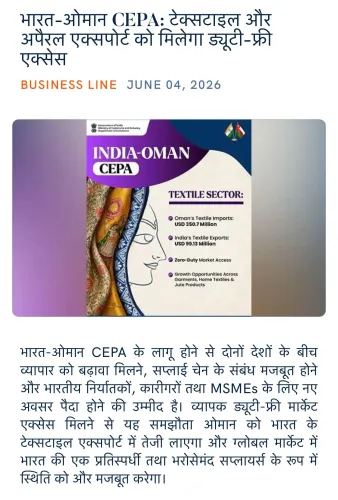
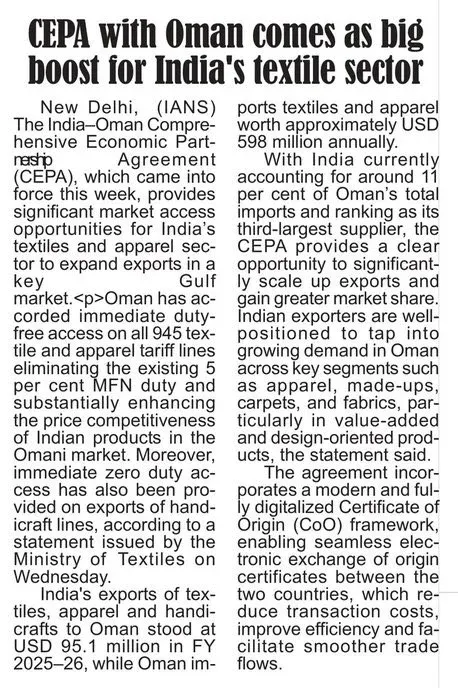
The agreement provides immediate duty-free access on 945 textile categories in Oman, according to the minister.
The deal is expected to benefit millions of weavers, artisans, and MSME entrepreneurs across India's textile clusters.
The India-UAE CEPA (February 2022) served as the template, covering over 90 percent of Indian textile lines with duty-free access.
The agreement aligns with government initiatives including Atmanirbhar Bharat , Viksit Bharat 2047 , and Make in India .
Full tariff schedules, rules-of-origin provisions, and post-implementation export data from textile clusters will be the key metrics to watch.
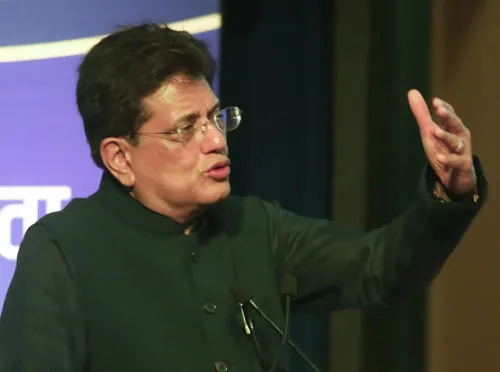
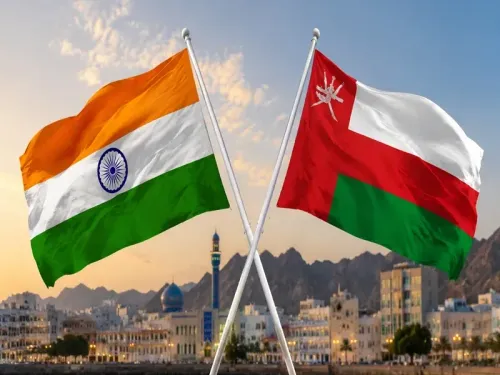
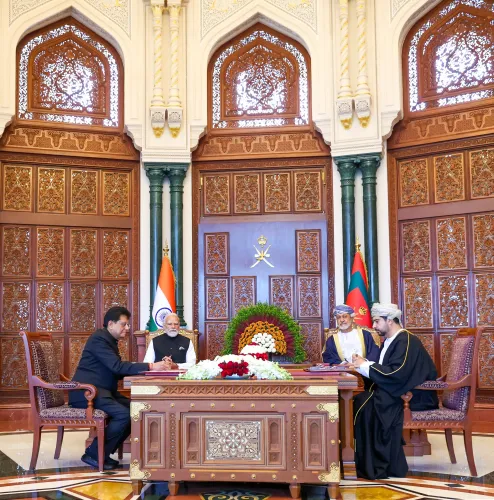
Union Textiles Minister Giriraj Singh on Monday, June 8, 2026, hailed the India-Oman Comprehensive Economic Partnership Agreement (CEPA) as a historic step for India's textile and handicrafts industry, saying it opens duty-free access across 945 textile categories in Oman with immediate effect and will benefit millions of weavers, artisans, and entrepreneurs.
Context
Posting on X, Giriraj Singh described the India-Oman CEPA as 'नए अवसरों के द्वार खोलने वाला एक ऐतिहासिक कदम' ('a historic step that opens the doors to new opportunities'). He said immediate zero-duty access on 945 textile categories in Oman would sharpen global competitiveness of Indian products, accelerate exports, and deliver direct gains to weavers, craftspeople, and small entrepreneurs.
The minister's remarks signal that the agreement has reached a stage where its textile provisions are operative or imminent, framing it as a flagship outcome of the government's trade diplomacy with Gulf Cooperation Council (GCC) nations.
Policy Backdrop
The India-Oman CEPA follows the template set by the India-UAE CEPA, signed in February 2022, which granted duty-free access to over 90 percent of Indian textile lines and became the model for subsequent Gulf deals. India formally launched CEPA negotiations with Oman in 2023 as part of a broader strategy to deepen trade ties across the GCC beyond traditional energy imports.
The textiles push sits squarely within the government's Atmanirbhar Bharat and Viksit Bharat 2047 frameworks, which aim to raise manufacturing's share of GDP and position India as a global export hub. Production-linked incentive schemes for textiles complement the market-access gains that CEPA provisions are designed to unlock.
Stakeholders and Impact
India's textile and handicrafts sector is among the country's most labour-intensive industries, employing millions of workers across major clusters in Uttar Pradesh, Gujarat, Tamil Nadu, and Rajasthan. Small and medium exporters, handloom weavers, and handicraft artisans — who have historically struggled to compete on price in Gulf markets against lower-tariff rivals — stand to be the primary beneficiaries of zero-duty access.
Oman is a longstanding trade and energy partner for India in the Gulf, and its market, while smaller than the UAE's, forms part of a wider GCC corridor that Indian exporters are increasingly targeting to diversify away from saturated Western markets.
What's Next
Analysts and industry bodies will closely watch the publication of the full tariff schedule and rules-of-origin provisions, which will determine which product lines and manufacturing processes qualify for the preferential rates. First-quarter export data from major textile clusters after the agreement enters into force will be the earliest concrete measure of on-ground impact.
With similar agreements being pursued with other GCC members, the India-Oman CEPA could serve as a building block for a broader regional trade corridor — one that places Indian textiles and handicrafts at the centre of South-to-Gulf supply chains for years to come.
Point of View
The BJP is also reinforcing a political narrative that links trade diplomacy directly to grassroots livelihoods. The 945-category duty-free figure, if borne out in the formal tariff schedule, would represent a meaningful expansion of market access beyond what earlier Gulf deals offered. This positions the Oman agreement as a template for the wider GCC corridor strategy, with other member-state deals likely to follow the same structure.
NationPress
23 Oct 2026
Frequently Asked Questions
What is the India-Oman CEPA and what does it mean for textiles?
The India-Oman Comprehensive Economic Partnership Agreement is a bilateral trade pact that, according to Union Textiles Minister Giriraj Singh, grants immediate zero-duty access on 945 textile categories in Oman, making Indian textile and handicraft exports more price-competitive in the Gulf market.
How many textile categories get duty-free access under the India-Oman CEPA?
Minister Giriraj Singh stated that 945 textile categories will receive immediate duty-free access in Oman under the CEPA.
Who benefits from the India-Oman CEPA in the textile sector?
Weavers, handicraft artisans, MSME exporters, and entrepreneurs — particularly those in clusters across Uttar Pradesh, Gujarat, Tamil Nadu, and Rajasthan — are the primary intended beneficiaries of the agreement's textile provisions.
How does the India-Oman CEPA compare to the India-UAE CEPA?
The India-UAE CEPA, signed in February 2022, granted duty-free access on over 90 percent of Indian textile lines and served as the template for subsequent Gulf deals including the Oman agreement.
What is India's broader trade strategy with Gulf countries?
India has been accelerating bilateral CEPAs with GCC nations to diversify export destinations away from saturated Western markets, with textiles and handicrafts positioned as a key labour-intensive sector to benefit from preferential Gulf market access.