Gadkari: Cabinet clears NIPU-2026 to boost urea self-reliance
Synopsis
The Union Cabinet approved NIPU-2026 on 15 July 2026, updating India's urea investment framework with a 12–16% RoE band, cost-transparency reforms, and foreign-exchange risk mitigation to spur domestic gas-based urea production and cut import dependence.
Key Takeaways
The Union Cabinet , chaired by PM Narendra Modi , approved the National Investment Policy for Urea-2026 (NIPU-2026) on 15 July 2026 .
NIPU-2026 targets fresh investment in gas-based urea manufacturing units to reduce India's import dependence.
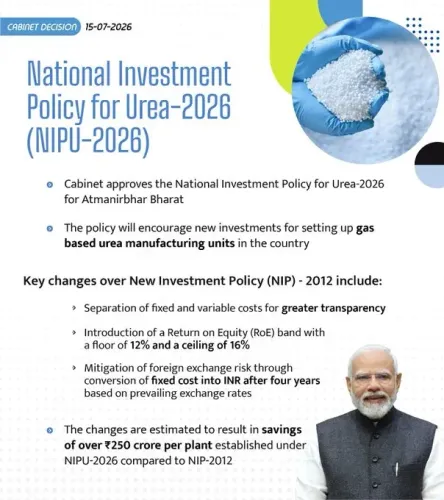
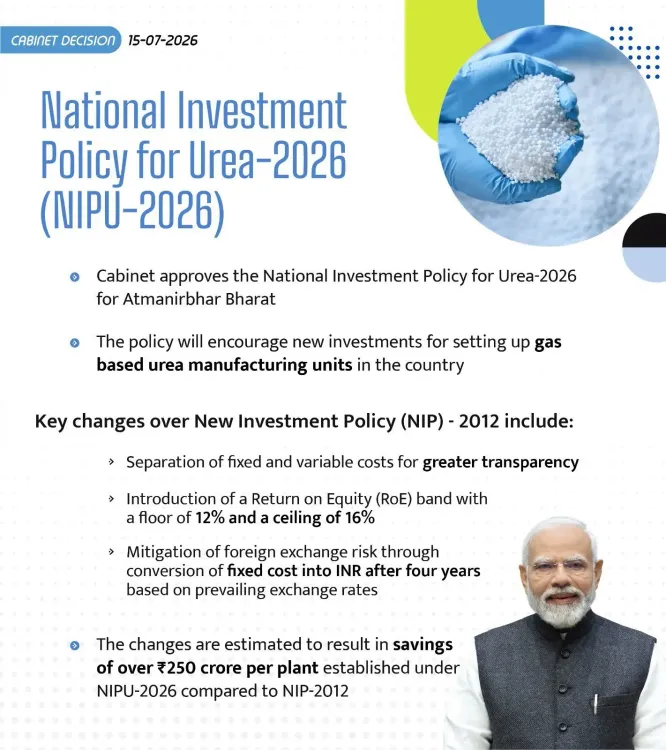
The policy introduces a Return on Equity (RoE) band of 12–16% and separates fixed and variable costs for greater transparency.
Measures to mitigate foreign exchange risk are included, addressing a long-standing concern for urea plant operators.
The government projects savings of over ₹250 crore per new plant established under the policy.
The policy is framed as a key instrument under the Atmanirbhar Bharat self-reliance initiative launched in May 2020 .
Union Road Transport and Highways Minister Nitin Gadkari on Wednesday, 15 July 2026 announced that the Union Cabinet, chaired by Prime Minister Narendra Modi, has approved the National Investment Policy for Urea-2026 (NIPU-2026), a framework proposed by the Department of Fertilizers to attract fresh capital into domestic gas-based urea manufacturing and advance India's goal of fertilizer self-sufficiency under the Atmanirbhar Bharat initiative.
Context
In his post, Gadkari noted that NIPU-2026 is designed to 'encourage fresh investments in gas-based urea manufacturing units, strengthening domestic production and advancing India's goal of self-sufficiency in urea.' The Cabinet decision marks a significant update to the country's urea investment framework, the previous iteration of which dates to 2012.
India remains one of the world's largest consumers of urea, a key nitrogen fertilizer used extensively by its farming community. Dependence on imports has long been a pressure point on the country's foreign-exchange reserves and agricultural input security, making domestic capacity addition a recurring policy priority.
Policy Backdrop
The New Investment Policy-2012 was the last major framework notified to revive investment in new urea plants. NIPU-2026 introduces structural reforms absent from its predecessor: a clear separation of fixed and variable costs to improve cost transparency, and a viable Return on Equity (RoE) band of 12–16% to make new plant investments commercially attractive to private capital.
The policy also incorporates measures to mitigate foreign exchange risk — a persistent concern for manufacturers who import gas or equipment in hard currency. Together, these changes are intended to crowd in private investment in an import-substituting sector that successive governments have identified as strategically important.
The broader Atmanirbhar Bharat programme, launched in May 2020, set explicit targets for self-sufficiency in fertilizers alongside other strategic sectors. NIPU-2026 is positioned as a direct instrument to fulfil those targets by making new gas-based urea capacity financially viable for investors.
Stakeholders and Impact
Fertilizer manufacturers stand to benefit from clearer cost-recovery norms and a defined equity return corridor, reducing the regulatory uncertainty that has historically deterred greenfield investment in the sector. The 12–16% RoE band is intended to signal a stable, predictable return environment to prospective plant developers.
For farmers — the ultimate consumers of urea — greater domestic production capacity could translate into more stable supplies and reduced vulnerability to global price shocks and import disruptions. The government estimates savings of over ₹250 crore for every new plant established under the policy, which could eventually ease the fiscal burden of the urea subsidy regime.
What's Next
The immediate next steps will involve the Department of Fertilizers notifying detailed operational guidelines under NIPU-2026, followed by bidding rounds or application windows for new gas-based plant licences. Analysts and industry participants will closely track the pace of capacity commitments by existing and new entrants.
If the policy succeeds in attracting the intended investments, India could meaningfully reduce its structural import dependence on urea over the next decade — a development that would carry implications not only for agricultural input security but also for the country's broader current-account dynamics.
Point of View
The policy attempts to address two of the most cited deterrents to greenfield fertilizer investment: regulatory opacity and return unpredictability. The foreign-exchange risk mitigation clause is particularly notable given the rupee volatility of recent years, and suggests the government is willing to absorb or share currency risk to accelerate capacity addition. Whether these incentives prove sufficient to trigger actual plant construction — rather than merely policy announcements — will be the real test of NIPU-2026's effectiveness.
NationPress
15 Jul 2026
Frequently Asked Questions
How is NIPU-2026 different from the 2012 urea policy?
Unlike the New Investment Policy-2012, NIPU-2026 separates fixed and variable costs for greater transparency, introduces a defined Return on Equity band of 12–16% to make investments commercially viable, and adds measures to mitigate foreign exchange risk for plant operators.
What savings does NIPU-2026 promise per new urea plant?
The government has stated that the policy reforms are expected to generate savings of over ₹250 crore for every new urea plant established under NIPU-2026.
How does NIPU-2026 relate to Atmanirbhar Bharat?
NIPU-2026 is proposed by the Department of Fertilizers as a direct instrument under the Atmanirbhar Bharat self-reliance initiative, which set explicit targets for self-sufficiency in fertilizers when it was launched in May 2020.
Who benefits from the new urea investment policy?
Fertilizer manufacturers benefit from clearer cost-recovery norms and a predictable equity return corridor, while farmers stand to gain from more stable domestic urea supplies and reduced vulnerability to global price shocks and import disruptions.