Gadkari breaks ground on 3 elevated highway projects in Pune
Synopsis
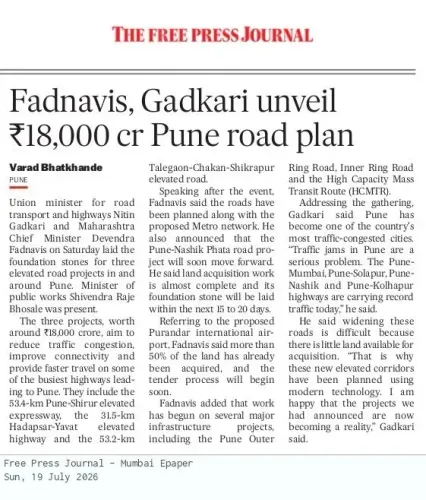
Union Minister Nitin Gadkari and Maharashtra CM Devendra Fadnavis broke ground on three elevated highway projects in Pune district on 18 July 2026, covering over 138 km at a combined outlay exceeding Rs 18,700 crore, with metro corridors planned on two of the elevated tiers.
Key Takeaways
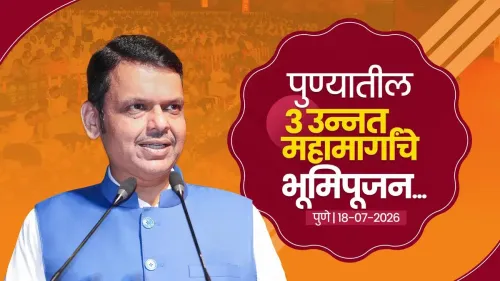
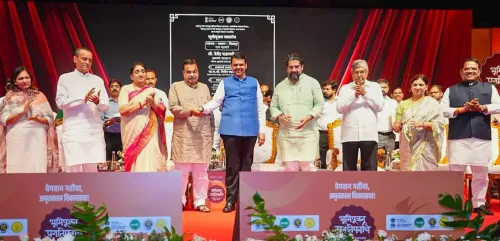
Ground-breaking for three elevated highway projects in Pune district was held on 18 July 2026 by Union Minister Nitin Gadkari and CM Devendra Fadnavis .
The Pune–Shirur Elevated Expressway (NH 753F) is 53.4 km long, costs Rs 7,515 crore , and includes a 7 km second-tier metro corridor .
The Talegaon–Chakan–Shikrapur Highway (NH 548D) spans 53.2 km at Rs 5,923 crore , targeting the industrial belt.
The Hadapsar–Yavat Highway (NH 65) covers 31.5 km at Rs 5,262.36 crore with a proposed 17.70 km metro tier .
All three projects will be executed on a DFBOT (Design-Finance-Build-Operate-Transfer) model via private financing.
The Pune–Shirur section is the first phase of the larger Pune–Chhatrapati Sambhajinagar Greenfield Six-Lane Expressway being developed by MSIDC .
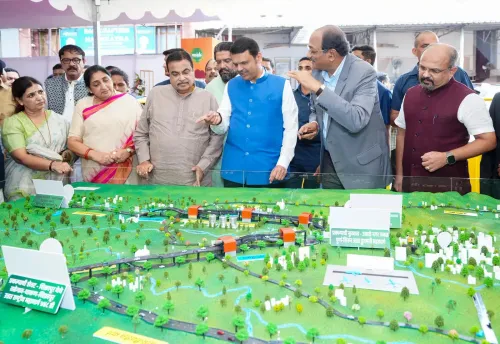
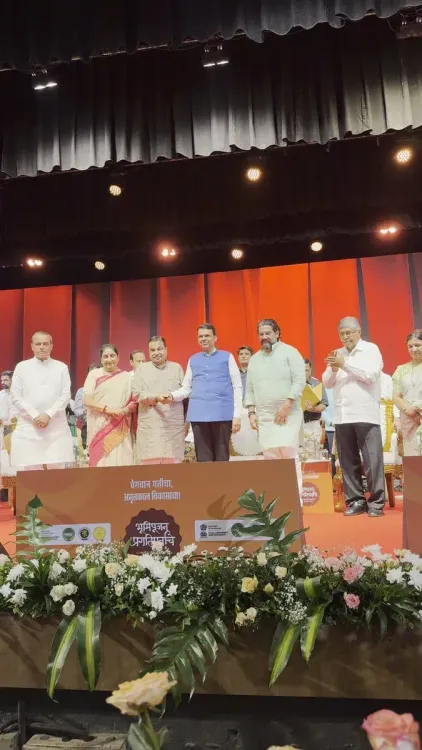
Union Road Transport and Highways Minister Nitin Gadkari on Saturday, 18 July 2026, performed the ground-breaking ceremony for three major elevated highway projects in Pune district, Maharashtra, alongside Chief Minister Devendra Fadnavis, Deputy Chief Minister Sunetra Pawar, and several state ministers and elected representatives.
Context
The three projects — the Pune–Shirur Elevated Expressway on NH 753F, the Talegaon–Chakan–Shikrapur Highway on NH 548D, and the Hadapsar–Yavat Elevated Highway on NH 65 — were inaugurated at a combined ceremony attended by Pune Mayor Manjusha Nagpure, Pimpri-Chinchwad Mayor Ravi Landge, members of parliament, legislators, and district officials. Gadkari described the projects as a 'modern transport corridor built keeping in view the growing future traffic needs' (भविष्यातील वाहतुकीच्या वाढत्या गरजा लक्षात घेऊन उभारला जात असलेला आधुनिक वाहतूक कॉरिडॉर).
Policy Backdrop
The Pune–Shirur Elevated Expressway is the first phase of the broader Pune–Chhatrapati Sambhajinagar Greenfield Six-Lane Expressway, to be developed by the Maharashtra State Infrastructure Development Corporation (MSIDC). The 53.4 km elevated section carries a project outlay of Rs 7,515 crore and proposes a 6-lane elevated road with a parallel 4-lane at-grade highway beneath it; a 7 km metro corridor is planned on its second tier. The Talegaon–Chakan–Shikrapur project spans 53.2 km at a cost of Rs 5,923 crore, featuring 26.3 km of 4-lane elevated road alongside a 4-lane at-grade highway. The Hadapsar–Yavat corridor covers 31.5 km at Rs 5,262.36 crore, with a 25 km, 6-lane elevated section and a proposed 17.70 km metro route on its second tier. All three projects will be executed on a DFBOT (Design-Finance-Build-Operate-Transfer) basis, reflecting the government's reliance on private-sector financing for large infrastructure delivery.
The projects fit within the framework of PM Gati Shakti, the national master plan unveiled in 2021 to integrate roads, metro, and multimodal infrastructure, and the Bharatmala Pariyojana launched in 2015 to construct and upgrade national highway corridors across India. Gadkari credited Prime Minister Narendra Modi's 'visionary leadership' (दूरदर्शी नेतृत्व) for enabling stronger connectivity and a faster transport network in Maharashtra.
Stakeholders and Impact
Pune commuters stand to benefit most directly: the elevated alignments are designed to reduce congestion on existing roads and cut travel time between Pune and Chhatrapati Sambhajinagar — the former Aurangabad — a key city in the Marathwada region. The Talegaon, Chakan, and Shikrapur industrial belt, home to automobile manufacturers and ancillary units, is a primary beneficiary of the NH 548D project, which promises 'a radical change in the transport system' (वाहतूक व्यवस्थेत अमूलाग्र बदल) for the rapidly expanding zone. The second-tier metro integrations on the Pune–Shirur and Hadapsar–Yavat corridors signal an intent toward multimodal urban mobility that could reduce private vehicle dependency over time.
What's Next
With ground-breaking ceremonies now complete, attention will shift to the award of DFBOT contracts and the start of detailed engineering work. The remaining phases of the Pune–Chhatrapati Sambhajinagar Greenfield Expressway beyond Shirur Bypass are yet to be taken up, and their timelines will be closely watched by industry and commuters alike. The integration of metro corridors on elevated road tiers is a relatively new model in India, making these Pune projects a test case for multimodal infrastructure delivery at scale.
Point of View
If executed on schedule, could position Pune as a model for multimodal corridor development in Tier-1 Indian cities. The visible presence of both central and state leadership at the ceremony underscores the political premium both the BJP-led Centre and the Mahayuti state government are placing on infrastructure optics in Maharashtra.
NationPress
17 Oct 2026
Frequently Asked Questions
What are the three highway projects inaugurated in Pune by Gadkari?
The three projects are the Pune–Shirur Elevated Expressway on NH 753F (Rs 7,515 crore, 53.4 km), the Talegaon–Chakan–Shikrapur Highway on NH 548D (Rs 5,923 crore, 53.2 km), and the Hadapsar–Yavat Elevated Highway on NH 65 (Rs 5,262.36 crore, 31.5 km).
What is the total cost of the Pune highway projects announced by Gadkari?
The combined project outlay for all three elevated highway projects in Pune district exceeds Rs 18,700 crore, with individual costs of Rs 7,515 crore, Rs 5,923 crore, and Rs 5,262.36 crore respectively.
Will there be a metro line on the Pune elevated highways?
Yes, a 7 km metro corridor is proposed on the second tier of the Pune–Shirur elevated highway, and a 17.70 km metro route is planned on the second tier of the Hadapsar–Yavat elevated highway.
What is the DFBOT model used for these Pune highway projects?
DFBOT stands for Design-Finance-Build-Operate-Transfer, a public-private partnership model where a private concessionaire designs, finances, builds, and operates the project before transferring it to the government at the end of the concession period.
How does the Pune–Shirur expressway connect to the Pune–Chhatrapati Sambhajinagar corridor?
The Pune–Shirur Elevated Expressway is the first phase of the larger Pune–Chhatrapati Sambhajinagar Greenfield Six-Lane Expressway being developed by the Maharashtra State Infrastructure Development Corporation (MSIDC) along NH 753F.