Gadkari pays tribute to 'Father of Pathology' Khanolkar
Synopsis
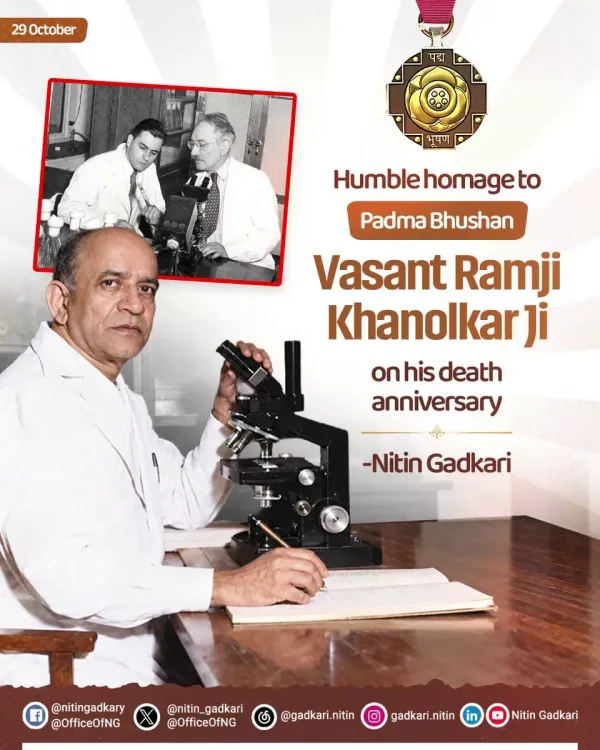
Union Minister Nitin Gadkari remembered Padma Bhushan Vasant Ramji Khanolkar — the 'Father of Pathology and Medical Research in India' and founder of the Indian Cancer Research Centre — on his death anniversary, calling it a 'humble homage.'
Key Takeaways
Nitin Gadkari paid tribute to Vasant Ramji Khanolkar on his death anniversary on 29 October 2026 .
Khanolkar is recognised as the 'Father of Pathology and Medical Research in India.' He was a recipient of the Padma Bhushan , one of India's highest civilian honours.
Khanolkar is credited with founding the Indian Cancer Research Centre , a landmark institution in Indian medical science.
Senior ministers regularly use social media to commemorate foundational Indian scientists on significant anniversaries.
On his death anniversary, Union Road Transport and Highways Minister Nitin Gadkari paused to honour a pioneer whose work shaped the very foundations of modern medicine in India — offering a 'humble homage' to Padma Bhushan Vasant Ramji Khanolkar, revered as the 'Father of Pathology and Medical Research in India.'
Who was Vasant Ramji Khanolkar?
Vasant Ramji Khanolkar was a towering figure in Indian medical science — a pathologist whose institutional and intellectual legacy stretches across decades. He is widely credited as the founding force behind the Indian Cancer Research Centre, one of the earliest dedicated cancer-research bodies in the country, and his contributions helped establish pathology as a rigorous scientific discipline in India at a time when the field was still finding its footing.
His recognition with the Padma Bhushan — one of India's highest civilian honours — reflected the national standing of a scientist who built institutions, trained generations of researchers, and brought international credibility to Indian medical research in the mid-20th century.
A pattern of remembering India's scientific architects
Gadkari's post is part of a broader practice among senior Indian ministers of using social media to mark the death anniversaries of foundational scientists and thinkers — figures whose contributions to national life often go undersung in popular discourse. These tributes carry a quiet but consistent signal: that nation-building was not only the work of politicians and generals, but of researchers and institution-builders who worked largely out of public view.
Khanolkar's legacy sits precisely in that tradition — a scientist whose name may not dominate textbooks today, but whose institutional architecture continues to underpin cancer research and pathology training across India.
Point of View
It signals an ongoing effort to embed scientific figures into the national commemorative calendar. Khanolkar's specific legacy in cancer research and pathology also resonates at a time when India's health infrastructure continues to expand. The tribute is ceremonial in form but carries soft ideological weight: the idea that scientific nation-building deserves the same reverence as political leadership.
NationPress
29 Oct 2026
Frequently Asked Questions
Who was Vasant Ramji Khanolkar?
Vasant Ramji Khanolkar was a pioneering Indian pathologist known as the 'Father of Pathology and Medical Research in India.' He founded the Indian Cancer Research Centre and was awarded the Padma Bhushan for his contributions to Indian medical science.
What is Vasant Ramji Khanolkar known for?
He is best known for establishing pathology as a rigorous scientific discipline in India, founding the Indian Cancer Research Centre, and training generations of medical researchers in the mid-20th century.
What award did Khanolkar receive from the Indian government?
Vasant Ramji Khanolkar was honoured with the Padma Bhushan, one of India's highest civilian awards, in recognition of his contributions to medical research and pathology.
Why did Nitin Gadkari post about Khanolkar?
Union Minister Nitin Gadkari paid tribute to Khanolkar on his death anniversary, describing it as a 'humble homage' to a foundational figure in Indian medical and scientific history.
What is the Indian Cancer Research Centre?
The Indian Cancer Research Centre is one of India's earliest dedicated cancer-research institutions, founded by Vasant Ramji Khanolkar, and is a key part of his enduring institutional legacy in Indian medicine.