Gadkari pays tribute to nuclear scientist Raja Ramanna
Synopsis
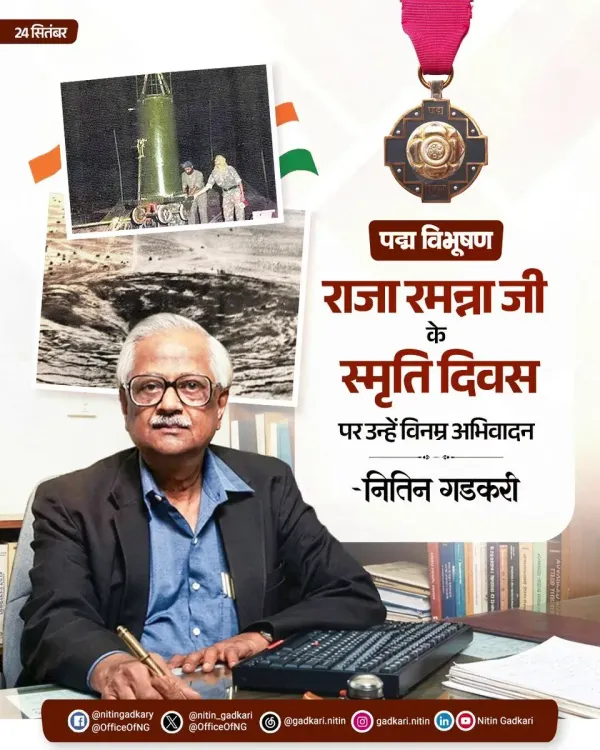
On Raja Ramanna's death anniversary, Union Minister Nitin Gadkari honoured the Padma Vibhushan nuclear physicist who led India's historic 1974 Pokhran test, calling him the architect of the nation's first nuclear experiment.
Key Takeaways
Union Minister Nitin Gadkari paid tribute to Raja Ramanna on his death anniversary on 24 September 2026 .
Gadkari described Ramanna as the sūtradhār (architect) of India's first nuclear test and honoured him as a 'great scientist.' Ramanna led Operation Smiling Buddha , India's first nuclear test, conducted on 18 May 1974 at Pokhran , Rajasthan.
He served as director of BARC and chairman of the Atomic Energy Commission of India .
Ramanna was awarded the Padma Vibhushan for his contributions to India's nuclear programme.
On the death anniversary of Padma Vibhushan Raja Ramanna — the physicist who quietly engineered India's first nuclear test over half a century ago — Union Road Transport and Highways Minister Nitin Gadkari offered a respectful salute to the scientist's enduring legacy on Thursday, 24 September 2026.
Posting in Hindi on X, Gadkari described Ramanna as the 'sūtradhār' (architect) of India's first nuclear test and a 'mahān vaijñānik' (great scientist), paying his 'vinamra abhivādан' — humble respects — on the occasion.The man behind Smiling Buddha
Raja Ramanna was the principal scientific force behind Operation Smiling Buddha, India's first nuclear test conducted on 18 May 1974 at Pokhran, Rajasthan. As director of the Bhabha Atomic Research Centre (BARC) and later chairman of the Atomic Energy Commission of India, Ramanna built the scientific infrastructure that made that detonation possible — largely in secrecy, largely with indigenous capability. The test announced to the world that India had crossed a threshold no amount of external pressure could reverse. For this, and for a lifetime of contributions to nuclear physics, he was awarded the Padma Vibhushan, one of India's highest civilian honours.Why tributes to Ramanna carry strategic weight
Since 1974, successive Indian governments have used anniversaries linked to Pokhran and its architects to reaffirm the country's commitment to strategic self-reliance in atomic energy and defence technology. A minister of Gadkari's stature invoking Ramanna on his death anniversary is part of that quiet, consistent tradition — honouring not just the man, but the idea that India's security and scientific ambition are inseparable. Ramanna was more than a weapons scientist. He was a classical pianist, a philosopher, and an author — a rare polymath who wore his country's nuclear ambitions alongside a deep humanist sensibility. That breadth is part of what makes him a figure Indian science returns to, year after year.Point of View
Invoking Pokhran 1974 is never merely nostalgic. It is a reminder of how far India has come — and how deliberately it chose that path.
NationPress
24 Sept 2026
Frequently Asked Questions
Who was Raja Ramanna?
Raja Ramanna was an eminent Indian nuclear physicist who served as director of the Bhabha Atomic Research Centre and chairman of the Atomic Energy Commission of India. He was the principal scientific leader of India's first nuclear test in 1974 and was awarded the Padma Vibhushan.
What was Raja Ramanna's role in India's nuclear programme?
Raja Ramanna was the key scientific architect of Operation Smiling Buddha, India's first nuclear test conducted on 18 May 1974 at Pokhran, Rajasthan. He led the BARC team that developed the device largely using indigenous technology.
When did Nitin Gadkari pay tribute to Raja Ramanna?
Union Minister Nitin Gadkari paid tribute to Raja Ramanna on his death anniversary on 24 September 2026, posting a message of respect on X in Hindi.
What award did Raja Ramanna receive?
Raja Ramanna was awarded the Padma Vibhushan, one of India's highest civilian honours, in recognition of his outstanding contributions to nuclear science and India's strategic programme.
What was Operation Smiling Buddha?
Operation Smiling Buddha was the code name for India's first successful nuclear test, conducted on 18 May 1974 at Pokhran in Rajasthan. Raja Ramanna was its principal scientific leader, making India one of the few countries in the world to have conducted a nuclear test at that time.