Rahul Gandhi slams IDBI Bank sale, says public banks are not assets to be sold
Synopsis
Rahul Gandhi has come out swinging against the Centre's plan to sell IDBI Bank to Canada's Fairfax, raising the stakes on a politically sensitive disinvestment. With the government-LIC stake set to plunge from 95% to 34%, Gandhi is framing this as a betrayal of a 2003 Parliament assurance and a threat to SC/ST/OBC reservations — putting the opposition firmly on the side of the bank's employees.
Key Takeaways
Rahul Gandhi on 30 October 2026 publicly criticised the Centre's plan to sell IDBI Bank to Fairfax , a Canadian company.
Gandhi posted on X and wrote a letter directly to IDBI Bank employees expressing solidarity.
The government and LIC currently hold around 95% of IDBI Bank; the combined stake would fall to approximately 34% after the sale.
IDBI Bank reported a profit of over ₹9,000 crore last year, having turned around from losses seven years ago .
Gandhi cited a 2003 Parliament assurance that the government would retain at least 51% ownership in the bank.
He warned privatisation could harm SC/ST/OBC reservation provisions and employee service conditions.
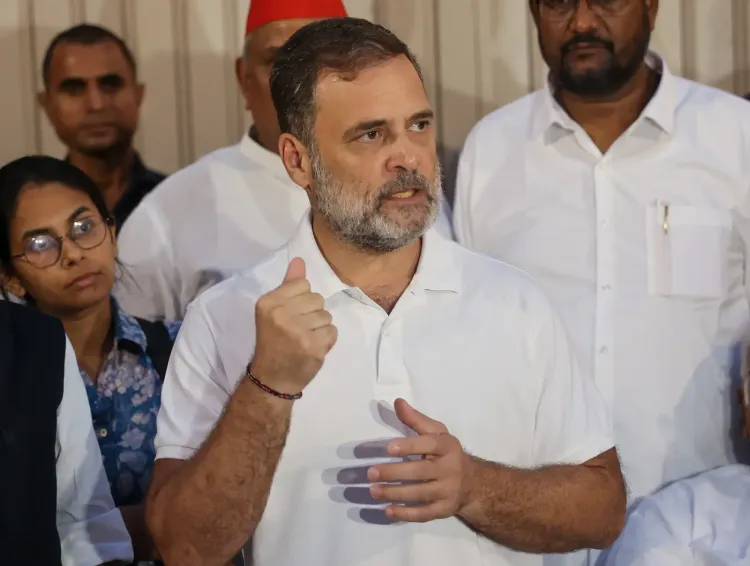
Leader of Opposition in the Lok Sabha Rahul Gandhi on Friday, 30 October 2026, launched a sharp attack on the Centre over its decision to divest IDBI Bank, accusing the Bharatiya Janata Party (BJP)-led government of systematically selling off institutions built during the Congress era. Gandhi also wrote a letter to IDBI Bank employees expressing solidarity with them in their fight against the proposed privatisation.
Gandhi's Post on X and Key Charges
Taking to social media platform X, Gandhi drew a pointed contrast between the two political regimes: 'During Congress's time, IDBI was established to build the nation's industry. During Modi's time, first the bidding was seen, then the price was set. During Congress's time, banks were being created. During Modi's time, they are being sold. I stand with the employees of IDBI Bank.'
The remarks come as the government moves ahead with the sale of its stake in IDBI Bank to Fairfax, a Canadian company. Gandhi questioned why a profitable public institution was being handed to a foreign private entity, noting that he had earlier raised the matter in the Lok Sabha but received no explanation from the government.
The Bank's Turnaround and the Employees' Question
In his letter to bank employees, Gandhi recalled a meeting at Parliament House in March last year, when a group of IDBI Bank staff confronted him with a direct challenge. 'You asked me a simple question: why is the government selling a bank that you have made profitable? I took that question to the Lok Sabha,' Gandhi wrote.
He acknowledged the bank's remarkable financial recovery, noting that seven years ago, IDBI Bank was recording losses, while last year it posted a profit of over ₹9,000 crore. 'That turnaround is your work,' he said, attributing the revival entirely to the efforts of the bank's employees.
Ownership Stake and the 2003 Parliament Assurance
Gandhi highlighted that the government and the Life Insurance Corporation of India (LIC) currently hold a combined stake of around 95 per cent in IDBI Bank. Following the proposed sale, that combined holding would fall to approximately 34 per cent — a sharp dilution of public ownership.
He further pointed to a 2003 assurance given to Parliament that the government would retain at least 51 per cent ownership in IDBI Bank, arguing that this commitment amounted to a binding promise to the people of India and cannot now be quietly abandoned.
Reservation and Service Conditions at Risk
Gandhi warned that privatisation could erode reservation provisions for Scheduled Castes (SC), Scheduled Tribes (ST), and Other Backward Classes (OBC) within the bank, along with established service conditions for existing employees. Critics of bank privatisation have long flagged this concern, and Gandhi's letter signals that the opposition intends to keep it at the centre of the political debate.
Congress Stance: Public Sector as Nation-Building Tool
Reiterating the Congress's ideological position, Gandhi said public banks were not commercial assets to be offloaded to the highest bidder but instruments of national development. 'The Congress has always believed in a strong public sector working alongside the private sector. Public banks are not assets to be sold off, they are tools to build the nation,' he said, closing his letter with a call for solidarity among IDBI employees.
This is not the first time the Congress has targeted the government's disinvestment agenda — the party has previously raised objections to the privatisation of Air India, Bharat Petroleum Corporation Limited (BPCL), and other public sector undertakings. The IDBI Bank sale, given its scale and the involvement of a foreign buyer, is shaping up to be one of the more politically charged disinvestment battles of the current term.
Point of View
But the deeper question is whether it can actually slow the disinvestment process. The government has not publicly explained why a profitable bank needs to be sold, and the 2003 Parliament assurance Gandhi cites is a genuine accountability gap — one the opposition should press harder on in the House, not just on X. The reservation angle is the most potent legally: courts have consistently held that privatisation can strip public-sector employees of constitutional protections, which means this is not just rhetoric. What is missing from the debate, however, is any serious counter-proposal from the Congress on how IDBI Bank's capital needs will be met if the state retains majority control indefinitely.
NationPress
30 Oct 2026
Frequently Asked Questions
Why is the government selling IDBI Bank?
The Centre is pursuing the disinvestment of IDBI Bank as part of its privatisation agenda, with Fairfax of Canada identified as the prospective buyer. The government has not publicly stated a specific reason for the sale despite the bank returning to profitability.
What stake does the government currently hold in IDBI Bank?
The government and the Life Insurance Corporation of India (LIC) together hold around 95% of IDBI Bank. Following the proposed sale to Fairfax, this combined stake is expected to fall to approximately 34%.
What is Rahul Gandhi's main objection to the IDBI Bank sale?
Gandhi argues that public banks built with taxpayers' money belong to the people and should not be privatised, particularly when profitable. He also cites a 2003 Parliament assurance that the government would retain at least 51% ownership, and warns of risks to SC/ST/OBC reservation provisions for employees.
How has IDBI Bank performed financially in recent years?
IDBI Bank posted a profit of over ₹9,000 crore last year after reporting losses seven years ago. Gandhi attributes this turnaround to the efforts of the bank's employees, which is central to his argument against the sale.
How does this fit into the Congress's broader stance on privatisation?
The Congress has consistently opposed the BJP-led government's disinvestment drive, previously raising objections to the privatisation of Air India and BPCL. The IDBI Bank case is now a focal point because it involves a foreign buyer and a significant dilution of public ownership in a systemically important bank.