Is FairPoint: Lights, Camera, Opposition - Rahul Gandhi’s Political Theatre Becoming a Reality?
Synopsis
In a landscape where politics is increasingly personal, Rahul Gandhi's leadership of the Opposition raises pressing questions. Are his theatrical approaches undermining democratic discourse? Dive into the complexities of his political strategies and their implications for Indian democracy.
Key Takeaways
Rahul Gandhi's leadership emphasizes performance over substance.
Disruptions in Parliament undermine institutional credibility.
A successful opposition requires organization and discipline.
Electoral outcomes reflect voter expectations.
Constructive dissent is essential for a healthy democracy.
New Delhi, Feb 15 (NationPress) Politics is morphing into something more personal and, at times, even peculiar. The rhetoric often drives a wedge rather than fostering persuasion, projecting a tone of grievance instead of governance and emotion over institutional growth. It creates an image of an individual aspiring for power without the requisite political diligence, seemingly under the impression that leadership is a birthright rather than a privilege earned through effort—a notion possibly influenced by the comforts of a dynastic background and its secluded entourage.
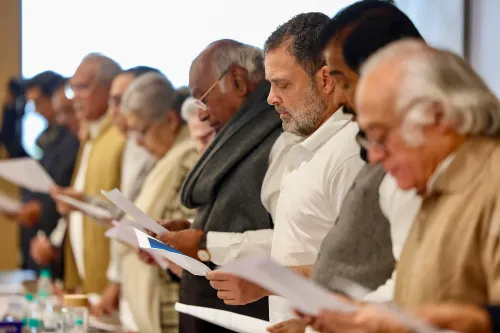
Rahul Gandhi is not just at the helm of the Opposition; he is transforming it into a performance. In a democratic landscape that calls for rigor, accountability, and resilience, his brand of politics increasingly resembles a show rather than a mission.
When the Leader of the Opposition views Parliament as a stage for incitement rather than dialogue, it diminishes the credibility of the institution.
A thriving democracy relies not only on the strength of those in authority but also on the maturity of those who oppose it.
Holding onto power in a nation as expansive and politically intricate as India is a formidable task. It demands organization, discipline, effective delivery, and tireless political engagement.
Prime Minister Narendra Modi’s work ethic and political discipline are frequently cited as pivotal to the BJP's sustained success. However, another critical element cannot be overlooked—the nature of the Opposition he confronts, led by Rahul Gandhi.
The events in Parliament from January 28, when the Budget Session began, to February 13, when the first phase wrapped up, raise significant alarms. Rather than fostering legislative dialogue, the House was marked by repeated disruptions and sensational confrontations. The Opposition seemed more focused on amplifying a singular political narrative than engaging in structured policy discussions.
This familiar pattern saw the Congress party making bold accusations with theatrical flair—such as the “vote chori” campaign and the so-called “H-Files,” alleging the manipulation of nearly 25 lakh votes in the upcoming 2024 Haryana Assembly elections.
Previously, serious claims were directed at the Election Commission of India, alleging “criminal fraud” and collusion with the BJP to manipulate elections, including assertions that 1,00,250 “fake votes” were created in the Mahadevapura Assembly seat under the Bangalore Central Lok Sabha constituency in Karnataka to facilitate a BJP win. These dramatic charges failed to create substantial political effects.
Similarly, after the Parliament passed the Viksit Bharat-Guarantee for Rozgar and Ajeevika Mission (Gramin) Act, 2025—widely known as the G RAM G Law—in December 2025, the Congress party declared nationwide protests. Dates for large-scale mobilization were announced.
Nevertheless, the anticipated agitation never materialized. The protests were postponed, rescheduled, and ultimately fizzled out. Apart from isolated demonstrations in Congress-led states like Karnataka, there was no significant national momentum.
Electoral outcomes have consistently reflected voter expectations. In Bihar, the narrative did not resonate. In Maharashtra’s local elections, including the significant BMC polls, the Congress party struggled to translate rhetoric into tangible results. In most political scenarios, repeated failures lead to introspection—new strategies are developed, leadership roles reassessed, and messaging refined. However, Congress seems to favor spectacle over necessary self-examination.
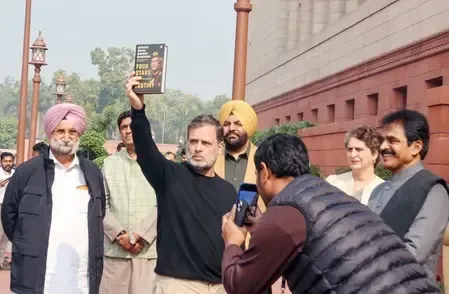
Rahul Gandhi’s behavior during the Budget Session underscored this perception. Incidents surrounding former Army Chief M.M. Naravane’s book, the public confrontation with Union Minister Ravneet Singh Bittu, and the “grip-and-choke” remark during the Motion of Thanks debate appeared more aimed at generating viral content than fostering parliamentary dialogue. While politics operates increasingly within a digital context, the seriousness of legislative engagement cannot be supplanted by social media popularity.
The occurrences on February 4 were particularly alarming. When the Lok Sabha Speaker advises a sitting Prime Minister to refrain from entering the House due to security issues stemming from protesting Members of Parliament, it indicates a profound malfunction. Disruption is a long-standing part of India’s parliamentary culture, but there exists a boundary between protest and institutional disarray. Repeatedly crossing this boundary undermines democratic principles.
The deeper issue stems from what seems to be a recurring tactic: escalating confrontation, inviting reactions, and then portraying oneself as a victim of institutional repression. While this strategy may invigorate a dedicated support base, it does little to cultivate widespread national trust.
India’s electorate has historically demonstrated political astuteness. It rewards consistent effort, organizational discipline, and credible alternatives. It does not, for long, reward perpetual grievance. When the Congress-led Opposition emphasizes spectacle over substance, it inadvertently bolsters the ruling narrative of stability versus chaos.
This assertion does not imply that dissent should be suppressed.
On the contrary, a robust democracy necessitates a vigilant and assertive opposition. However, dissent must be rooted in facts, preparation, and institutional respect.
Some may find the drama captivating. Yet, India, for the most part, remains unenthused by spectacle devoid of seriousness. In a democracy of 1.4 billion, performance may create a stir, but only responsibility nurtures trust.
Rahul Gandhi, who keeps a miniature Constitution in his pocket, must also show the resolve to practice its principles.
(Deepika Bhan can be contacted at deepika.b@ians.in)
Point of View
My perspective aligns with the nation's pulse. The current political landscape, marked by theatrics over substance, raises critical concerns about the health of our democracy. An effective opposition is essential, yet it must prioritize genuine engagement over sensationalism to foster trust and accountability.
NationPress
22 Sept 2026
Frequently Asked Questions
What are the main criticisms of Rahul Gandhi's leadership?
Critics argue that Rahul Gandhi's approach has become more about spectacle than substance, leading to disruptions in Parliament rather than constructive dialogue.
How does the Opposition's performance affect democracy?
The effectiveness of the Opposition is crucial for democracy, as it ensures accountability and checks on the ruling party's power.
What has been the public's reaction to the Congress party's recent protests?
Public response has been mixed, with many feeling that the protests lacked genuine momentum and failed to translate rhetoric into action.
What does the future hold for the Congress party?
The path forward will require introspection and a pivot towards more credible and substantive political alternatives.
Why is institutional respect important in politics?
Institutional respect fosters trust in democratic processes, ensuring that dissent is effective and constructive rather than chaotic.