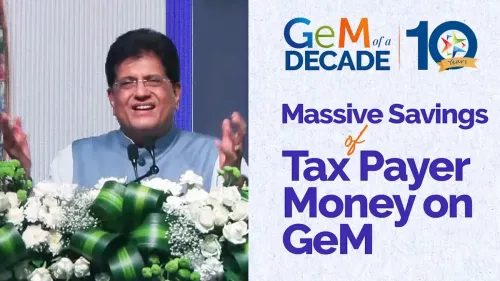
Pralhad Joshi marks GeM's decade with ₹20L cr GMV milestone

Synopsis
Union Minister Pralhad Joshi marks GeM's tenth anniversary, highlighting over ₹20 lakh crore in GMV, 3.78 crore orders, and 12.28 lakh MSE registrations — a decade-long transformation of India's public procurement landscape under PM Modi's digital governance push.
Key Takeaways
GeM was launched on 9 August 2016 as a pilot by the Ministry of Commerce to digitise government procurement.
The platform has crossed ₹20 lakh crore+ in Gross Merchandise Value over its first decade.
A total of 3.78 crore+ orders have been processed on the platform to date.
12.28 lakh Micro and Small Enterprises (MSEs) are now registered as suppliers on GeM.
GeM is a core pillar of India's Digital India and Make in India programmes, aimed at reducing procurement leakages and boosting MSME access.
Deeper penetration into state-level procurement remains the platform's next major challenge.
Ten years ago, a quiet digital experiment in government purchasing launched from a single ministry. Today, Union Consumer Affairs Minister Pralhad Joshi is marking that experiment's transformation into a procurement juggernaut — the Government e-Marketplace (GeM) — which has crossed ₹20 lakh crore in Gross Merchandise Value, processed 3.78 crore+ orders, and onboarded 12.28 lakh Micro and Small Enterprises (MSEs) in its first decade.
From a 2016 pilot to a ₹20 lakh crore platform
GeM was launched on 9 August 2016 by the Ministry of Commerce as a paperless, transparent alternative to the opaque tender-and-middleman procurement chain that had long defined government buying in India. The mandate was straightforward: digitise the purchase of goods and services by central and state government entities, cut out rent-seekers, and make every transaction auditable. A decade on, the numbers speak for themselves — ₹20 lakh crore+ in total GMV is not a rounding error; it is a structural shift in how the Indian state spends public money.
Why MSE access is the real story inside the headline number
The 12.28 lakh MSE registrations on GeM are arguably the most consequential figure in Minister Joshi's post. Before GeM, small manufacturers and service providers were effectively locked out of government contracts by paperwork, local nexuses, and the sheer cost of navigating procurement bureaucracy. A direct digital storefront — visible to every government buyer from a district collectorate to a central ministry — changed the calculus entirely. This aligns squarely with the broader Digital India and Make in India push to channel public spending toward domestic micro and small producers rather than large intermediaries.
GeM's place in India's e-governance arc
GeM is not a standalone scheme. It sits at the intersection of two long-running policy bets: the digitisation of government processes to reduce leakage, and the expansion of MSME access to formal economic opportunities. Prime Minister Narendra Modi's administration has consistently used procurement reform as a lever — mandating GeM adoption across ministries, pushing state governments to onboard, and linking GeM compliance to ease-of-doing-business rankings. The #10YearsOfGeM moment is as much a political milestone as an administrative one, arriving as the government seeks to demonstrate that its digital governance wagers have compounded into real, measurable outcomes.
The next frontier will be watched closely: whether legislative mandates can deepen GeM's penetration into state-level procurement — where the bulk of India's public spending still happens outside the platform's reach.
Point of View
Data-backed governance win to showcase ahead of any electoral cycle — a rare instance where a digital reform story comes with auditable numbers rather than aspirational targets. The ₹20 lakh crore GMV figure, if it holds scrutiny, represents a meaningful compression of procurement leakage that previous administrations could not demonstrate. The MSE onboarding count is politically significant too, signalling that the government's small-business constituency has a tangible stake in the platform's success. The real test, however, lies in state adoption — where political will and legacy procurement interests remain the biggest friction points.
NationPress
24 Sept 2026
Frequently Asked Questions
What is the Government e-Marketplace (GeM)?
GeM is India's national online portal for government procurement, launched on 9 August 2016, designed to make buying of goods and services by government entities transparent, paperless, and efficient.
What is GeM's total GMV after 10 years?
According to Union Minister Pralhad Joshi's post marking the platform's tenth anniversary, GeM has crossed ₹20 lakh crore in Gross Merchandise Value.
How many MSEs are registered on GeM?
As cited by Minister Joshi, over 12.28 lakh Micro and Small Enterprises are registered as suppliers on the GeM portal.
Who launched GeM and when?
GeM was launched on 9 August 2016 by the Ministry of Commerce under the Modi government as a pilot to digitise public procurement in India.
Why does GeM matter for small businesses in India?
GeM gives Micro and Small Enterprises direct access to government buyers across the country without navigating traditional procurement bureaucracy, significantly lowering the barrier to winning government contracts.