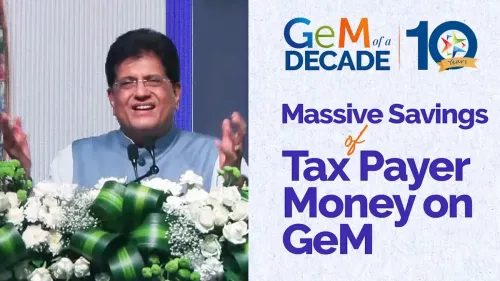
Goyal Marks GeM's Decade: GMV Soars to ₹1.55 Lakh Crore

Synopsis
Union Commerce Minister Piyush Goyal has celebrated the Government e-Marketplace's tenth anniversary, highlighting a GMV jump from ₹422 crore to over ₹1,55,000 crore, with over 12.28 lakh MSEs, 2.25 lakh women-led enterprises, and 42,000 startups now registered on the platform.
Key Takeaways
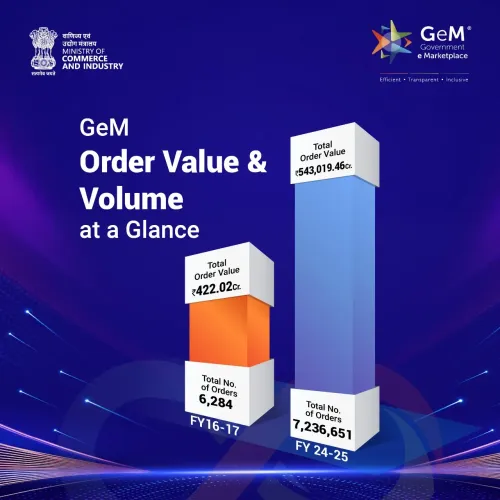
GeM's Gross Merchandise Value (GMV) has grown from ₹422 crore at launch to over ₹1,55,000 crore over the past decade.
Over 12.28 lakh Micro and Small Enterprises (MSEs) are registered on the platform, including more than 2.25 lakh women-led enterprises .
More than 42,000 startups , along with Self Help Groups, artisans, and weavers, have been onboarded as government vendors.
GeM was launched on 9 August 2016 as a pilot under the Digital India programme for central government procurement.
The platform enforces Make in India and Vocal for Local preferences structurally through local-content procurement mandates.
Minister Goyal frames GeM as a foundational pillar of the Viksit Bharat vision for a developed India by 2047 .
Ten years ago, the Indian government was buying paperclips and computers the old way — opaque, slow, and riddled with middlemen. Today, Union Commerce and Industry Minister Piyush Goyal has marked the tenth anniversary of the Government e-Marketplace (GeM) by pointing to a number that stops you cold: the platform's Gross Merchandise Value (GMV) has surged from ₹422 crore to over ₹1,55,000 crore — a transformation that has rewritten how the Indian state spends its money.
From a Pilot to a Procurement Powerhouse
GeM was launched on 9 August 2016 as a modest pilot for central government procurement, embedded within the broader Digital India programme approved in 2015. The ambition was straightforward: replace fragmented, paper-heavy tendering with a single, transparent digital marketplace. What followed was anything but modest. Over a decade, the portal has grown into the primary procurement channel for government ministries and departments, cutting cycle times, improving price discovery, and generating documented savings for the exchequer.
Goyal's post on 10 August 2026 — marking the #10YearsOfGeM milestone — frames the platform not merely as an efficiency tool but as an instrument of grassroots economic inclusion. 'Grassroots empowerment is not merely a slogan,' he wrote, 'but a genuine commitment.'
12.28 Lakh MSEs, 42,000 Startups — and 2.25 Lakh Women Sellers
The headline numbers are the vendor-side figures. Over 12.28 lakh Micro and Small Enterprises (MSEs) are now registered on the portal, including more than 2.25 lakh enterprises led by women. More than 42,000 startups have also joined, alongside Self Help Groups, artisans, and weavers — categories that historically had no seat at the government-procurement table.
This aligns directly with the Public Procurement Policy for Micro and Small Enterprises, which was revised in 2012 and later calibrated to GeM onboarding targets, mandating a minimum share of government purchases from the MSE sector. GeM operationalised that mandate at scale. For a woman-run weaver cooperative in a tier-3 town, access to a ₹1.55 lakh crore marketplace — without a broker, without a middleman, without knowing the right official — is a structural shift, not a statistic.
Vocal for Local, Make in India — and the Viksit Bharat Arc
Goyal explicitly ties GeM's trajectory to Prime Minister Narendra Modi's flagship economic frameworks: Make in India, announced in September 2014 to boost domestic manufacturing and reduce import dependence, and Vocal for Local, which pushes government and citizens to preference Indian-made goods. GeM enforces these preferences structurally — procurement rules on the platform can mandate local content, giving domestic producers a built-in advantage over importers.
The minister describes @GeM_India as 'a key driver of self-reliance' and a foundation for Viksit Bharat — the government's official vision for a developed India by 2047. The framing is deliberate: public procurement, which accounts for a significant share of GDP in any large economy, is positioned as an active lever of industrial policy, not just administrative housekeeping.
What the Auditors and the Next Annual Report Will Reveal
The GMV figure is a measure of orders placed through the platform — the sharper test is how much of that translated into realised savings against benchmark prices, and whether vendor quality and delivery timelines held up at scale. The next Comptroller and Auditor General review of GeM, along with the platform's annual report, will be the independent scoreboard. Possible updates to the General Financial Rules incorporating GeM data could further institutionalise the platform's role across all tiers of government spending.
A ₹422 crore marketplace in 2016. A ₹1,55,000 crore marketplace in 2026. The question now is whether the governance infrastructure — dispute resolution, quality assurance, payment timelines for small vendors — can keep pace with the scale it has already achieved.
Point of View
55,000 crore GMV is a hard number that gives the government a credible data point for its self-reliance narrative heading into the 2047 Viksit Bharat timeline. The inclusion metrics — women entrepreneurs, artisans, weavers — are politically potent because they convert an abstract 'digital governance' story into visible beneficiary groups. The sharper policy question, however, is whether the platform's dispute-resolution, payment-cycle, and quality-assurance infrastructure has scaled alongside its vendor and order volumes — that is the gap an independent audit will ultimately expose or validate.
NationPress
24 Sept 2026
Frequently Asked Questions
What is the Government e-Marketplace (GeM) and when was it launched?
GeM is an online portal for public procurement by Indian government ministries and departments, launched on 9 August 2016 as a pilot under the Digital India programme to improve transparency, efficiency, and access for smaller suppliers.
What is GeM's total GMV after 10 years?
According to Minister Piyush Goyal's post, GeM's Gross Merchandise Value (GMV) has grown from ₹422 crore at its inception to over ₹1,55,000 crore over the past decade.
How many MSEs and startups are registered on GeM?
Over 12.28 lakh Micro and Small Enterprises (MSEs) — including more than 2.25 lakh women-led enterprises — and more than 42,000 startups are registered on the GeM portal.
How does GeM support Make in India and Vocal for Local?
GeM enforces domestic preference structurally by allowing procurement rules on the platform to mandate local content, giving Indian manufacturers a built-in advantage and operationalising the Make in India and Vocal for Local policy goals within government purchasing.
What is Viksit Bharat and how does GeM connect to it?
Viksit Bharat is the Indian government's official vision for a fully developed, self-reliant economy by 2047 . Minister Goyal has described GeM as 'a key driver of self-reliance' and a foundational pillar supporting that long-term national goal.