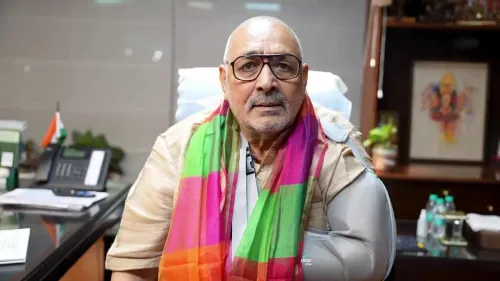
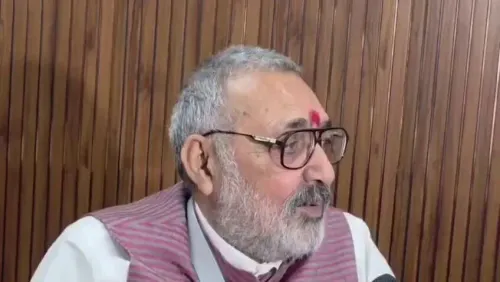
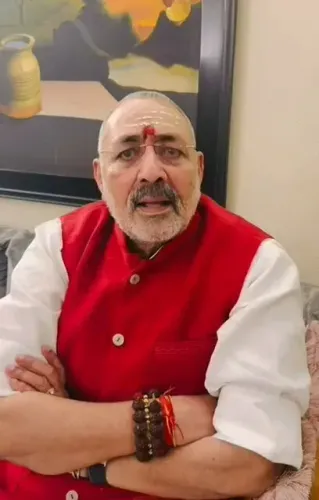
Giriraj Singh targets Akhilesh over 'appeasement politics'
Synopsis
Union Textiles Minister Giriraj Singh posted a sharp Hindi attack on Akhilesh Yadav on 9 November 2026, branding SP's politics as Congress-Lalu-style appeasement and invoking Vivekananda, Shivaji and Maharana Pratap to frame a culturally-nationalist 'new India' counter-narrative.
Key Takeaways
Union Textiles Minister Giriraj Singh posted a direct attack on Akhilesh Yadav on 9 November 2026 .
Singh accused Akhilesh of following the 'appeasement policy' of Congress and Lalu Prasad Yadav .
He invoked Swami Vivekananda , Chhatrapati Shivaji Maharaj , and Maharana Pratap to symbolise an assertive 'new India'.
The BJP has used the 'appeasement politics' charge as a core campaign theme since the early 1990s Ram Janmabhoomi movement.
The post included a video, signalling intent for wide digital amplification.
No formal response from Samajwadi Party was recorded at the time of publication.
The era of intimidation is over — that is the blunt message Union Textiles Minister Giriraj Singh fired at Samajwadi Party chief Akhilesh Yadav on Monday, 9 November 2026, in a sharply-worded post on X that invoked three of Hinduism's most resonant historical icons to frame his party's cultural-nationalist pitch.
Singh's post, in Hindi, declared: 'Kaangres-Lalu ki tushteekaran neeti par chalne waale Akhilesh Yadav samajh lein ki ab daraane ka daur beet chuka hai.' ('Akhilesh Yadav, who follows the appeasement policy of Congress and Lalu, should understand that the era of intimidation is now over.') He went on to describe present-day India as a 'newly awakened nation' inspired by Swami Vivekananda, Chhatrapati Shivaji Maharaj, and Maharaj Shri Maharana Pratap — one that 'knows how to give a crushing reply to every conspiracy.'
Appeasement charge and its electoral genealogy
Akhilesh Yadav leads the Samajwadi Party, whose electoral arithmetic has historically rested on a Yadav-Muslim coalition in Uttar Pradesh. Lalu Prasad Yadav, founder of the Rashtriya Janata Dal and former Bihar Chief Minister, is a veteran Congress-allied opposition figure synonymous with Mandal-era social justice politics. By pairing both names under the 'appeasement' label, Singh deploys a rhetorical frame the BJP has refined since the Ram Janmabhoomi movement of the early 1990s — positioning the opposition as vote-bank opportunists and itself as the guardian of assertive national identity.
Vivekananda, Shivaji, Maharana Pratap — why these three names
The triumvirate Singh cites is not accidental. Swami Vivekananda's calls for national strength and spiritual revival have been a staple of BJP messaging for decades. Chhatrapati Shivaji Maharaj, the 17th-century Maratha king who defied Mughal expansion, and Maharana Pratap, the 16th-century Rajput ruler of Mewar, both serve as emblems of Hindu martial resistance in the party's cultural vocabulary. Invoking all three in a single post signals a deliberate appeal to voters across Maharashtra, Rajasthan, and the broader Hindi belt simultaneously — a composite nationalist image rather than a regional one.
A pattern that sharpens near election cycles
Senior BJP figures have long used social media to draw this contrast between what they call 'old appeasement politics' and 'new India' — and the rhetoric reliably intensifies as state-level elections in Uttar Pradesh and Bihar approach. Singh's post carries a video, suggesting the message was crafted for broader digital amplification beyond the text alone. No specific triggering incident has been publicly identified, but the phrasing — 'every conspiracy' — implies a response to a perceived recent provocation, details of which remain unconfirmed.
Whether Akhilesh Yadav or Samajwadi Party spokespeople respond formally will determine whether this stays a unilateral broadside or escalates into an open exchange — and in UP's always-live political theatre, silence from the other side is rarely the safer bet.
Point of View
Shivaji and Maharana Pratap — figures with distinct regional resonance in Bengal/national discourse, Maharashtra and Rajasthan/UP respectively — suggests the message is calibrated for a broad Hindi-belt and beyond audience rather than a single state. The timing, absent a clearly identified triggering event, is consistent with the BJP's practice of keeping cultural-nationalist sentiment activated in between formal electoral cycles. Whether Samajwadi Party responds or stays quiet will itself be read as a strategic signal ahead of the next UP electoral contest.
NationPress
9 Nov 2026
Frequently Asked Questions
What did Giriraj Singh say about Akhilesh Yadav?
Singh said Akhilesh Yadav follows the 'appeasement policy' of Congress and Lalu Prasad Yadav, warning him that the era of intimidation is over and that a newly awakened India inspired by Vivekananda, Shivaji and Maharana Pratap knows how to give a crushing reply to every conspiracy.
Why did Giriraj Singh mention Swami Vivekananda, Shivaji and Maharana Pratap?
These three figures are regularly invoked in BJP's cultural-nationalist rhetoric as symbols of Hindu strength and resistance. Vivekananda represents spiritual national revival, Shivaji symbolises Maratha Hindu sovereignty, and Maharana Pratap embodies Rajput martial resistance — together forming a pan-Hindu historical frame.
What is 'appeasement politics' in Indian political context?
In BJP's political vocabulary, 'appeasement politics' refers to the charge that opposition parties like Congress, RJD and SP court Muslim voters through policy concessions and rhetoric, prioritising vote-bank calculus over national interest. The BJP has used this charge as a core campaign theme since the 1990s.
What is the history between Giriraj Singh and Akhilesh Yadav?
Giriraj Singh, a senior BJP leader and Union Minister, has a long record of attacking Samajwadi Party leaders on social media. The BJP and SP are principal rivals in Uttar Pradesh, and Singh frequently targets SP's Yadav-Muslim coalition strategy as an example of minority appeasement.
What is Akhilesh Yadav's political background?
Akhilesh Yadav is the national president of the Samajwadi Party and a former Chief Minister of Uttar Pradesh. His party historically relies on a Yadav-Muslim electoral alliance and aligns with Congress-led opposition coalitions at the national level.