Giriraj Singh flags NHA report on falling health out-of-pocket spend
Synopsis
Union Textiles Minister Giriraj Singh highlighted findings from the latest National Health Accounts report on 28 May 2026, pointing to a declining trend in out-of-pocket health expenditure in India — a key marker of financial risk protection under schemes like Ayushman Bharat.
Key Takeaways
Union Textiles Minister Giriraj Singh shared the latest National Health Accounts (NHA) report findings on 28 May 2026 , noting a decline in out-of-pocket health spending.
The NHA report , published by the Ministry of Health and Family Welfare , tracks how health expenditure is distributed across government, insurers, and households.
Reducing out-of-pocket expenditure has been a core goal of the National Health Policy 2017 , which targets government health spending at 2.5 per cent of GDP .
Ayushman Bharat , launched in 2018 , provides health cover of up to Rs 5 lakh per eligible family and is a central driver of the declining OOPE trend.
Low-income households and patients are the primary beneficiaries of reduced direct health payments, lowering the risk of catastrophic health expenditure.
State-level OOPE data in the report will be closely watched to assess which states have made the most progress under centrally sponsored health schemes.
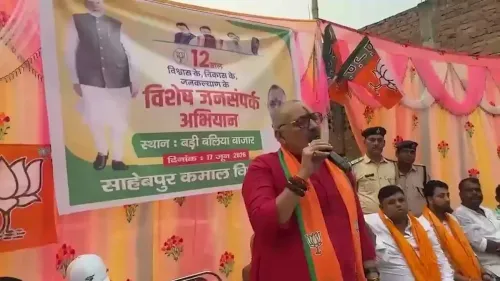
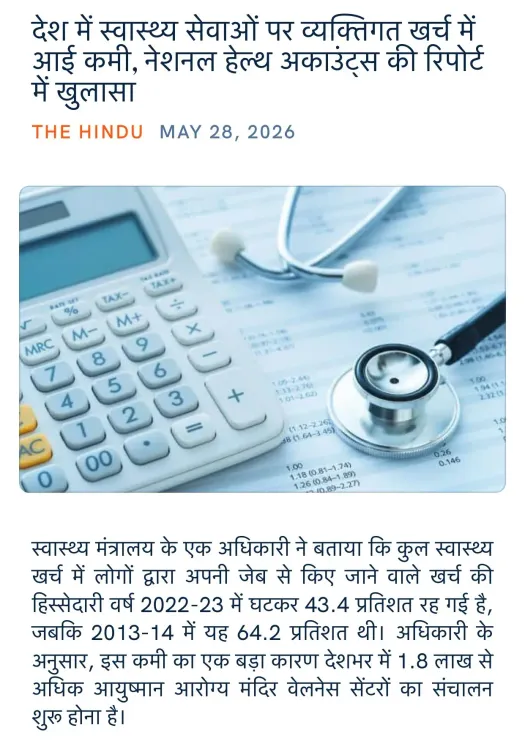
Union Textiles Minister Giriraj Singh on Thursday, 28 May 2026, shared findings from the latest National Health Accounts (NHA) report, highlighting a declining trend in out-of-pocket expenditure on health services across India. The post, shared via the NaMo App, drew attention to what the government views as a sign of progress in reducing the direct financial burden on Indian households seeking medical care.
Context
The post, in Hindi, translates as: 'Desh mein swasthya sevaon par vyaktigat kharch mein aayi kami, National Health Accounts ki report mein khulasa' — 'Out-of-pocket expenditure on health services in the country has declined, as revealed in the National Health Accounts report.' The NHA report is an annual publication by the Ministry of Health and Family Welfare that tracks how health spending flows across government, insurers, and households.
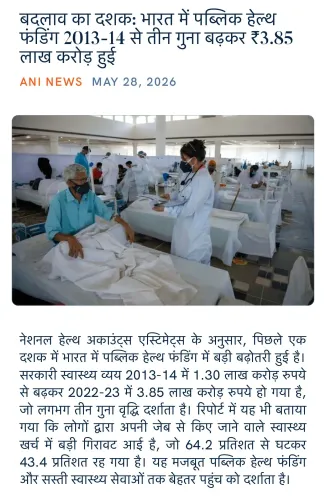
Out-of-pocket expenditure (OOPE) — the direct payments households make at the point of care — is a key measure of financial vulnerability in health systems. A sustained decline in OOPE as a share of total health spending is considered a marker of improved financial risk protection for citizens, particularly those in lower-income groups.
Policy Backdrop
The push to reduce household health spending has been a stated policy goal since the National Health Policy 2017, which set a target of raising government health expenditure to 2.5 per cent of GDP while simultaneously reducing the out-of-pocket burden on families. Successive NHA reports have documented a gradual decline in the OOPE share of total health expenditure at both national and state levels.
Ayushman Bharat, the flagship programme launched in 2018, combined the Pradhan Mantri Jan Arogya Yojana (PM-JAY) health insurance scheme — offering annual cover of up to Rs 5 lakh per eligible family for secondary and tertiary care — with a network of Health and Wellness Centres to strengthen primary care infrastructure. The programme is widely credited with expanding financial protection for low-income households and is frequently cited in the context of declining OOPE trends.
India's broader effort to shift health financing away from direct household payments aligns with universal health coverage goals championed by global health bodies. The NHA framework provides the evidence base for tracking whether these policy interventions are achieving their intended effect on household finances.
Stakeholders and Impact
The most direct beneficiaries of a decline in out-of-pocket health spending are low-income households and patients who previously faced the risk of catastrophic health expenditure — spending so large it pushed families into poverty or debt. Reduced OOPE signals that public insurance schemes, government facilities, and subsidised medicines are increasingly absorbing costs that once fell entirely on individuals.
State governments also feature prominently in this picture: NHA reports track expenditure flows at the state level, and variation in OOPE across states reflects differences in public health infrastructure, insurance enrolment, and the reach of centrally sponsored schemes. The publication of the latest report is expected to sharpen scrutiny of which states have made the most progress and which continue to lag.
What's Next
Attention will now turn to the granular findings of the NHA report — including state-level OOPE data and the share of government spending in total health expenditure — as analysts and policymakers assess whether India is on track to meet the targets set under the National Health Policy 2017. Utilisation data under Ayushman Bharat for the current financial year will also be closely watched as a complementary indicator of the scheme's reach and financial impact.
If the declining OOPE trend is confirmed and sustained, it would represent a meaningful step toward the government's universal health coverage ambitions — and is likely to feature prominently in political messaging ahead of state elections in health-sensitive constituencies.
Point of View
Which remain to be independently scrutinised.
NationPress
19 Sept 2026
Frequently Asked Questions
What is the National Health Accounts report in India?
The National Health Accounts (NHA) report is an annual publication by India's Ministry of Health and Family Welfare that tracks how health expenditure is distributed across the government, insurance schemes, and direct household payments. It is the primary data source for monitoring trends in out-of-pocket health spending.
What is out-of-pocket expenditure on health and why does it matter?
Out-of-pocket expenditure (OOPE) refers to direct payments made by individuals at the point of receiving health care, without reimbursement from insurance or government schemes. High OOPE can push low-income families into debt or poverty, making its reduction a key goal of universal health coverage policy.
How has Ayushman Bharat helped reduce out-of-pocket health costs in India?
Ayushman Bharat, launched in 2018, provides eligible families with health insurance cover of up to Rs 5 lakh per year for secondary and tertiary care under PM-JAY, and has expanded primary care through Health and Wellness Centres. By covering hospitalisation costs for low-income households, it reduces the direct payments families would otherwise make.
What is India's target for government health spending?
The National Health Policy 2017 set a target of raising government health expenditure to 2.5 per cent of GDP, alongside reducing the share of total health spending borne directly by households.
Why is Giriraj Singh, the Textiles Minister, commenting on a health report?
As a senior BJP leader and Union Cabinet minister, Giriraj Singh regularly shares government policy achievements across sectors on social media, even those outside his Textiles portfolio, as part of the party's broader public communications effort.