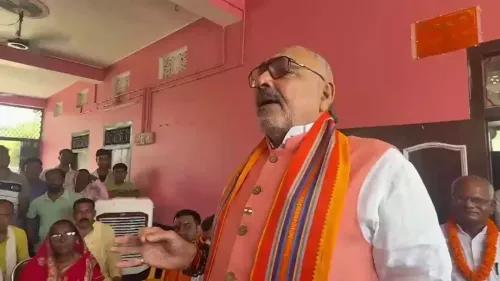
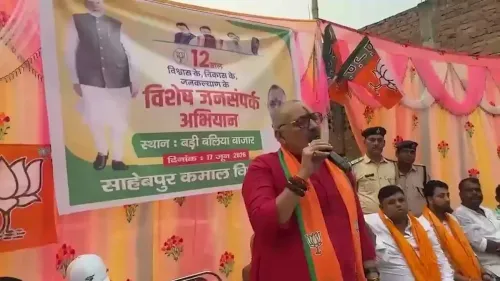
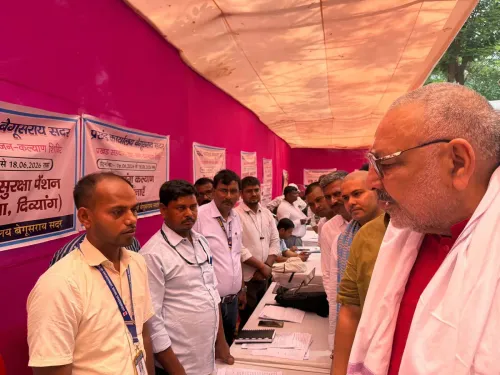
Giriraj Singh links seva philosophy to BJP welfare schemes
Synopsis
Union Textiles Minister Giriraj Singh invoked the twin slogans 'Nar Seva Narayan Seva' and 'Jan Seva se Desh Seva' to frame BJP welfare schemes — pucca housing, LPG access, farmer support and girls' education — as expressions of a single philosophy of service to the nation.
Key Takeaways
Giriraj Singh posted on September 24, 2026 , framing governance as rooted in the spirit of seva (service).
He cited four outcomes: permanent homes for the poor, smoke-free kitchens for mothers, economic support for farmers, and education for daughters.
The Pradhan Mantri Awas Yojana ( 2015 ) and Pradhan Mantri Ujjwala Yojana ( 2016 ) are the flagship schemes underpinning these claims.
The 'Jan Seva se Desh Seva' framing is part of a broader BJP narrative linking ideological vocabulary to welfare delivery since 2014 .
Bihar , represented by Singh from Begusarai , is among the states with the densest concentration of scheme beneficiaries.
Service, declared Union Textiles Minister Giriraj Singh on Thursday, September 24, 2026, is not merely a sentiment — it is the engine that moves society and nation forward. In a post on X, the senior BJP leader and Lok Sabha MP from Begusarai, Bihar, wove together a philosophical thread that runs from ancient Sanskrit to modern welfare policy, arguing that when intention and policy both carry the spirit of service, the poorest citizens are the ones who gain.
From 'Nar Seva' to pucca roofs and smoke-free kitchens
The minister's post, written in Hindi, framed governance as a continuum: 'Nar Seva Narayan Seva' ('serving man is serving God') flowing into 'Jan Seva se Desh Seva' ('serving the people is serving the nation'). Between those two poles, he placed four concrete outcomes — a permanent home for the poor, freedom from cooking smoke for mothers, economic support for farmers, and educational opportunity for daughters. Each phrase maps directly onto landmark central schemes.
The Pradhan Mantri Awas Yojana, launched in 2015, has been the government's flagship effort to deliver pucca (permanent) housing to rural and urban poor households. The Pradhan Mantri Ujjwala Yojana, launched in 2016, extended free LPG cooking-gas connections to women from below-poverty-line families — eliminating the wood-smoke that caused serious respiratory harm in tens of millions of homes. Singh's post, in effect, re-anchors both schemes inside a moral vocabulary the BJP has cultivated since 2014.
A vocabulary built for Bihar and beyond
The framing is not accidental. Giriraj Singh represents Begusarai, a constituency in Bihar — one of India's states with the highest concentration of scheme beneficiaries. Rural housing, clean cooking fuel and girls' schooling are not abstract priorities there; they are lived realities. By tying ideology to delivery, the minister signals that the philosophical slogan and the administrative record are meant to be read as a single story.
This governing narrative — service as a moral duty, delivered through measurable schemes — has become a recurring motif across BJP communication since the first Modi government. The tight bundling of farmer income support, women's welfare, housing and education under one umbrella of seva is a deliberate political architecture, not just a rhetorical flourish.
Watch for whether the 'Jan Seva se Desh Seva' formulation surfaces in upcoming parliamentary sessions or state-level campaign messaging, particularly in Bihar — a state that will remain a crucial electoral and political focus.
Point of View
Where Ujjwala and Awas Yojana penetration is high, such messaging serves both a national-narrative and a local-constituency function simultaneously. The 'Jan Seva se Desh Seva' formulation also signals a party preparing to consolidate its welfare-governance identity ahead of future electoral cycles. It is a reminder that in Indian politics, the vocabulary of governance and the grammar of campaign communication are increasingly indistinguishable.
NationPress
24 Sept 2026
Frequently Asked Questions
What did Giriraj Singh post on September 24, 2026?
Union Textiles Minister Giriraj Singh posted a Hindi message arguing that service is the force that advances society and the nation, linking the BJP's seva philosophy to welfare outcomes such as pucca housing, LPG access for women, farmer support, and education for girls.
What is 'Jan Seva se Desh Seva'?
'Jan Seva se Desh Seva' translates as 'serving the people is serving the nation' — a slogan the BJP uses to frame its welfare governance as an expression of national duty rooted in the ancient principle of 'Nar Seva Narayan Seva' (serving man is serving God).
What is the Pradhan Mantri Ujjwala Yojana mentioned in the context of Giriraj Singh's post?
The Pradhan Mantri Ujjwala Yojana, launched in 2016, provides free LPG cooking-gas connections to women from below-poverty-line households, eliminating harmful wood-smoke — which Giriraj Singh referenced as 'freedom from smoke for mothers'.
What is the Pradhan Mantri Awas Yojana?
Launched in 2015, the Pradhan Mantri Awas Yojana is the central government's flagship scheme to provide permanent or pucca housing to rural and urban poor families — what Giriraj Singh described as 'a pucca home for the poor'.
Why is Giriraj Singh's Bihar constituency relevant to this post?
Giriraj Singh represents Begusarai in Bihar, a state with one of the highest concentrations of beneficiaries under housing and LPG schemes. His messaging directly addresses the lived realities of his constituency while reinforcing the BJP's national welfare narrative.