Giriraj Singh: 70% Indian Households Now Eat Shree Anna Millets
Synopsis
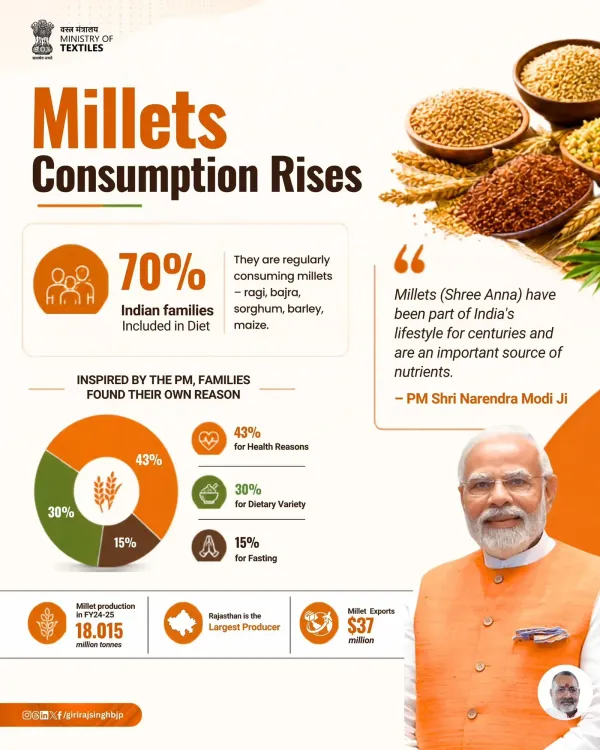
Union Textiles Minister Giriraj Singh said 70 per cent of Indian households now include Shree Anna millets in their meals, crediting Prime Minister Narendra Modi's awareness drive for the shift and linking it to gains in public health, farm production and exports of the traditional grain.
Key Takeaways
Giriraj Singh said 70% of Indian families now consume Shree Anna (millets).
He credited PM Narendra Modi's awareness campaign for the dietary shift.
Post highlights gains in health, production and exports of millets.
Branding 'Shree Anna' was adopted in Union Budget 2023-24.
India led the UN's International Year of Millets in 2023.
Promotion ties into the Atmanirbhar Bharat framework launched in 2020.
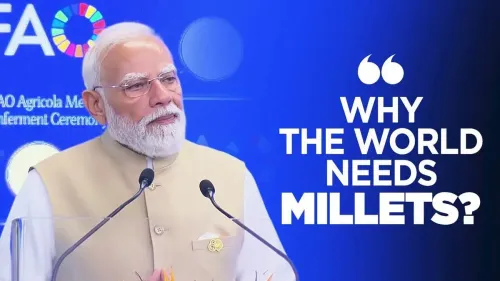
Union Textiles Minister Giriraj Singh on Wednesday, 3 June 2026 said that 70 per cent of Indian families have now made 'Shree Anna' (millets) a part of their daily plate, crediting the awareness push driven by Prime Minister Narendra Modi. In a post on X, the senior BJP leader and Lok Sabha MP from Begusarai linked the shift to gains in public health, farm production and exports.
'Inspired by the call of Hon'ble Prime Minister Shri Narendra Modi ji, today 70% of Indian families have made Shree Anna (millets) a part of their plate,' the minister wrote, adding that 'sustained government awareness efforts have given this traditional superfood a global identity, boosting health, production and exports.' The post carried the hashtags #ShreeAnna, #Millets, #HealthyIndia, #AtmanirbharBharat and #NewIndia.
Context
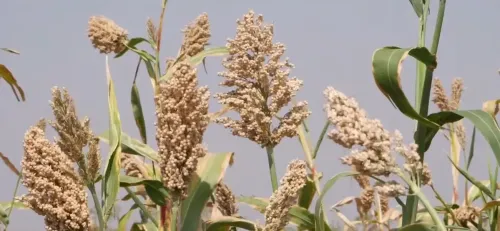
The term 'Shree Anna' (literally 'the foremost grain') was formally adopted by the Centre in the Union Budget 2023-24 as the umbrella branding for millets such as jowar, bajra, ragi, kodo, kutki and sanwa. The government has since positioned the coarse-cereal basket as both a nutrition intervention and an export category.
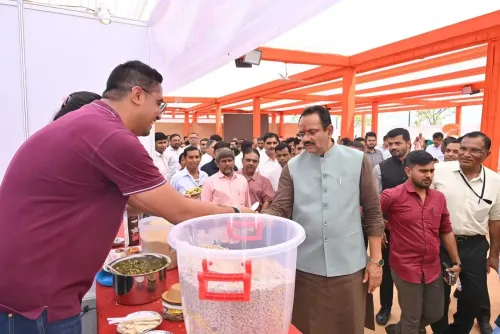
Mr Singh's post arrives as the Centre continues to roll out millet-based recipes through Anganwadi centres, mid-day meal menus and select Public Distribution System pilots in states like Karnataka, Odisha and Madhya Pradesh.
Policy backdrop
India was the principal mover behind the United Nations declaration of 2023 as the International Year of Millets, a proposal it tabled in 2021 and which the UN General Assembly adopted. The year-long campaign saw Indian missions abroad host millet tasting events, while the Indian Institute of Millets Research in Hyderabad was designated a global centre of excellence.
Millet promotion also slots into the broader Atmanirbhar Bharat framework launched in 2020, which seeks to strengthen domestic production of traditional crops and reduce dependence on imported staples. The crop's low water footprint dovetails with the government's climate-smart agriculture targets, particularly for rain-fed regions in the Deccan plateau and central India.
Stakeholders and impact
For small and marginal farmers in semi-arid belts, higher minimum support prices and procurement linkages for millets have been pitched as a route to better realisations. Ragi and jowar in particular have seen renewed sowing interest in Karnataka, Maharashtra and Tamil Nadu.
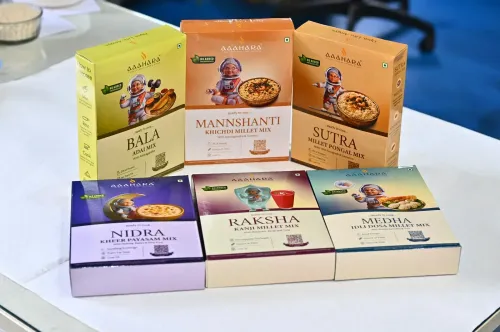
On the consumer side, urban demand for ready-to-eat millet snacks, flours and breakfast cereals has expanded, with start-ups entering the value-added segment. Exporters, supported by APEDA, have targeted markets in West Asia, the United States and parts of Europe, where Indian millet shipments have featured at trade fairs over the past two years.
Health professionals have flagged millets as useful for managing diabetes, cholesterol and gluten intolerance, given their high fibre and mineral content. The minister's framing of the grain as a 'superfood' aligns with that medical positioning.
What's next
The next set of official figures on millet acreage, procurement and shipments is expected in the forthcoming Economic Survey and Agricultural Statistics release. State governments are also likely to firm up millet inclusion targets within nutrition missions and PDS reforms in the coming financial year.
With the Centre signalling continued political backing at the ministerial level, the trajectory of Shree Anna will depend on whether consumption gains translate into durable farm-gate prices and a wider export footprint beyond the International Year of Millets momentum.
Point of View
Reinforcing millets as a signature achievement of the Modi government's nutrition-and-agriculture pitch. By bracketing Shree Anna with Atmanirbhar Bharat hashtags, Mr Singh ties a dietary trend to the ruling party's self-reliance narrative ahead of fresh agricultural data cycles. The 70 per cent figure will invite scrutiny, but the strategic intent is clear: keep millets in the national conversation beyond the 2023 UN year. Watch for state-level missions and PDS pilots to convert messaging into measurable procurement.
NationPress
24 Sept 2026
Frequently Asked Questions
What did Giriraj Singh say about millets?
Giriraj Singh said 70 per cent of Indian families have made Shree Anna a part of their plate, inspired by Prime Minister Narendra Modi's call. He added that government awareness efforts have boosted health outcomes, production and exports.
Why was 2023 the International Year of Millets?
The UN General Assembly declared 2023 the International Year of Millets after India's 2021 proposal. The aim was to spotlight the nutritional and agricultural value of millets and encourage global production and consumption.
How does millet promotion fit into Atmanirbhar Bharat?
Millet promotion is part of the Atmanirbhar Bharat campaign launched in 2020, which seeks to strengthen domestic production of traditional crops and reduce import dependence. Millets also support climate-smart farming in rain-fed regions.
Which Indian states grow the most millets?
Karnataka, Rajasthan, Maharashtra, Madhya Pradesh and Tamil Nadu are among the leading millet-producing states. Ragi is concentrated in Karnataka, while bajra and jowar dominate in Rajasthan and Maharashtra.