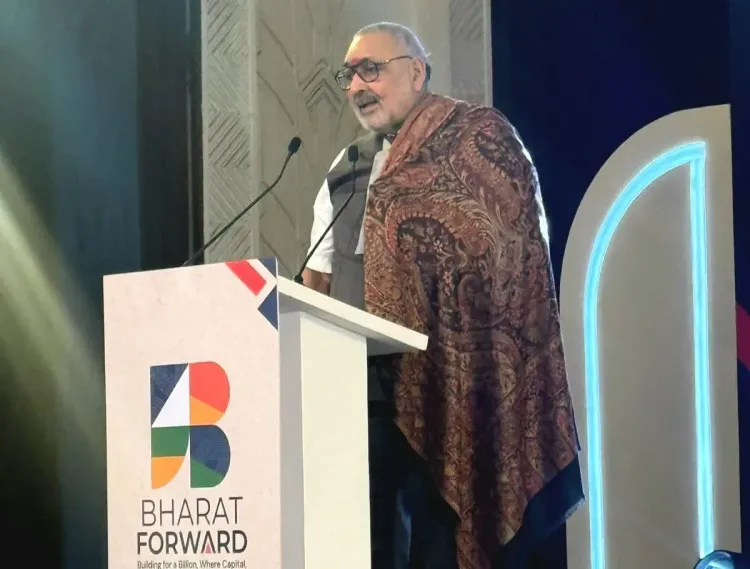
Giriraj Singh at Bharat Forward Summit: Rural India Key to Growth
Synopsis
Union Textiles Minister Giriraj Singh, speaking at the Bharat Forward Summit 2026, argued that 12 years of rural public investment have created new economic possibilities and called on private investors and entrepreneurs to convert them into jobs and self-employment.
Key Takeaways
Giriraj Singh addressed the 'Startups as India's Development Infrastructure' session at Bharat Forward Summit 2026 on November 17, 2026 .
He argued that 12 years of government rural development since 2014 have created new possibilities and opportunities in village India.
The minister called for a partnership of private investment, entrepreneurship, and industry to convert rural potential into employment and self-employment.
He positioned rural India as the essential economic foundation of a developed India, not merely a welfare target.
His remarks extend the logic of Startup India (2016) and the Atmanirbhar Bharat framework to the rural economy.
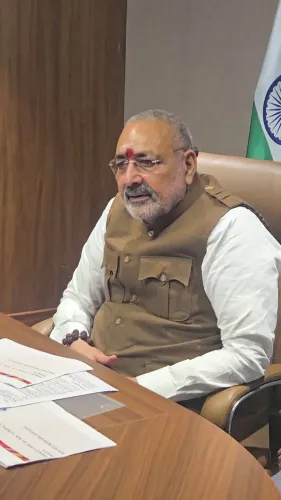
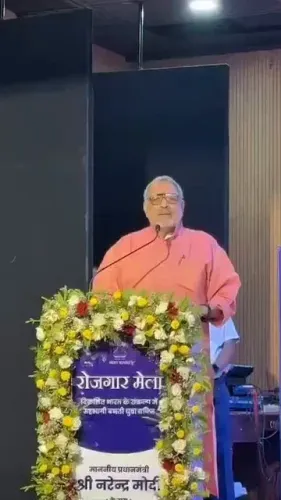
Rural India is not just a welfare destination — it is the next frontier for private capital and entrepreneurship. That was the core message Union Textiles Minister Giriraj Singh delivered on Tuesday, November 17, 2026, when he addressed a session titled 'Startups as India's Development Infrastructure' at the Bharat Forward Summit 2026, organised by Rozana Foundation.
Speaking alongside industry representatives, investors, and entrepreneurs, Singh argued that 12 years of government-led rural development have seeded a landscape ripe for private enterprise. The task now, he said, is to convert that groundwork into jobs and self-employment — not through further public spending alone, but through the deliberate partnership of capital, policy, and industry.
The case Singh made: public investment as a launchpad, not an endpoint
Singh's framing was pointed. The state has built the runway — roads, connectivity, infrastructure, livelihood schemes — across villages since 2014. The private sector and startup ecosystem, he said, must now provide the take-off. 'ग्रामीण भारत ही विकसित भारत की आर्थिक मजबूती का आधार बनेगा' ('Rural India alone will form the economic backbone of a developed India'), he said, in what amounted to the summit's sharpest policy thesis.
It is a logical extension of the Startup India initiative, launched in 2016, which built the foundational scaffolding — recognition, funding access, regulatory easing — for a national innovation ecosystem. That framework, however, was largely urban in its early impact. Singh's remarks signal a push to extend its logic to the village economy.
Why rural entrepreneurship is the missing link
India's startup story has been told overwhelmingly through its metros. The minister's message at the summit is that the next chapter must be written in Bihar, Rajasthan, Uttar Pradesh, Madhya Pradesh — in the district towns and gram panchayats where government schemes have changed daily realities but formal enterprise has not yet followed. Private investment and self-employment, he argued, are how those changed realities become durable prosperity.
This aligns directly with the Atmanirbhar Bharat framework, which has consistently paired welfare delivery with the expectation of private-sector co-investment. The summit session gave Singh a platform to make that linkage explicit to exactly the audience — investors and founders — who can act on it.
The minister's presence at a startup-and-investment summit, rather than a purely sectoral textiles forum, also signals an expansion of his public brief: championing rural economic transformation as a national growth story, not just a social-welfare one. That is the pitch India's government is now making to capital — and Tuesday's summit was its latest venue.
Point of View
Not just a social obligation. By invoking 12 years of infrastructure spending as a 'launchpad' for private capital, he is making an argument the budget cycle will soon have to back up with concrete funding mechanisms. The framing also previews a political narrative: that the government's rural welfare record is now graduating into economic transformation, a distinction that matters ahead of any electoral cycle. Whether private capital actually flows to tier-3 and tier-4 geographies remains the hard test of this thesis.
NationPress
17 Nov 2026
Frequently Asked Questions
What did Giriraj Singh say at Bharat Forward Summit 2026?
Union Textiles Minister Giriraj Singh said that 12 years of rural development by the government have created new economic possibilities in village India, and called on private investors and entrepreneurs to convert these into jobs and self-employment opportunities.
What is the Bharat Forward Summit 2026?
The Bharat Forward Summit 2026 is an event organised by Rozana Foundation that brought together industry representatives, investors, and entrepreneurs to discuss India's development agenda, including the role of startups as development infrastructure.
What is Startup India and how does it relate to rural development?
Startup India is a government initiative launched in 2016 to build a national ecosystem for innovation and entrepreneurship. Singh's remarks signal an intent to extend its impact beyond urban centres to rural India, where public investment has already laid the groundwork.
What is Atmanirbhar Bharat's role in rural entrepreneurship?
Atmanirbhar Bharat, India's self-reliance framework, pairs government welfare delivery with private-sector co-investment. Singh's speech explicitly linked this framework to rural entrepreneurship, arguing that private capital and startups must now build on the rural infrastructure the state has created.
Why is rural India important for India's economic development?
Singh argued that rural India, having benefited from 12 years of public infrastructure and livelihood investment, now represents the foundation for sustained national economic growth — provided private enterprise and investment are directed there to generate employment.