Giriraj Singh backs BHAVYA-Rasayan scheme for chemical parks
Synopsis
Union Textiles Minister Giriraj Singh on 25 July 2026 championed the BHAVYA-Rasayan scheme, saying dedicated chemical parks will lower production costs and sharpen India's edge in global chemical markets, linking the initiative to the Viksit Bharat 2047 development vision.
Key Takeaways
Giriraj Singh publicly backed the BHAVYA-Rasayan scheme on 25 July 2026 , framing it as a major industrial-cluster initiative for the chemical sector.
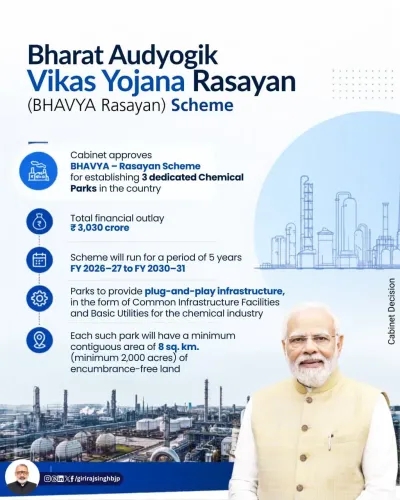
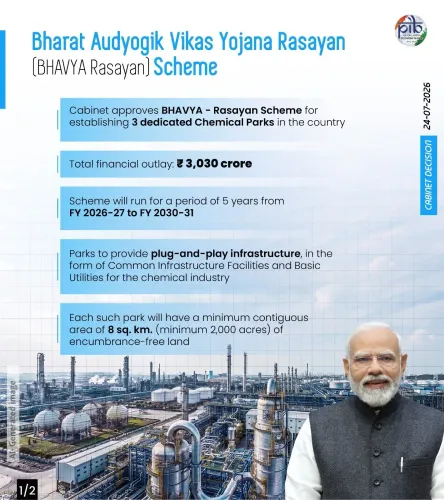
The scheme's stated goals are strong industrial infrastructure, lower production costs, and an improved investment climate through dedicated chemical parks.
The initiative is linked to Make in India and the long-term Viksit Bharat 2047 national development roadmap.
The policy lineage traces back to the PCPIR framework notified in 2007 , which first promoted integrated chemical-industry clusters in India.
Chemical manufacturers, small and medium producers, and foreign investors seeking China-plus-one alternatives are the primary stakeholders identified.
Future milestones to watch include budgetary allocations in the next Union Budget and state-level memoranda for park locations.
Union Textiles Minister Giriraj Singh on Saturday, 25 July 2026, highlighted the BHAVYA-Rasayan scheme, calling dedicated chemical parks a critical step towards making India's chemical sector globally competitive by reducing production costs and strengthening industrial infrastructure.
Context
Posting on X, the minister wrote: 'मजबूत औद्योगिक अवसंरचना, कम उत्पादन लागत और निवेश के लिए बेहतर माहौल भव्य-रसायन (BHAVYA-Rasayan) योजना का प्रमुख लक्ष्य है' — 'Strong industrial infrastructure, lower production costs and a better environment for investment are the primary goals of the BHAVYA-Rasayan scheme.' He added that the initiative aims to make India's chemical sector 'more competitive at the global level through dedicated chemical parks,' tagging it under #MakeInIndia and #ViksitBharat2047.
The post is notable because the chemicals sector falls under a separate ministry, suggesting cross-governmental advocacy for the scheme rather than a direct ministerial announcement.
Policy Backdrop
The BHAVYA-Rasayan scheme envisions dedicated chemical parks modelled on the cluster-based industrial policy India has pursued for over a decade. The concept of integrated chemical zones has roots in the Petroleum, Chemicals and Petrochemicals Investment Regions (PCPIR) policy, first notified in 2007, which sought to create large, self-contained chemical industry clusters to attract domestic and foreign investment.
Make in India, launched in September 2014, further reinforced the push for dedicated manufacturing corridors by promising streamlined approvals, infrastructure support, and global value-chain integration. BHAVYA-Rasayan appears to carry forward this lineage, with the explicit goal of lowering logistics and input costs that have historically made Indian chemical producers less price-competitive than peers in China and Southeast Asia.
The scheme's association with Viksit Bharat 2047 — the government's roadmap to achieve developed-nation status by India's centenary of independence — signals that it is framed as a long-horizon structural reform rather than a short-term stimulus.
Stakeholders and Impact
Chemical manufacturers and investors are the primary beneficiaries identified in the scheme's framing. Dedicated parks are expected to reduce per-unit logistics costs by co-locating raw-material suppliers, processors, and exporters within a single zone, cutting the fragmentation that currently inflates production expenses.
Small and medium chemical producers, who often lack the capital to independently access world-class utilities and effluent-treatment infrastructure, stand to gain disproportionately from shared-facility models embedded in such parks. Foreign investors scouting for China-plus-one manufacturing destinations could also find ring-fenced chemical zones with pre-cleared land and utilities attractive.
What's Next
The scheme's momentum will be tested against concrete budgetary allocations and state-level agreements. Analysts will watch the next Union Budget and any forthcoming policy updates from the Ministry of Chemicals and Fertilisers for capital outlay figures, identified park locations, and timelines for operationalisation.
If state governments sign memoranda of understanding to host dedicated chemical parks under BHAVYA-Rasayan, it could accelerate India's bid to capture a larger share of global specialty-chemical supply chains — a market where domestic producers have already posted strong export growth over the past several years.
Point of View
Even though chemicals sit outside his own ministerial portfolio. The move fits a pattern of senior BJP leaders cross-promoting flagship industrial schemes to amplify political messaging around manufacturing self-reliance. Anchoring the scheme to Viksit Bharat 2047 is a deliberate framing choice: it elevates what could be a routine sector-specific announcement into a civilisational-scale narrative. The real test will be whether the scheme attracts committed capital and state buy-in, or remains a policy aspiration awaiting fiscal backing.
NationPress
23 Oct 2026
Frequently Asked Questions
What is the BHAVYA-Rasayan scheme?
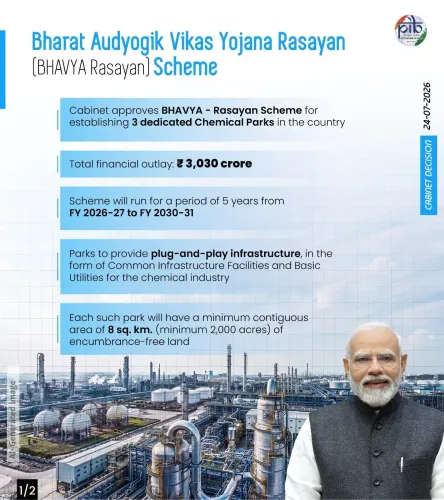
BHAVYA-Rasayan is a scheme aimed at developing dedicated chemical parks in India to provide strong industrial infrastructure, lower production costs, and a better investment climate, with the goal of making India's chemical sector more globally competitive.
What did Giriraj Singh say about BHAVYA-Rasayan?
On 25 July 2026, Giriraj Singh posted on X that BHAVYA-Rasayan's primary goals are strong industrial infrastructure, lower production costs, and a better investment environment, and that dedicated chemical parks are a critical step toward global competitiveness.
How does BHAVYA-Rasayan relate to Make in India and Viksit Bharat 2047?
The scheme is positioned as an extension of the Make in India manufacturing push launched in 2014, and is linked to Viksit Bharat 2047, the government's roadmap for India to achieve developed-nation status by the centenary of independence.
Who benefits from dedicated chemical parks under BHAVYA-Rasayan?
Chemical manufacturers, small and medium producers who need shared infrastructure, and foreign investors looking for China-plus-one manufacturing destinations are the primary beneficiaries identified in the scheme's framing.
What is India's history with chemical park policy?
India's cluster-based chemical policy dates to the Petroleum, Chemicals and Petrochemicals Investment Regions (PCPIR) framework notified in 2007, which sought to create large integrated chemical zones to attract investment and reduce fragmentation in the sector.