Giriraj Singh: Expressways grew from 93 km to 3,052 km since 2014
Synopsis
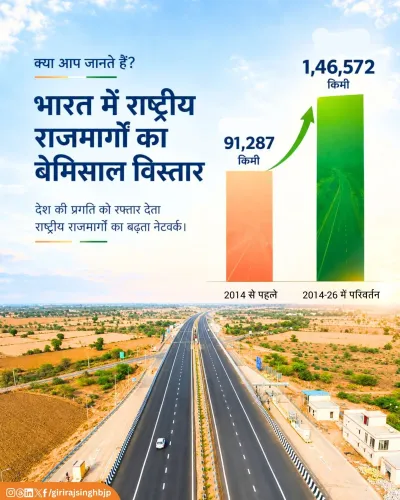
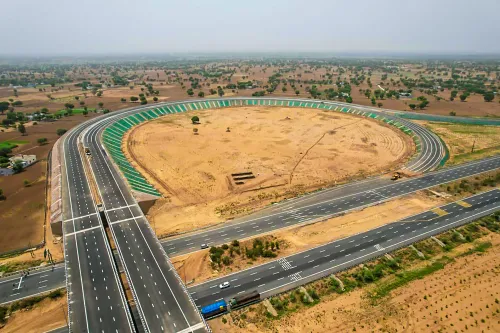
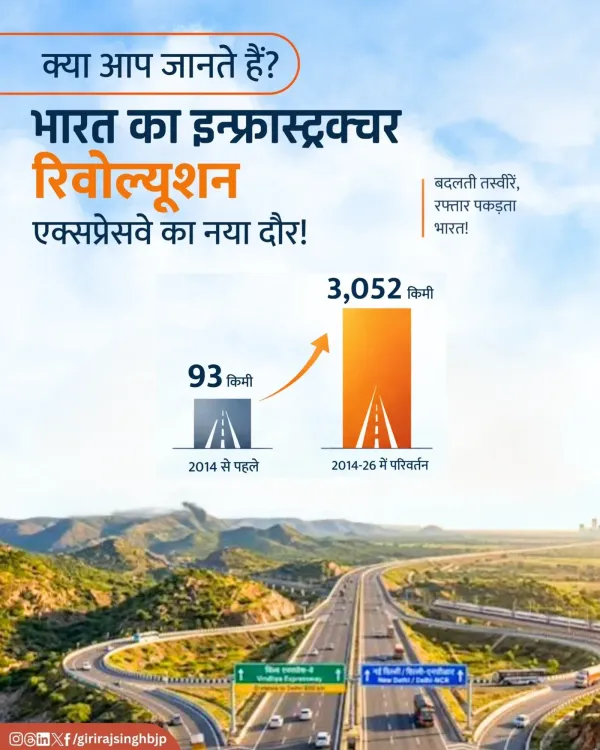
Union Textiles Minister Giriraj Singh has highlighted that India's operational access-controlled expressway network has grown from 93 km in 2014 to 3,052 km — a more than 32-fold expansion that the minister calls a marker of India's accelerating development and modern connectivity.
Key Takeaways
India's operational access-controlled high-speed corridors and expressways stood at just 93 km in 2014 .
The network has expanded to 3,052 km — a 32-fold increase over twelve years.
Union Textiles Minister Giriraj Singh shared the figures on October 23, 2026 .
The average addition works out to roughly 280 km of new expressway per year over the period.
Access-controlled expressways reduce logistics costs, cut travel times, and support industrial cluster development.
The post reflects the BJP government's broader strategy of promoting infrastructure milestones as cross-sector development indicators.
From a mere 93 kilometres in 2014 to an operational network spanning 3,052 kilometres today — India's high-speed expressway story is one of the sharpest infrastructure turnarounds in the country's modern history. Union Textiles Minister Giriraj Singh flagged the milestone on Friday, October 23, 2026, citing the dramatic expansion of access-controlled high-speed corridors and expressways across the country.
From 93 km to 3,052 km: the expressway arithmetic
In his post, Minister Singh wrote: 'भारत के इंफ्रास्ट्रक्चर में तेजी से बदलाव!' — 'A rapid transformation in India's infrastructure!' The numbers behind that claim are striking. Operational access-controlled high-speed corridors and expressways in India stood at just 93 km when the current government came to power in 2014. That figure has since grown more than 32-fold to 3,052 km, a scale of expansion that reflects a sustained, decade-long push to modernise the country's road network.
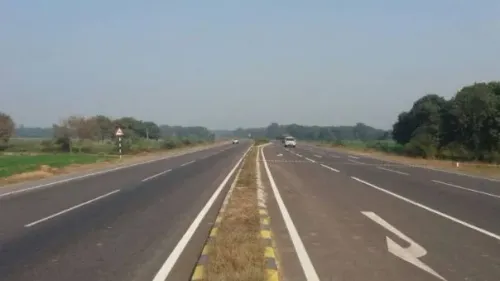
Access-controlled expressways — where entry and exit points are strictly managed, enabling higher speeds and safer, uninterrupted travel — represent the premium tier of India's highway ecosystem. Unlike conventional national highways, these corridors are engineered specifically to cut travel times between major economic centres, reduce logistics costs, and attract industrial investment along their alignments.
What a 32x expansion actually means on the ground
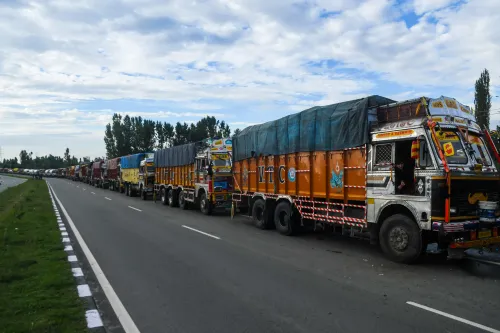
The leap from 93 km to 3,052 km means India has added, on average, roughly 280 kilometres of new expressway every year over the past twelve years. That pace — sustained across changes in fuel costs, land acquisition disputes, and financing cycles — is widely regarded as one of the more consistent delivery records in India's infrastructure sector. For freight operators, it translates into faster truck turnarounds; for commuters, it means travel times between cities that once consumed full days now fit inside a working morning.
Singh framed the expansion explicitly as a marker of 'modern connectivity and the accelerating pace of development in India' — positioning the expressway network not just as a transport asset but as an economic multiplier for the regions it passes through.
Why a Textiles Minister is talking expressways
Singh's portfolio is textiles, not roads — but senior BJP leaders routinely amplify the government's broader infrastructure narrative, particularly ahead of key political and economic milestones. Connectivity directly affects the textiles and manufacturing sectors: faster freight corridors lower input logistics costs, and new expressways have historically anchored industrial clusters in their corridors. The post signals that the government views the expressway number as a cross-portfolio win worth broadcasting widely.
With India's infrastructure ambitions now extending to dedicated freight corridors, greenfield expressways in the northeast, and the Bharatmala programme's second phase on the horizon, the 3,052 km figure is almost certainly not the final chapter. The question is how fast the next thousand kilometres arrive.
Point of View
And Giriraj Singh's post is a deliberate amplification of that record at a moment when economic momentum and electoral positioning both reward visible delivery. Expressways are politically legible in a way that fiscal deficits or bond yields are not — voters can drive on them. That a Textiles Minister is the messenger underscores how the BJP deploys its entire senior bench to project infrastructure achievements as a whole-of-government story, not a roads-ministry silo. The more substantive question the figure raises is about quality and utilisation: kilometres commissioned is only one half of the infrastructure equation; whether these corridors are financially self-sustaining and operating at planned traffic volumes is where the real policy audit lies.
NationPress
23 Oct 2026
Frequently Asked Questions
How long is India's expressway network in 2026?
India's operational access-controlled high-speed corridors and expressways had reached 3,052 km as of October 2026, according to Union Textiles Minister Giriraj Singh's post.
How much did India's expressway network grow since 2014?
India's expressway network grew from 93 km in 2014 to 3,052 km — a more than 32-fold expansion over roughly twelve years.
What is an access-controlled expressway in India?
An access-controlled expressway is a high-speed road corridor where entry and exit are permitted only at designated interchanges, enabling faster, safer, and uninterrupted travel compared to conventional national highways.
Why did Giriraj Singh post about expressways if he is the Textiles Minister?
Senior BJP ministers routinely amplify the government's broader infrastructure and development narrative. Faster expressways also directly benefit the textiles and manufacturing sectors by lowering freight logistics costs.
What is the Bharatmala programme?
Bharatmala is India's flagship national highway development programme launched to build economic corridors, expressways, and ring roads to improve freight movement and connectivity across the country.