Giriraj Singh Flags Record $307 mn Gherkin Exports in FY26
Synopsis
Union Textiles Minister Giriraj Singh flagged India's gherkin exports hitting a record $307 million in FY26, citing resilience despite US tariffs. The milestone underscores India's agri-export diversification strategy, with southern-state farmers and processors as key beneficiaries amid ongoing India-US trade friction.
Key Takeaways
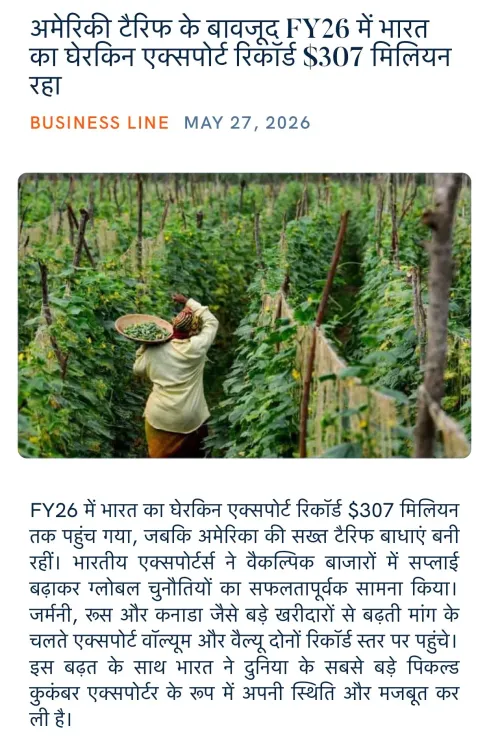
Union Textiles Minister Giriraj Singh shared data on 27 May 2026 showing India's gherkin exports reached a record $307 million in FY26 .
The record was achieved despite US tariffs that have created trade friction between India and the United States since 2018 .
Gherkin cultivation is concentrated in Karnataka and Tamil Nadu , with exports primarily directed toward Europe , the US , and ASEAN markets.
APEDA and Commerce Ministry incentives have supported market diversification, helping exporters offset US tariff headwinds.
The milestone benefits contract farmers , processing-unit workers, and agri-exporters across southern India.
Official confirmation from Commerce Ministry quarterly data and any fresh India-US trade talks will be the next key markers to watch.
Union Textiles Minister Giriraj Singh on Wednesday, 27 May 2026 shared data showing India's gherkin exports reached a record $307 million in FY26, even as US tariffs continued to weigh on bilateral trade flows. The minister highlighted the milestone via the NaMo App, flagging it as a marker of resilience in India's agricultural export sector.
Context
The post, shared in Hindi, reads: 'Amriki tariff ke bawajood FY26 mein Bharat ka gherkin export record $307 million raha' — ['Despite US tariffs, India's gherkin exports stood at a record $307 million in FY26']. The figure, if confirmed, would mark a new high for a niche horticultural commodity that has quietly become a significant foreign-exchange earner for Indian farmers and processors.
Gherkins — small pickling cucumbers — are grown predominantly in Karnataka, Tamil Nadu, and other southern states. India has emerged as one of the world's leading suppliers of processed gherkins, exporting largely to Europe, the United States, and ASEAN markets.
Policy Backdrop
Trade friction between India and the United States has persisted since 2018, when Washington imposed Section 232 tariffs on steel and aluminium, prompting New Delhi to levy retaliatory duties on select US agricultural goods. Subsequent rounds of tariff actions have created an uncertain environment for Indian exporters reliant on the American market.
Despite this, India's agriculture and processed-food export agencies — including APEDA (Agricultural and Processed Food Products Export Development Authority) — have pursued a strategy of market diversification and value addition. Commerce Ministry incentives have supported exporters in shifting volumes toward European Union and ASEAN buyers, cushioning the impact of US tariff headwinds.
The gherkin sector fits squarely within this broader export-resilience narrative. India's competitive advantage in gherkin cultivation — low input costs, suitable agro-climatic conditions in the south, and established processing infrastructure — has allowed exporters to sustain growth even when individual destination markets impose duties.
Stakeholders and Impact
The primary beneficiaries of the export surge are gherkin farmers across Karnataka and Tamil Nadu, many of whom operate on contract-farming arrangements with processing units. A record export figure translates directly into improved farmgate realisations and greater demand for labour in processing facilities.
For processed-food exporters, the milestone signals that product quality and supply-chain reliability have overcome tariff-related price disadvantages in key markets. Industry bodies have long argued that Indian gherkins command a quality premium in European retail chains, providing a buffer against tariff-induced cost pressures.
The data is also politically significant for the BJP-led government, which has set ambitious agricultural export targets as part of its broader economic agenda. A record in a visible, farmer-linked commodity strengthens the government's narrative on rural income and export diversification.
What's Next
Attention will now turn to the Commerce Ministry's quarterly export data releases, which will provide granular breakdowns of destination-wise gherkin shipments and year-on-year growth rates. Any progress in ongoing India-US bilateral trade talks — including discussions on a limited trade package — could further ease tariff friction and open additional headroom for Indian gherkin exporters.
If the $307 million figure is corroborated by official APEDA and Commerce Ministry data, it will likely be cited in parliamentary debates and trade-policy presentations as evidence that India's agri-export strategy is delivering results even in a challenging global tariff environment.
Point of View
If verified, fits a recurring government narrative of agri-export resilience that has been used to counter criticism over rural distress. Politically, highlighting a record achieved 'despite US tariffs' serves a dual purpose: it signals economic competence domestically while implicitly framing Washington's trade measures as obstacles India has overcome. The episode is part of a wider pattern in which individual ministers actively curate positive economic data on social media to reinforce the government's export-growth story ahead of any electoral or policy cycle.
NationPress
19 Sept 2026
Frequently Asked Questions
What is India's gherkin export figure for FY26?
According to data shared by Union Textiles Minister Giriraj Singh, India's gherkin exports reached a record $307 million in FY26 , the highest figure on record for the commodity.
Which states in India produce gherkins for export?
Gherkin cultivation in India is concentrated in Karnataka and Tamil Nadu , along with other southern states, where agro-climatic conditions and established processing infrastructure support large-scale production.
How have US tariffs affected India's gherkin exports?
Despite US tariffs that have created trade friction since 2018, India's gherkin exporters have diversified toward European and ASEAN markets, sustaining growth and achieving a record export total in FY26.
What is APEDA's role in India's gherkin exports?
APEDA (Agricultural and Processed Food Products Export Development Authority) supports Indian agri-exporters through market development, quality certification, and incentive schemes that help producers access and retain international buyers.
Why is Giriraj Singh, a Textiles Minister, commenting on gherkin exports?
Senior ministers in India frequently share positive economic data across sectors as part of the government's broader communication strategy. Giriraj Singh shared the gherkin export milestone via the NaMo App , a platform used by BJP leaders to amplify government achievements.