Giriraj Singh marks Digital India's 11th anniversary
Synopsis
Union Textiles Minister Giriraj Singh marked Digital India's 11th anniversary on 1 July 2026 via the NaMo App, spotlighting how Aadhaar, UPI, and digital infrastructure have reshaped Indian governance, welfare delivery, and the economy since the programme's launch by PM Modi in 2015.
Key Takeaways
Digital India was launched on 1 July 2015 by Prime Minister Narendra Modi and completed 11 years on 1 July 2026.
Union Textiles Minister Giriraj Singh marked the anniversary with a post shared via the NaMo App .
Aadhaar , whose rollout began in 2010 and was given statutory backing in 2016 , forms the foundational identity layer of India's digital welfare architecture.
UPI , launched by NPCI in August 2016 , has become the backbone of India's real-time digital payments ecosystem.
India's Digital Public Infrastructure (DPI) model has been promoted internationally, including through India's G20 presidency.
The next legislative milestones include Data Protection Act amendments and the IndiaAI Mission expansion expected in the 2026-27 budget cycle .
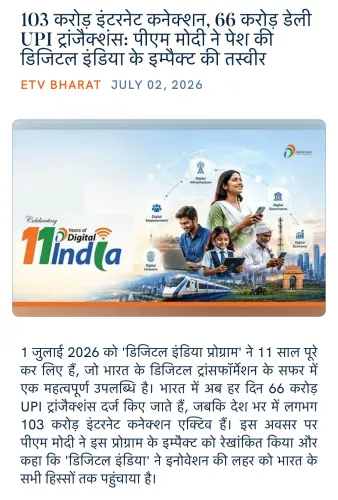
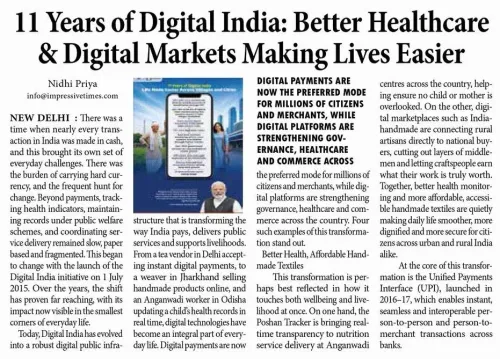
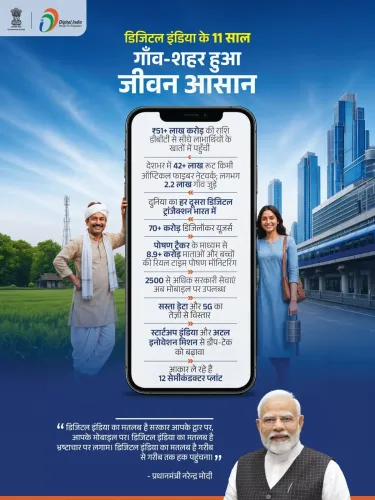
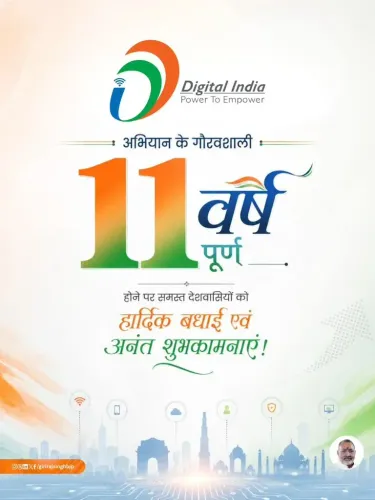
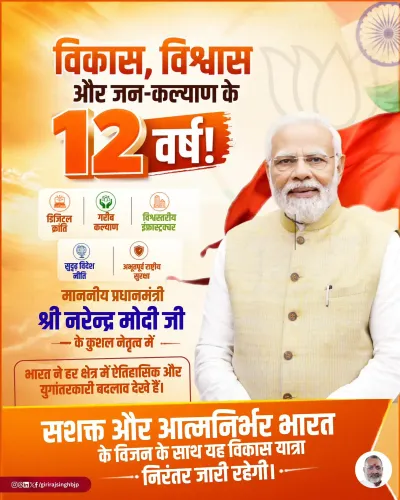
Union Textiles Minister Giriraj Singh on Wednesday, 1 July 2026 shared a tribute to the Digital India programme on its 11th anniversary, highlighting how digital infrastructure has transformed governance, welfare delivery, and the economy since the initiative's launch in 2015. The minister shared the post via the NaMo App, underscoring the BJP's continued emphasis on the programme as a landmark achievement of the Modi government.
Context
Prime Minister Narendra Modi formally launched the Digital India programme on 1 July 2015, anchoring it on nine pillars that included broadband highways, e-governance platforms, and electronic manufacturing. The initiative was designed to bridge the digital divide and deliver government services electronically to citizens across urban and rural India. Over eleven years, it has evolved into a broad ecosystem that underpins identity verification, welfare transfers, and digital commerce.
Minister Singh's post referenced the programme's journey 'डिजिटल इंफ्रास्ट्रक्चर ने बदली भारत की तस्वीर' ('how digital infrastructure changed India's picture'), framing the anniversary as a moment to reflect on structural transformation rather than incremental progress.
Policy Backdrop
Two technologies have been central to Digital India's reach. Aadhaar, the biometric unique identity system whose rollout began in 2010 and received statutory backing through the Aadhaar Act of 2016, provided the foundational authentication layer for nearly every digital welfare scheme. The Unified Payments Interface (UPI), introduced by the National Payments Corporation of India (NPCI) in August 2016, subsequently became the backbone of India's cash-light economy, enabling real-time interoperable payments for individuals, merchants, and government disbursements alike.
Successive Union Budgets have reinforced this Digital Public Infrastructure (DPI) stack — linking identity, payments, and data — as the government's primary tool for reducing leakages in welfare delivery and expanding access to formal financial services. India has also positioned its DPI model as an exportable governance framework, most prominently through its G20 presidency.
Stakeholders and Impact
The programme's beneficiaries span a wide cross-section: individual citizens who access government services digitally, welfare recipients who receive direct benefit transfers through Aadhaar-linked accounts, and MSMEs that have integrated UPI-based payments into their operations. For rural populations, the combination of expanded mobile connectivity and digital identity has opened access to banking, insurance, and subsidies that were previously difficult to reach.
The textiles sector — Minister Singh's own portfolio — has also been drawn into the digital governance arc, with schemes for weavers and artisans increasingly channelled through digital platforms to improve targeting and reduce intermediary losses.
What's Next
The anniversary comes as policymakers are debating the next phase of India's digital agenda. Parliamentary discussions on proposed Data Protection Act amendments and the expansion of the IndiaAI Mission — expected to feature prominently in the 2026-27 budget cycle — will determine how the DPI stack evolves beyond payments and identity into areas such as health records, agricultural data, and artificial intelligence-driven service delivery.
As Digital India enters its second decade, the policy question shifts from infrastructure build-out to deepening inclusion and establishing robust data governance — arenas where legislative and regulatory decisions in the coming months will be closely watched by citizens, industry, and India's international partners alike.
Point of View
Rather than a policy programme, reflects the government's broader effort to cement the initiative as a legacy marker ahead of the next electoral cycle. What gives the messaging additional weight is its timing alongside live legislative debates on data protection and AI governance, suggesting the anniversary is being used to build public goodwill for the next, more contested phase of digital policymaking. The choice of a senior cabinet minister from a non-technology portfolio to amplify the message also illustrates how deeply Digital India has been woven into the BJP's pan-government communication strategy.
NationPress
29 Sept 2026
Frequently Asked Questions
When was Digital India launched?
Digital India was formally launched on 1 July 2015 by Prime Minister Narendra Modi , making 1 July 2026 its 11th anniversary.
What is the NaMo App?
The NaMo App is a mobile application associated with Prime Minister Narendra Modi and the BJP, used for political communication and sharing government updates with supporters.
What role does Aadhaar play in Digital India?
Aadhaar serves as the foundational biometric identity layer for Digital India, enabling digital authentication and direct benefit transfers for government welfare schemes. It received statutory backing through the Aadhaar Act of 2016 .
How has UPI changed India's economy?
UPI (Unified Payments Interface) , launched by NPCI in August 2016 , enabled real-time interoperable digital payments and became the backbone of India's cash-light economy, benefiting individuals, MSMEs, and government disbursement systems.
What is India's Digital Public Infrastructure (DPI)?
India's Digital Public Infrastructure (DPI) is the interconnected stack of identity (Aadhaar), payments (UPI), and data systems that together power digital governance and welfare delivery. India has also promoted DPI as a model for other countries through forums like the G20 .