Giriraj Singh Hails India's Hydrogen Train Era Launch
Synopsis
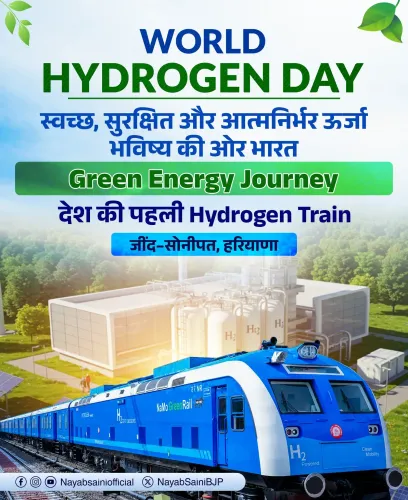
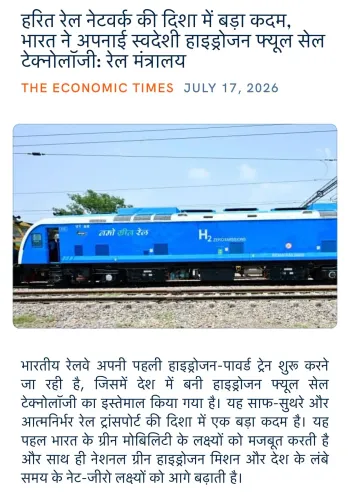
Union Textiles Minister Giriraj Singh marked the launch of India's hydrogen train era on 17 July 2026, sharing a post that positions the initiative as distinct from and superior to global hydrogen rail networks, building on the National Green Hydrogen Mission and Indian Railways' net-zero target.
Key Takeaways
Giriraj Singh posted on 17 July 2026 celebrating the start of India's hydrogen train era and its comparison with global networks.
Indian Railways has a stated goal of achieving net-zero carbon emissions by 2030 , with hydrogen trains a key pillar.
The National Green Hydrogen Mission , approved by the Union Cabinet in 2023 , provides the policy and funding backbone for hydrogen in transport.
Indian Railways and BHEL signed a development and trial agreement for hydrogen fuel-cell trains in 2022 .
India's programme is framed around integration with its broad-gauge network and domestic manufacturing , differentiating it from pilots in Germany, Japan and South Korea.
Selection of first commercial pilot routes and dedicated green hydrogen production clusters are the immediate milestones to watch.
Union Textiles Minister Giriraj Singh on Friday, 17 July 2026 shared a post on X celebrating the launch of India's hydrogen train initiative, calling it a landmark moment and highlighting how the domestic programme compares favourably with global hydrogen rail networks. The minister, a senior BJP leader and Lok Sabha MP from Begusarai, Bihar, shared the post via the NaMo App, underscoring the ruling party's push to amplify the milestone across its digital ecosystem.
Context
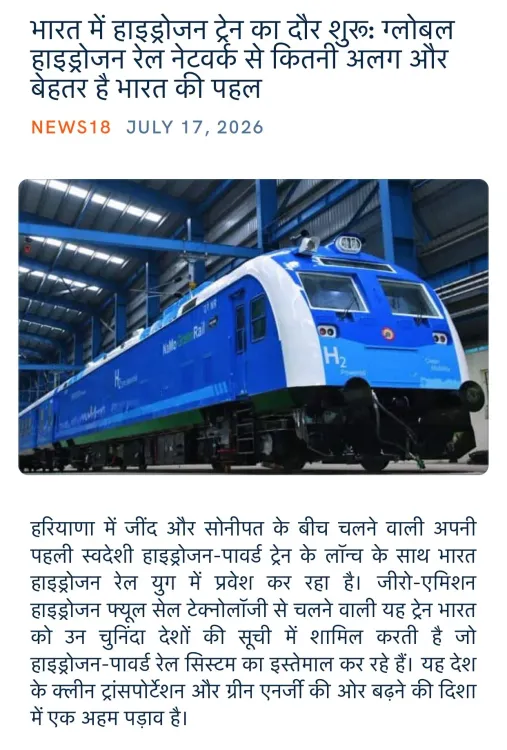
The post — headlined in Hindi as 'Bharat mein hydrogen train ka daur shuru' ('India's hydrogen train era begins') — frames the initiative as a decisive break from fossil-fuel-dependent rail propulsion. Singh's post poses a pointed question: how different and better is India's initiative compared with the global hydrogen rail network? The framing positions India not merely as a follower of international trends but as a nation charting its own technologically and strategically superior course.
Although Singh holds the Textiles portfolio, senior BJP ministers routinely amplify flagship infrastructure and green-energy milestones, reflecting the party's whole-of-government communications approach around transformative projects.
Policy Backdrop
Prime Minister Narendra Modi first announced the National Hydrogen Mission during his Independence Day address in 2021, signalling green hydrogen as a strategic priority for India's energy transition. The National Green Hydrogen Mission was formally approved by the Union Cabinet in 2023, committing resources to scale up green hydrogen production and its application across sectors, including transport.
On the rail side, Indian Railways — which has set a target of achieving net-zero carbon emissions by 2030 — signed an agreement with BHEL (Bharat Heavy Electricals Limited) in 2022 to develop and trial hydrogen fuel-cell trains, initially on heritage and branch lines. The current launch marks a progression of that multi-year development arc, moving the technology from the laboratory and pilot phase toward operational deployment.
Stakeholders and Impact
The most direct beneficiaries are Indian Railways passengers on routes where hydrogen trains are deployed, who stand to travel on cleaner, quieter rolling stock. More broadly, the shift reduces India's dependence on imported diesel — a significant strategic and fiscal concern given the country's large fuel import bill.
Domestic renewable energy firms and manufacturers also stand to gain, as the Atmanirbhar Bharat framing of the initiative prioritises indigenously built hydrogen production clusters and train components. Countries including Germany, Japan and South Korea have run comparable hydrogen rail pilots, but India's programme emphasises integration with its existing broad-gauge network — the largest in Asia — and domestic manufacturing, distinguishing it from narrower European or East Asian pilots.
What's Next
The immediate focus will be on the selection of first commercial pilot routes and the commissioning of dedicated green hydrogen production clusters linked to the 2023 National Green Hydrogen Mission. The scale and pace of rollout will determine whether India's hydrogen rail ambition translates into a systemic shift or remains a high-profile but limited demonstration.
Policymakers and industry will also watch whether the domestic manufacturing ecosystem — anchored by BHEL and allied suppliers — can deliver trains and fuelling infrastructure at a cost that makes hydrogen competitive with electrified rail on high-traffic corridors, a question that will define the programme's long-term viability.
Point of View
Where ministers outside a project's direct portfolio lend political weight to flagship milestones. By framing India's hydrogen rail push as both environmentally superior and strategically autonomous, the messaging fuses the government's green-energy narrative with Atmanirbhar Bharat sentiment — a pairing that has proven electorally durable. The timing, ahead of what would be a major commissioning event, suggests a coordinated communications push rather than a spontaneous share. Whether the hydrogen train programme delivers at scale will ultimately be the harder test of the ambition this post signals.
NationPress
15 Oct 2026
Frequently Asked Questions
What is India's hydrogen train and when did it launch?
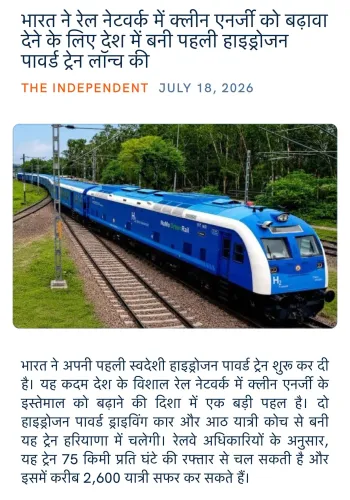
India's hydrogen train is a fuel-cell-powered rail vehicle developed by Indian Railways in collaboration with BHEL, designed to run on green hydrogen instead of diesel. The launch of the initiative was celebrated around 17 July 2026, marking the beginning of its operational phase.
How does India's hydrogen train compare with those in Germany and Japan?
India's programme emphasises integration with its existing broad-gauge network — the largest in Asia — and domestic manufacturing under the Atmanirbhar Bharat framework. Germany and Japan have run hydrogen rail pilots on narrower or heritage lines, whereas India aims for a wider-scale rollout tied to the National Green Hydrogen Mission.
What is the National Green Hydrogen Mission?
The National Green Hydrogen Mission is a Union Cabinet-approved scheme from 2023 that funds and scales up green hydrogen production and its use across sectors including transport, power, and industry, with the goal of reducing India's fossil fuel dependence.
Why did Textiles Minister Giriraj Singh post about hydrogen trains?
Senior BJP ministers routinely amplify the government's flagship infrastructure and clean-energy milestones across social media, even when the project falls outside their direct portfolio, as part of a coordinated party communications effort.
What is Indian Railways' net-zero target?
Indian Railways has committed to achieving net-zero carbon emissions by 2030, one of the most ambitious decarbonisation targets for a national rail network globally, with hydrogen trains, solar energy, and electrification all contributing to that goal.