Giriraj Singh Highlights India's Indigenous Hydrogen Rail Tech
Synopsis
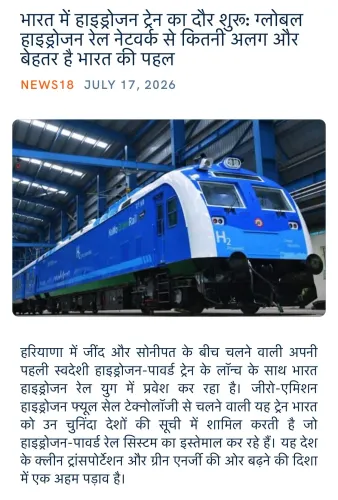
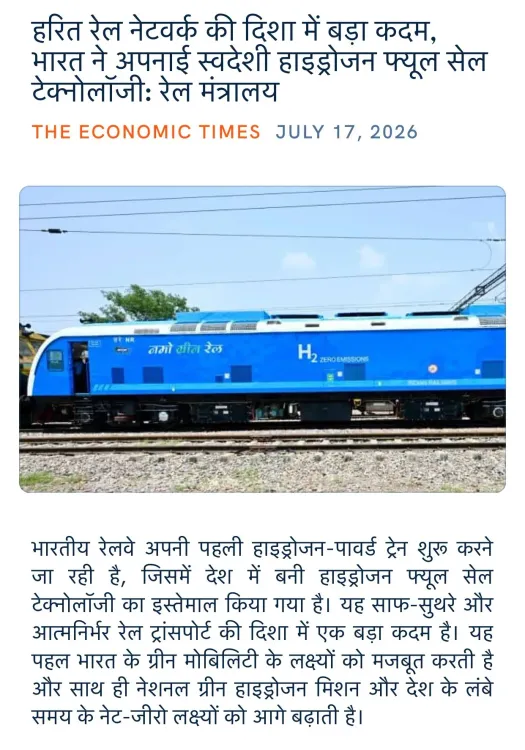
Union Textiles Minister Giriraj Singh amplified a Ministry of Railways announcement on 17 July 2026 stating that India has adopted indigenous hydrogen fuel cell technology to build a greener rail network, aligning with the National Green Hydrogen Mission and India's net-zero 2070 target.
Key Takeaways
Union Textiles Minister Giriraj Singh shared the Ministry of Railways announcement on 17 July 2026 via the NaMo App.
India has adopted indigenously developed hydrogen fuel cell technology to power a greener rail network, according to the Railways Ministry.
The development aligns with the National Green Hydrogen Mission approved in January 2023 .
Indian Railways has been identified as a priority sector for hydrogen adoption, especially on long-haul, high-load routes.
The initiative is part of India's broader Atmanirbhar Bharat programme and its commitment to reach net-zero by 2070 .
Future milestones include hydrogen train pilots, Railway Budget allocations for fuel-cell stock, and new RDSO standards.
Union Textiles Minister Giriraj Singh on Friday, 17 July 2026 shared a Ministry of Railways update announcing that India has adopted indigenous hydrogen fuel cell technology to power a greener rail network, amplifying the development across his social media platforms via the NaMo App.
Context
The post, shared in Hindi, highlights what the Ministry of Railways has described as a major step towards a green rail network — 'हरित रेल नेटवर्क की दिशा में बड़ा कदम' ['a big step towards a green rail network']. The ministry's announcement centres on the adoption of indigenously developed hydrogen fuel cell technology to drive cleaner rail operations across the country.
While Giriraj Singh holds the Textiles portfolio, senior BJP leaders routinely amplify significant government initiatives beyond their own ministries, particularly those aligned with flagship national programmes such as Atmanirbhar Bharat and India's clean-energy transition.
Policy Backdrop
The announcement sits within the framework of the National Green Hydrogen Mission, approved in January 2023, which set out to scale indigenous green hydrogen production and deploy it across sectors including transport. Indian Railways, as the operator of one of the world's largest rail networks, has been identified as a priority sector for hydrogen adoption, particularly on long-haul, high-load routes where battery-based solutions remain less viable.
India's broader net-zero commitment for 2070 has accelerated indigenisation efforts in clean-energy technology for public transport. The approach combines research and development funding, pilot projects, and public-sector procurement to build domestic manufacturing capacity rather than relying on imported systems.
The Research Designs and Standards Organisation (RDSO), the technical arm of Indian Railways, is expected to play a central role in notifying standards for hydrogen fuel cell rolling stock as the programme matures.
Stakeholders and Impact
Indian Railways and its network of domestic railway suppliers stand as the primary stakeholders in this transition. Successful indigenisation of hydrogen fuel cell technology could open a significant manufacturing opportunity for Indian firms, consistent with the government's push to develop domestic capacity in advanced clean-energy components.
Passengers on high-density corridors could eventually benefit from lower-emission rail services, while the broader energy sector stands to gain from demonstrated demand for green hydrogen at scale. The railways' adoption also sends a signal to private investors and state-owned enterprises about the commercial viability of hydrogen in Indian transport.
What's Next
Attention will now turn to the progress of hydrogen train pilot projects, the inclusion of fuel-cell rolling stock in future Railway Budget outlays, and any new technical standards that RDSO may notify in the coming months. The scale and timeline of deployment will be closely watched as a test of whether indigenous hydrogen technology can move from announcement to operational reality on the Indian Railways network.
Point of View
If substantiated at scale, would mark a significant inflection point in Indian Railways' decarbonisation arc, moving the programme from policy aspiration to operational deployment. It also reinforces the Atmanirbhar Bharat narrative by centering indigenisation rather than technology import. The key test will be whether pilot timelines and procurement budgets follow the announcement with speed and transparency.
NationPress
15 Oct 2026
Frequently Asked Questions
What is India's indigenous hydrogen fuel cell technology for railways?
According to the Ministry of Railways, India has developed and adopted its own hydrogen fuel cell technology to power trains, reducing dependence on imported clean-energy systems and supporting a greener rail network.
What is the National Green Hydrogen Mission?
The National Green Hydrogen Mission was approved by the Indian government in January 2023 to scale domestic production and use of green hydrogen across sectors, including transport and railways.
Why is hydrogen preferred over batteries for Indian Railways?
Hydrogen fuel cells are considered more suitable for long-haul, high-load rail routes where battery-based solutions are less viable due to energy density and recharging constraints.
What is India's net-zero target and how does this relate?
India has committed to achieving net-zero carbon emissions by 2070. Adopting indigenous hydrogen technology in railways is part of the broader decarbonisation strategy to meet this target.
What happens next after this hydrogen rail technology announcement?
Key developments to watch include the progress of hydrogen train pilot projects, inclusion of fuel-cell rolling stock in Railway Budget outlays, and new technical standards from the Research Designs and Standards Organisation (RDSO).