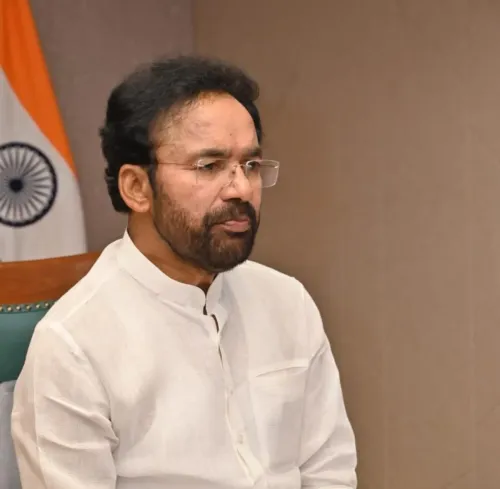
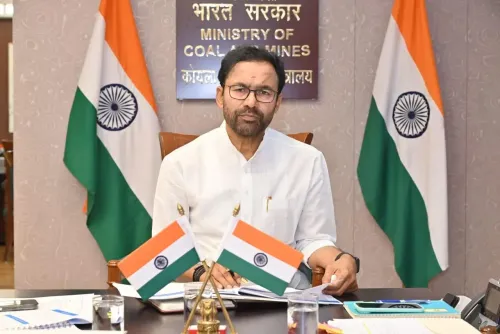
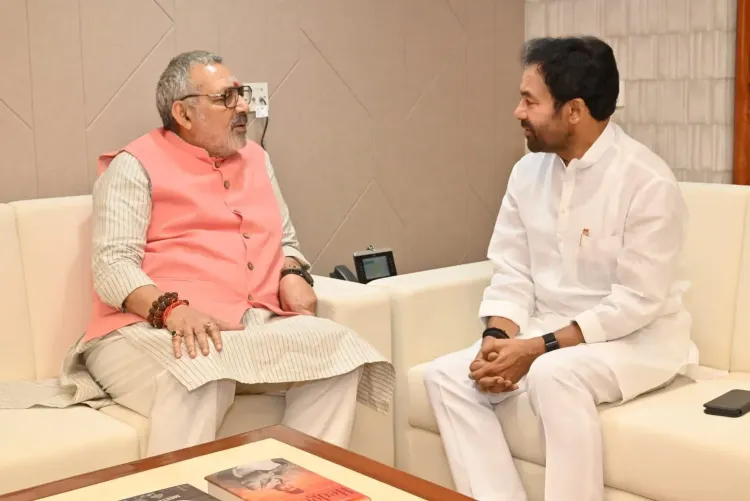
Giriraj Singh meets Coal Minister Kishan Reddy on development push
Synopsis
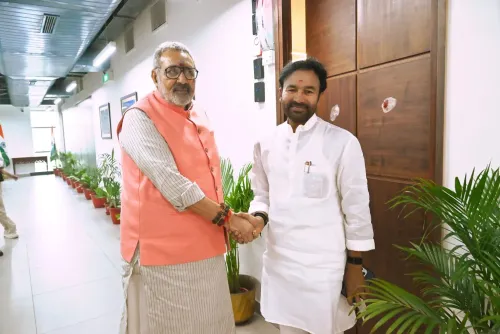
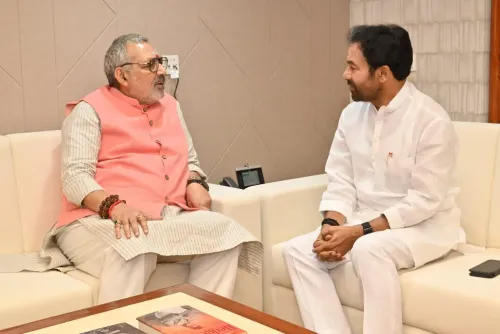
Union Textiles Minister Giriraj Singh said he met Union Coal and Mines Minister G. Kishan Reddy in New Delhi for talks on development works and effective implementation of central government schemes, invoking Atmanirbhar Bharat and Viksit Bharat 2047 as guiding frames for the discussion.
Key Takeaways
Union Textiles Minister Giriraj Singh announced a meeting with Union Coal and Mines Minister G.
The discussion covered development projects and public welfare priorities, per the post.
Both ministers reviewed effective implementation of central government schemes.
Hashtags invoked Atmanirbhar Bharat, Viksit Bharat 2047 and New India.
Singh represents Begusarai in Bihar; Reddy represents Hyderabad in Telangana.
Specific agenda items and outcomes were not disclosed in the post.
Union Textiles Minister Giriraj Singh on Wednesday said he held a 'cordial meeting' with Union Coal and Mines Minister G. Kishan Reddy in New Delhi, with the two BJP colleagues discussing development projects and welfare-linked priorities. The minister disclosed the engagement in a post on X, framing it as part of ongoing inter-ministerial coordination on flagship central schemes.
'Today I had a cordial meeting with Union Coal and Mines Minister Shri G. Kishan Reddy ji and held a meaningful discussion on various development works and important issues linked to public welfare,' Singh wrote in Hindi, adding that the two ministers also deliberated on the 'prabhavi kriyanvayan' (effective implementation) of central government schemes for 'the country's overall development and public welfare'. The post carried the hashtags #NewIndia, #ViksitBharat2047, #AtmanirbharBharat, #Development and #RashtraHit.
Context
Singh, the Lok Sabha MP from Begusarai in Bihar, holds the textiles portfolio and has a track record of public engagement on rural development and the MSME ecosystem. Reddy, the Lok Sabha MP from Hyderabad in Telangana, heads the Ministry of Coal and Mines, a sector central to India's energy security and revenue-sharing arrangements with mineral-bearing states.
While the post did not detail the specific agenda items, the choice of hashtags signals an alignment with the BJP-led central government's overarching economic frames — self-reliance under Atmanirbhar Bharat and the long-horizon goal of a developed India under Viksit Bharat 2047.
Policy backdrop
The Atmanirbhar Bharat Abhiyan, announced in May 2020, is built on five pillars — economy, infrastructure, system, demography and demand — and has since served as the umbrella for production-linked incentive schemes spanning textiles, electronics and other priority sectors. Viksit Bharat 2047, the government's articulation of a developed-economy roadmap timed to the centenary of independence, layers multi-sectoral growth targets over earlier initiatives such as Make in India.
Inter-ministerial coordination has been a recurring instrument since 2019, with groups of secretaries and NITI Aayog reviews used to align scheme delivery across line ministries. Coal and textiles, though apparently distant portfolios, intersect through industrial energy demand, employment in resource-rich and cluster-based regions, and welfare programmes targeted at workers in both sectors.
Stakeholders and impact
Bilateral meetings of this kind matter most for two constituencies: scheme beneficiaries who depend on smoother last-mile delivery, and state economies anchored by sector-specific activity. Coal mining districts — including parts of Jharkhand, Odisha, Chhattisgarh and Telangana — and textile clusters spread across Tamil Nadu, Gujarat, Maharashtra and Uttar Pradesh both look to the Centre for capital outlays and regulatory clarity.
Bihar, Singh's home state, has been a focus of MSME and handloom interventions, while Telangana, Reddy's base, is one of the larger coal-producing states through Singareni Collieries. The convergence of welfare programmes — from skilling to credit access — across these geographies typically requires coordination between ministries that do not share an obvious operational interface.
What's next
Neither minister has detailed the specific projects under review, and the post does not commit to any follow-up announcement. Observers will look to the upcoming parliamentary session for ministry-wise updates on scheme convergence, and to state-level rollout reports on coal logistics and textile cluster development in Bihar and Telangana.
For now, the meeting reinforces the visual of routine Cabinet-level coordination that the government has projected since 2014 — and adds another data point on how Atmanirbhar Bharat and Viksit Bharat 2047 are being kept centre-stage in ministerial messaging ahead of policy and budgetary milestones.
Point of View
The government continues to weave sector-specific portfolios into a single development narrative. For BJP ministers from Bihar and Telangana, such visuals also double as constituency-facing messaging in states where the party's electoral footprint is still being negotiated. The substance, as always, will be judged by what reaches the ground.
NationPress
21 Oct 2026
Frequently Asked Questions
Who did Giriraj Singh meet on June 3, 2026?
Union Textiles Minister Giriraj Singh said he met Union Coal and Mines Minister G. Kishan Reddy. According to his X post, the two ministers discussed development works and central government scheme implementation.
What was discussed in the Giriraj Singh and Kishan Reddy meeting?
The post says the discussion covered 'various development works' and important issues linked to public welfare, along with effective implementation of central government schemes. Specific projects or decisions were not disclosed.
Which ministries do Giriraj Singh and G. Kishan Reddy head?
Giriraj Singh is the Union Minister of Textiles, while G. Kishan Reddy is the Union Minister of Coal and Mines. Both are senior BJP leaders in the Union Council of Ministers.
What is Viksit Bharat 2047?
Viksit Bharat 2047 is the central government's long-term vision to transform India into a developed economy by the centenary of independence in 2047. It encompasses multi-sectoral growth and welfare targets across ministries.
Which constituencies do Giriraj Singh and Kishan Reddy represent?
Giriraj Singh is the Lok Sabha MP from Begusarai in Bihar. G. Kishan Reddy is the Lok Sabha MP from Hyderabad in Telangana.