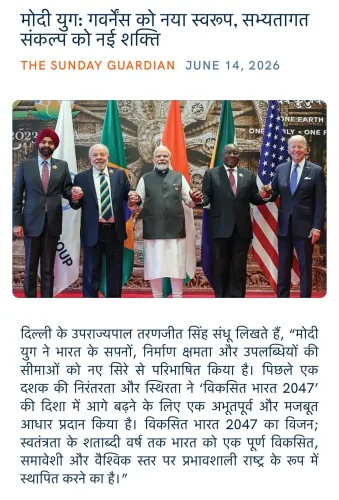
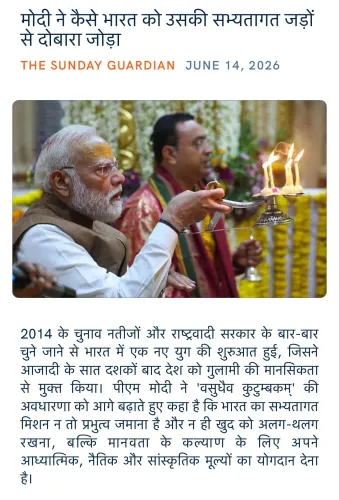
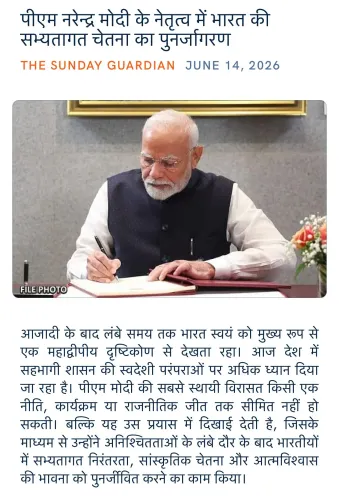
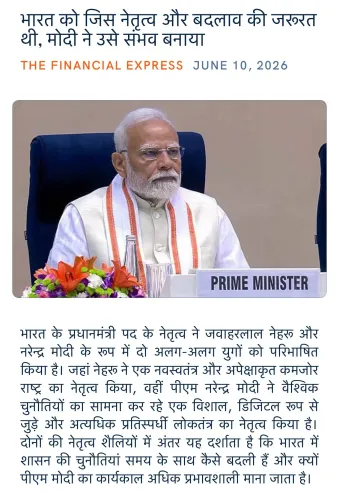
Giriraj Singh: Modi Helped India Rediscover Its 'Bharat' Identity
Synopsis
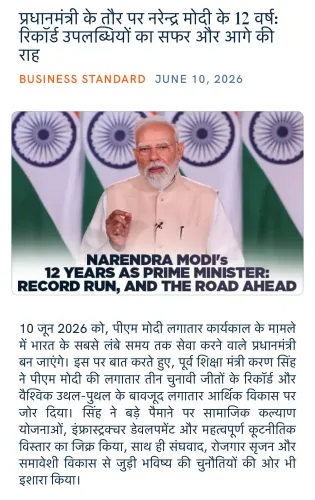
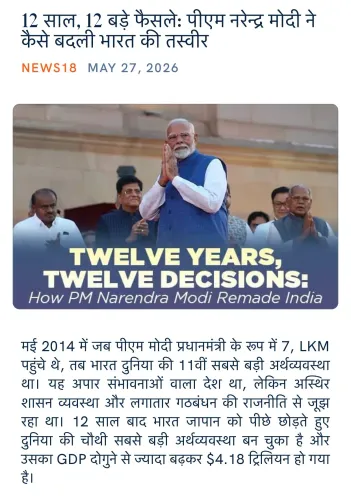
Union Textiles Minister Giriraj Singh shared a cultural-nationalist piece on June 14, 2026, arguing that PM Modi has helped India rediscover its ancient identity as 'Bharat' — continuing a BJP-driven narrative on indigenous national nomenclature that gained prominence during the 2023 G20 presidency.
Key Takeaways
Union Textiles Minister Giriraj Singh shared a post on June 14, 2026 via the NaMo App asserting that PM Modi has reconnected India with its identity as 'Bharat' .
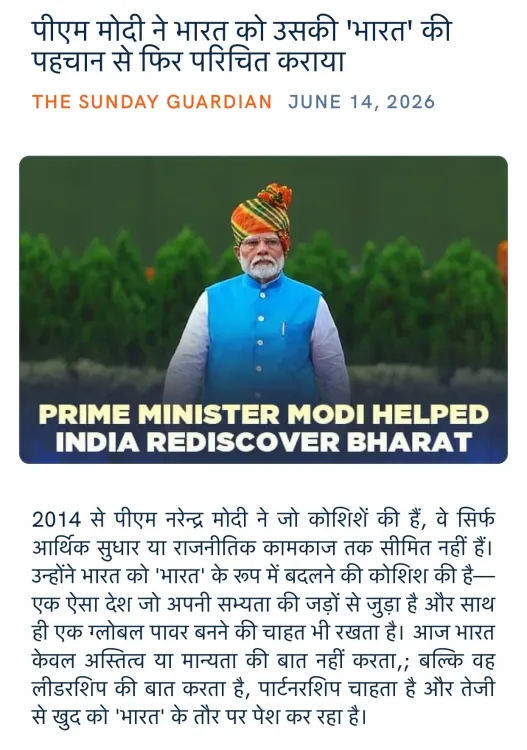
The caption translates as: 'PM Modi has reintroduced India to its identity as Bharat.' The 'Bharat' nomenclature debate gained national visibility in September 2023 when G20 presidency communications used 'President of Bharat' on official invitations.
Article 1 of the Indian Constitution already recognises both names: 'India, that is Bharat, shall be a Union of States.' The post is part of a broader BJP pattern of symbolic measures to highlight pre-colonial Indian heritage, including place and institution renaming.
Future parliamentary sessions and official documents may see further pushes to formalise 'Bharat' as the preferred national identifier.
Union Textiles Minister Giriraj Singh on Sunday, June 14, 2026, shared a piece arguing that Prime Minister Narendra Modi has helped India reconnect with its ancient identity as 'Bharat', amplifying a cultural-nationalist narrative that has gained momentum under the current government.
Context
Singh shared the piece with the caption 'पीएम मोदी ने भारत को उसकी 'भारत' की पहचान से फिर परिचित कराया' — translated as 'PM Modi has reintroduced India to its identity as Bharat'. The post was shared via the NaMo App, a platform closely associated with BJP outreach and Prime Minister Modi's communications ecosystem.
The framing centres on the idea that colonial-era nomenclature distanced the nation from its indigenous roots, and that the current government has worked to reverse that cultural drift. Singh, a Lok Sabha MP from Begusarai, Bihar, is a senior party voice known for amplifying such narratives on social media.
Policy Backdrop
The 'Bharat versus India' debate entered mainstream political discourse most visibly in September 2023, when official communications during India's G20 presidency used the designation 'President of Bharat' on state dinner invitations, prompting wide discussion on national nomenclature.
The name 'Bharat' is enshrined in Article 1 of the Indian Constitution, which reads: 'India, that is Bharat, shall be a Union of States.' Successive BJP-led governments have pursued a broader symbolic agenda — including renaming of places and institutions — to foreground pre-colonial heritage over colonial-era terminology.
This messaging aligns with the party's long-standing cultural-nationalist platform, which draws on ancient Sanskrit texts and indigenous traditions to frame a distinct national identity rooted in civilisational continuity rather than the post-1947 administrative inheritance alone.
Stakeholders and Impact
The conversation around 'Bharat' as a preferred national identifier resonates strongly with BJP supporters and cultural-nationalist constituencies, while drawing scepticism from opposition parties and commentators who view it as symbolic politics rather than substantive governance.
For ordinary citizens, the debate touches on questions of cultural pride, linguistic heritage, and the relationship between the modern Indian state and its ancient civilisational past. Educational institutions, official documents, and diplomatic correspondence are all potential arenas where such terminological shifts could have practical implications.
What's Next
The post signals continued emphasis by senior BJP leaders on cultural identity as a political theme heading into the latter half of 2026. Observers will watch for any references to 'Bharat' in upcoming parliamentary sessions, official government communications, or constitutional discussions that could give the nomenclature debate a legislative dimension.
As long as PM Modi's government holds office, the strategic use of 'Bharat' as a marker of civilisational pride is likely to remain a recurring motif in ministerial messaging — moving gradually from symbolic assertion toward potential institutional embedding.
Point of View
Keeping the 'Bharat' identity debate alive in public discourse. The choice to share the piece via the NaMo App signals coordinated party amplification rather than a spontaneous personal view. This sits within a decade-long arc of the Modi government layering symbolic cultural assertions — from renaming cities to G20 branding — onto its policy record. The persistence of this narrative suggests the party sees civilisational identity as a durable electoral and ideological asset, not merely a moment of enthusiasm.
NationPress
13 Sept 2026
Frequently Asked Questions
What did Giriraj Singh post about Bharat on June 14 2026?
Giriraj Singh shared a piece arguing that PM Modi has helped India rediscover its ancient identity as 'Bharat', captioning it: 'PM Modi has reintroduced India to its identity as Bharat.'
What is the difference between 'India' and 'Bharat'?
Both names refer to the same nation. Article 1 of the Indian Constitution states 'India, that is Bharat, shall be a Union of States.' 'Bharat' is the ancient Sanskrit name rooted in pre-colonial heritage, while 'India' derives from colonial-era usage.
When did the Bharat vs India name debate start under Modi?
The debate gained significant national attention in September 2023 when official G20 presidency communications used 'President of Bharat' on state dinner invitations, prompting wide political and public discussion.
Why does BJP emphasise the name 'Bharat'?
The BJP's emphasis on 'Bharat' is part of a broader cultural-nationalist agenda to foreground pre-colonial Indian heritage over colonial-era terminology, aligning with the party's platform of civilisational pride and indigenous identity.
Who is Giriraj Singh?
Giriraj Singh is the Union Minister of Textiles, a senior BJP leader, and a Lok Sabha MP representing Begusarai constituency in Bihar.