Giriraj Singh hails Modi era's governance and civilisational resolve
Synopsis
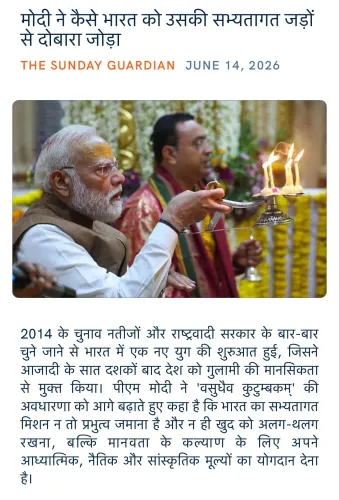
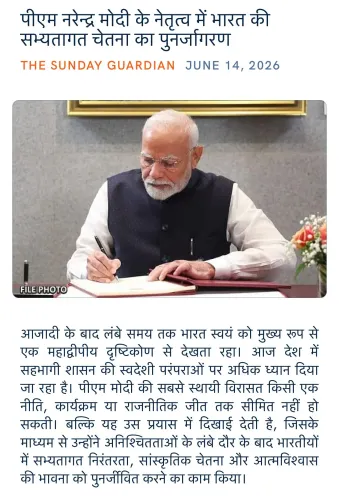
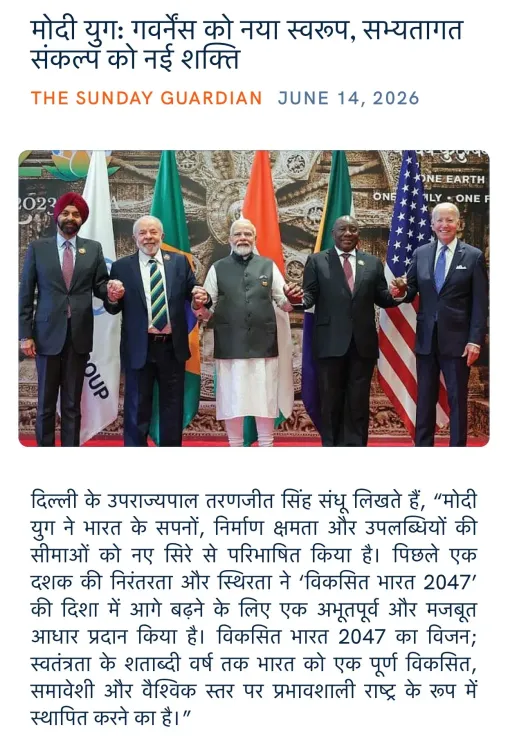
Union Textiles Minister Giriraj Singh on 14 June 2026 shared an article via the NaMo App framing the Modi era as a reimagining of governance and a renewal of India's civilisational resolve, reinforcing the BJP's long-running ideological narrative ahead of future electoral cycles.
Key Takeaways
Giriraj Singh , Union Textiles Minister and Lok Sabha MP from Begusarai, Bihar , shared the article on 14 June 2026 via the NaMo App on X.
The Hindi headline translates to 'The Modi era: a new form for governance, new strength for civilisational resolve.' The BJP has consistently linked governance reforms such as Digital India (2015) and the abrogation of Article 370 (August 2019) to a civilisational identity narrative.
Senior ministers sharing ideologically framed content through the NaMo App is a deliberate party communications strategy.
The post signals early positioning of the BJP's governance-and-identity narrative ahead of the 2029 general election .
Union Textiles Minister Giriraj Singh on Sunday, 14 June 2026, shared an article through the NaMo App on X that frames the Modi era as a period of reimagined governance and renewed civilisational resolve, drawing attention to what he described as a structural transformation in how India is administered and how its cultural identity is expressed through policy.
Context
The post, shared in Hindi, carries the headline 'Modi yug: governance ko naya swaroop, sabhyatagat sankalp ko nayi shakti' — translated as 'The Modi era: a new form for governance, new strength for civilisational resolve.' The minister shared a link to an article elaborating on these themes, signalling his alignment with the BJP's broader ideological framing of the government's record since 2014.
Singh's endorsement comes at a politically charged moment, with state assembly polls on the horizon and the 2029 general election beginning to shape the party's public messaging. Senior ministers sharing ideologically resonant content through official party platforms like the NaMo App is a deliberate strategy to amplify the ruling party's governance narrative.
Policy Backdrop
The 'civilisational resolve' framing has been a recurring motif in BJP communications since the party came to power at the Centre. Landmark decisions such as the abrogation of Article 370 in August 2019 — which ended the special status of Jammu and Kashmir — were presented by the government not merely as administrative acts but as the completion of India's territorial and civilisational integration.
On the governance modernisation front, the Digital India programme, launched in 2015, sought to re-engineer public service delivery through technology and e-governance platforms. The government has consistently argued that these reforms represent a break from colonial-era administrative structures, positioning them as expressions of indigenous governance philosophy rather than mere technocratic upgrades.
The BJP's communications machinery has, over successive years, woven these two threads — administrative efficiency and cultural self-assertion — into a unified political narrative, one that ministers like Giriraj Singh regularly amplify through social media.
Stakeholders and Impact
The primary audience for such messaging is the BJP's ideological base, which responds strongly to the combination of development claims and civilisational pride. Policy commentators and opposition parties, however, have often questioned whether the 'civilisational' framing serves as a substantive policy argument or functions primarily as electoral rhetoric.
For the Textiles Ministry, Singh's broader public profile has always extended well beyond his portfolio. As a Lok Sabha MP from Begusarai, Bihar, his social media presence is closely watched in the state, where BJP's political fortunes are tied to both developmental delivery and ideological mobilisation.
What's Next
With the BJP preparing its messaging ahead of upcoming electoral cycles, expect further amplification of the 'Modi era' governance narrative from senior party leaders. The convergence of administrative achievement claims with civilisational identity themes is likely to intensify as the party seeks to consolidate its core vote while expanding its appeal. Any formal policy announcements from the Textiles Ministry or the broader government in the coming weeks will be watched for how they are framed within this larger ideological arc.
Point of View
The act of sharing itself becomes a signal of party loyalty and ideological alignment, not merely an opinion. This kind of ministerial amplification is likely to grow in frequency as the party calibrates its messaging for the next electoral cycle. The broader pattern suggests the BJP intends to contest 2029 on a record-plus-resolve platform, where administrative achievement and cultural pride are presented as inseparable.
NationPress
14 Sept 2026
Frequently Asked Questions
What did Giriraj Singh post on X on 14 June 2026?
Giriraj Singh shared an article via the NaMo App with the Hindi headline translating to 'The Modi era: a new form for governance, new strength for civilisational resolve,' framing the BJP government's tenure as a civilisational and administrative transformation.
What is the NaMo App?
The NaMo App is a BJP-linked digital platform associated with Prime Minister Narendra Modi, used by party leaders and supporters to share news, party communications, and ideological content.
What does 'civilisational resolve' mean in the BJP's governance narrative?
In BJP communications, 'civilisational resolve' refers to the framing of policy decisions — such as the abrogation of Article 370 or the promotion of Indian cultural identity — as expressions of India's long-term civilisational continuity, not just administrative acts.
Who is Giriraj Singh?
Giriraj Singh is the Union Minister of Textiles and a senior BJP leader who serves as a Lok Sabha MP from Begusarai, Bihar. He is known for his strong public commentary on party ideology and governance themes.
How does this post relate to the 2029 general election?
Senior BJP ministers amplifying the 'Modi era' governance narrative through party platforms is seen by political analysts as early positioning for the 2029 general election, where the party is expected to campaign on a combination of developmental record and civilisational identity.