Giriraj Singh approves Central Silk Board office for Maharashtra
Synopsis
Union Textiles Minister Giriraj Singh has confirmed the establishment of a Central Silk Board regional office in Maharashtra, acting on a formal letter from Chief Minister Devendra Fadnavis. The move aims to expand sericulture infrastructure, open new avenues for silk farmers, and boost silk production in the state.
Key Takeaways
Union Textiles Minister Giriraj Singh confirmed on 20 October 2026 that a Central Silk Board regional office will be set up in Maharashtra.
The decision directly follows a written request from Maharashtra Chief Minister Devendra Fadnavis .
The Central Silk Board was constituted in 1948 under the Central Silk Board Act to promote sericulture and the silk industry across India.
The new office is expected to provide silk farmers with technical support, training, and market-linkage services.
The move is part of the Centre's broader push to expand the CSB's footprint into non-traditional silk-producing states to increase domestic raw silk output.
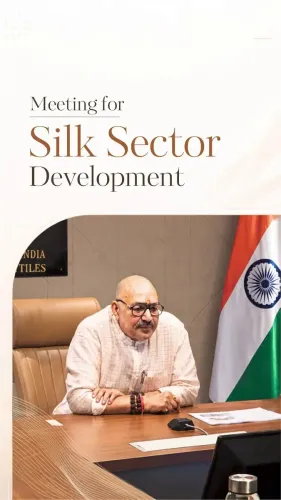
A formal letter from Maharashtra Chief Minister Devendra Fadnavis has moved the needle for the state's silk farmers — Union Textiles Minister Giriraj Singh confirmed on Tuesday, 20 October 2026 that a regional office of the Central Silk Board will be established in Maharashtra, directly responding to Fadnavis's written request.
Posting on X in Hindi, Minister Singh expressed gratitude for the Chief Minister's 'positive initiative' (skaratmak pahel), saying: 'I am pleased that in keeping with your request, this important step has been taken towards the development of the silk sector in Maharashtra. This will give silk farmers new opportunities and promote silk production and the silk industry in the state.'
Why Maharashtra needed its own silk office
The Central Silk Board, constituted in 1948 under the Central Silk Board Act, has historically concentrated its regional infrastructure in India's traditional sericulture belts — Karnataka, Andhra Pradesh, and West Bengal. Maharashtra, despite its agricultural scale and rural workforce, lacked a dedicated CSB regional presence, leaving silk farmers without direct access to the board's technical support, seed supply, and market-linkage services.
The new office changes that calculus. A regional CSB presence brings on-the-ground extension services: training for farmers on silkworm rearing, quality certification for cocoons and yarn, and a direct pipeline to central schemes. For a state with vast irrigated farmland suited to mulberry cultivation, the infrastructure gap was a genuine bottleneck.
What the expansion means for silk farmers
The central government has been deliberately widening the CSB's footprint beyond legacy silk states, targeting newer geographies to boost domestic raw silk output and rural employment. Maharashtra fits that template: a large agrarian population, existing textile clusters, and government intent to diversify income streams for farmers.
Singh's post underlines that the move is a direct outcome of state-centre coordination — Fadnavis wrote, the Centre responded. That sequence matters. It signals that state governments can accelerate sectoral infrastructure through formal advocacy, and that the Ministry of Textiles is prepared to act on those requests.
The actual operationalisation of the office — its location within Maharashtra, staffing, and first project mandates — will be the next critical marker. When the office goes live, sericulture farmers across the state will, for the first time, have a Central Silk Board window on their doorstep.
Point of View
Minister Singh reinforces the BJP's state-centre coordination narrative ahead of Maharashtra's political calendar. More substantively, establishing CSB infrastructure in Maharashtra fits into a longer-term push by the Textiles Ministry to diversify India's sericulture map beyond its southern and eastern strongholds — a strategy tied to rural employment targets and the 'Atmanirbhar' self-sufficiency goal in textiles. The real test will be the speed of operationalisation; announcements of regional offices have historically preceded long gestation periods.
NationPress
20 Oct 2026
Frequently Asked Questions
What is the Central Silk Board and what does it do?
The Central Silk Board is a statutory body established in 1948 under the Central Silk Board Act. It operates under the Ministry of Textiles and is responsible for the overall development of the silk industry in India, including research, training, seed supply, and market support for sericulture farmers.
Why is a Central Silk Board regional office being set up in Maharashtra?
Maharashtra Chief Minister Devendra Fadnavis formally requested the office in a letter to Union Textiles Minister Giriraj Singh. The state currently lacks a dedicated CSB regional presence, limiting silk farmers' access to technical support and central schemes.
How will silk farmers in Maharashtra benefit from the new CSB office?
The regional office will provide silk farmers with on-the-ground extension services including silkworm rearing training, quality certification for cocoons and yarn, and direct access to central government schemes — services that were previously unavailable without travelling to offices in other states.
Is Maharashtra a significant state for silk production in India?
Maharashtra is not traditionally counted among India's top silk-producing states — those are Karnataka, Andhra Pradesh, and West Bengal — but it has large irrigated agricultural land suited to mulberry cultivation, making it a target for the Centre's sericulture expansion drive.
What did Giriraj Singh say about the Maharashtra silk office?
Minister Singh said he was pleased that 'in keeping with your request, this important step has been taken towards the development of the silk sector in Maharashtra,' adding that it would give silk farmers new opportunities and promote silk production and the silk industry in the state.