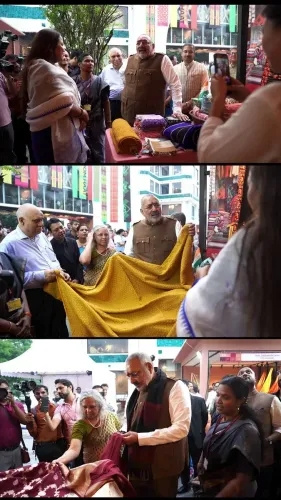
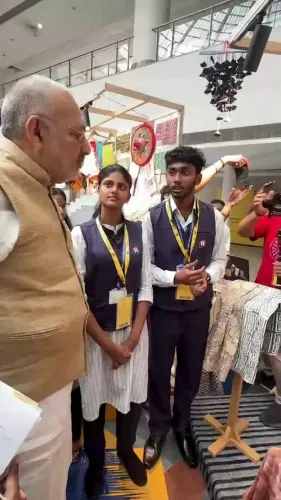
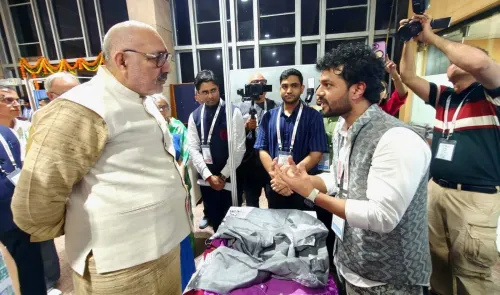
Giriraj Singh launches Handloom Tech Centre at IIT Delhi
Synopsis
Union Textiles Minister Giriraj Singh on August 3, 2026 launched the Centre of Excellence for Handloom Technology at IIT Delhi, along with five initiatives — Handloom 4.0, e-Vidya, HandloomX, Kalagriha Handloom Studio, and Threads of Valour — to modernise India's weaving sector through research and technology.
Key Takeaways
Centre of Excellence for Handloom Technology (CoE-HT) was inaugurated at IIT Delhi on August 3, 2026 by Union Textiles Minister Giriraj Singh .
The centre aims to bridge traditional handloom craft with modern technology to boost weaver productivity and market access.
Five initiatives launched alongside: Handloom 4.0 , Handloom e-Vidya , HandloomX , Kalagriha Handloom Studio , and Threads of Valour .
The move continues the Textiles Ministry's strategy of government-academia partnerships to upgrade traditional industries.
The handloom sector is protected under the Handlooms (Reservation of Articles for Production) Act, 1985 , but faces persistent challenges of low productivity and limited market reach.
Key metrics to watch include research adoption rates among weavers and future Union Budget allocations for the centre.
India's handloom sector — home to millions of weavers whose craft dates back centuries — got a modern-day anchor on Monday, August 3, 2026, when Union Textiles Minister Giriraj Singh inaugurated the Centre of Excellence for Handloom Technology (CoE-HT) at IIT Delhi, positioning one of the country's premier engineering institutions as the nerve centre of a reinvented weaving economy.
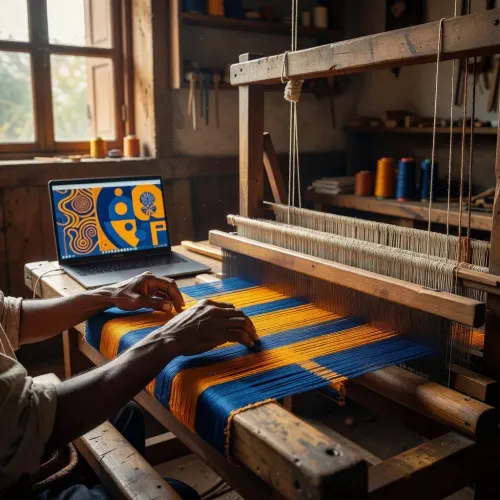
Posting on X, the minister described the centre as a bridge between traditional craft and modern technology — 'पारंपरिक शिल्प और आधुनिक तकनीक के बीच सेतु' ('a bridge between traditional craft and modern technology') — that will boost weaver productivity, ease their work, drive innovation, and connect handloom products to new markets.
Five initiatives launched alongside the CoE-HT
The inauguration was not a ribbon-cutting alone. Five distinct programmes were launched in tandem: Handloom 4.0, Handloom e-Vidya, HandloomX, Kalagriha Handloom Studio, and Threads of Valour. Together, they span the arc from digital skilling and e-learning to design studios and market-linkage platforms — signalling that the ministry intends the CoE-HT to be an operating engine, not a ceremonial address.
The names themselves telegraph intent. 'Handloom 4.0' borrows the language of the Fourth Industrial Revolution. 'e-Vidya' targets knowledge transfer. 'Threads of Valour' hints at a cultural-patriotic positioning of Indian handloom on the global stage.
Why IIT Delhi, and why now
IIT Delhi's selection as host is deliberate. The institute's strengths in materials science, design engineering, and applied research make it a natural partner for an industry whose core challenge is translating artisanal skill into scalable, market-competitive output. The government-academia partnership model mirrors similar collaborations in pharmaceuticals and defence manufacturing — sectors where research institutions were used to de-risk industrial transitions.
The handloom sector has long operated under a protective legal framework — the Handlooms (Reservation of Articles for Production) Act, 1985 — which shields traditional products from powerloom competition. But protection alone cannot solve low productivity or limited market reach. The CoE-HT is the ministry's bet that technology-led intervention can do what legislation could not.
What weavers stand to gain
The direct stakeholders are India's handloom weavers and textile artisans — a workforce that is geographically dispersed, often informally employed, and historically underserved by mainstream industrial policy. If the centre's research outputs translate into accessible tools and training, weavers could see measurable gains in output per loom-hour and in their ability to reach buyers beyond local mandis.
The key variables to watch: how quickly the centre produces usable research, whether adoption rates among weavers are tracked and published, and whether follow-up funding appears in the next Union Budget.
India's looms have always told a story. The question the CoE-HT must now answer is whether technology can help weavers write the next chapter on their own terms.
Point of View
A shift that carries real electoral resonance given the weaver community's size across states like UP, West Bengal, and Telangana. Anchoring the centre at IIT Delhi rather than a textile-specific institution signals an intent to import hard engineering rigour into a sector long treated as a cultural preserve. The five simultaneous initiative launches suggest a ministry eager to demonstrate momentum, though the gap between inauguration optics and ground-level adoption remains the sector's perennial challenge. If the CoE-HT produces tools weavers can actually use, it could become a template for modernising other artisan-heavy industries; if it remains a research island, it joins a long list of well-intentioned centres that never reached the loom.
NationPress
17 Sept 2026
Frequently Asked Questions
What is the Centre of Excellence for Handloom Technology (CoE-HT)?
The CoE-HT is a new research and innovation centre inaugurated at IIT Delhi on August 3, 2026, by Union Textiles Minister Giriraj Singh. It is designed to bridge traditional handloom craft with modern technology to improve weaver productivity, ease of work, and market access for handloom products.
What are the five initiatives launched with the CoE-HT?
Five initiatives were launched alongside the centre: Handloom 4.0, Handloom e-Vidya, HandloomX, Kalagriha Handloom Studio, and Threads of Valour. They collectively address digital skilling, design, innovation, and market linkage for the handloom sector.
Why was IIT Delhi chosen for the handloom centre?
IIT Delhi's expertise in materials science, design engineering, and applied research makes it suited to partner with the handloom industry. The choice reflects the government's strategy of using premier academic institutions to drive technology upgrades in traditional industries.
How does the CoE-HT help handloom weavers?
The centre aims to develop technologies and tools that increase weaver productivity, simplify their work processes, promote innovation in handloom design, and connect weavers to new domestic and international markets.
What is the Handlooms Reservation Act and how does it relate to this initiative?
The Handlooms (Reservation of Articles for Production) Act, 1985 protects traditional handloom products from powerloom competition. The CoE-HT complements this legal protection by adding a technology-driven approach to address productivity and market-reach challenges that legislation alone cannot solve.