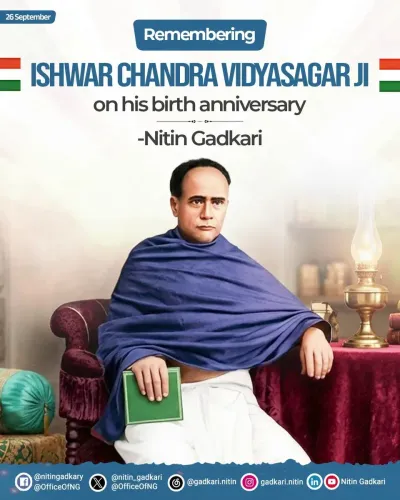
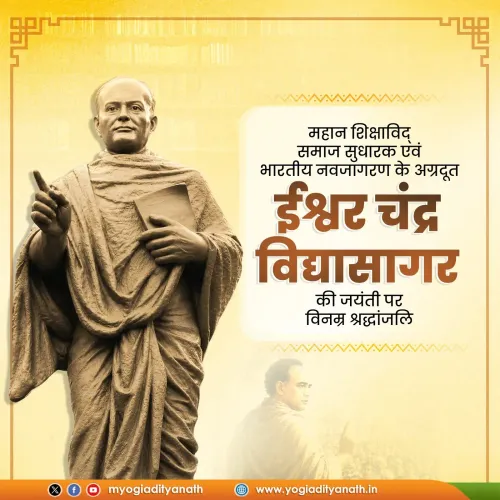
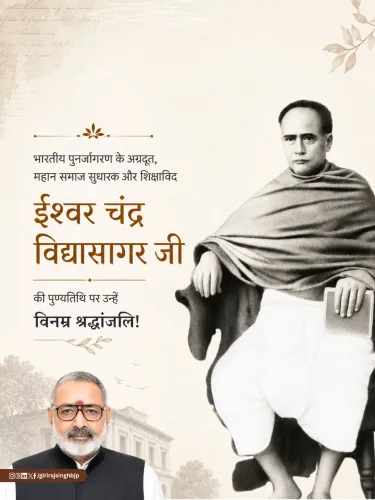
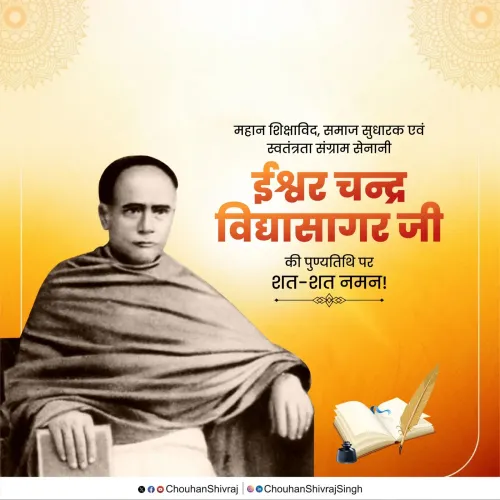
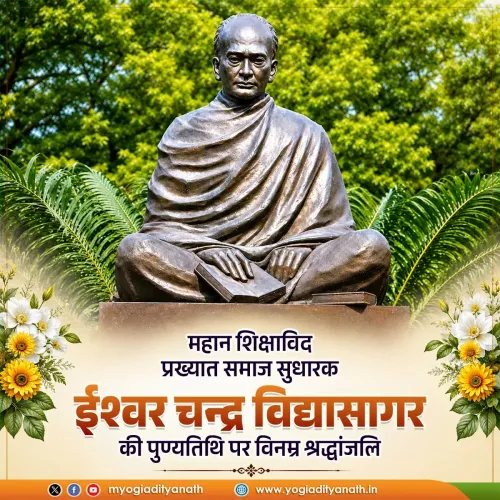
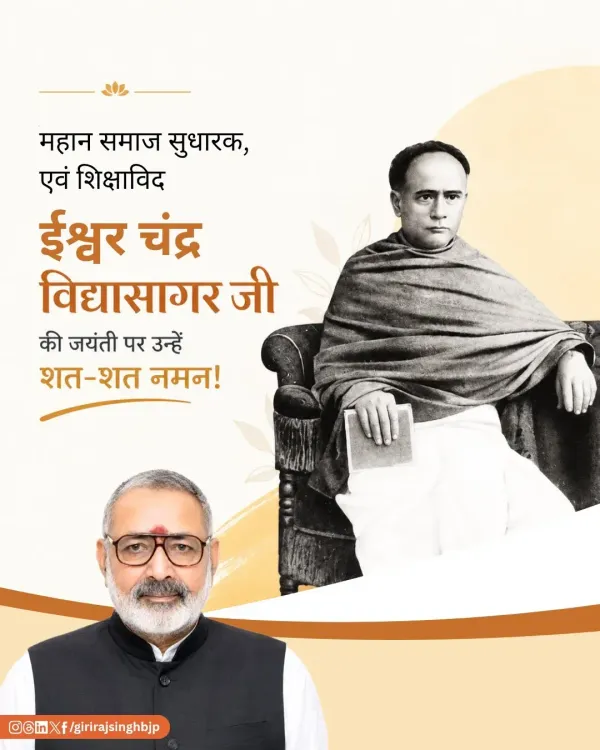
Giriraj Singh pays tribute to Ishwar Chandra Vidyasagar on birth anniversary
Synopsis
Union Textiles Minister Giriraj Singh paid tribute to 19th-century Bengali reformer Ishwar Chandra Vidyasagar on his birth anniversary, honouring his campaigns for women's education and the 1856 Hindu Widows' Remarriage Act.
Key Takeaways
Giriraj Singh posted a birthday tribute to Ishwar Chandra Vidyasagar on 26 September 2026 .
Singh described Vidyasagar as a 'great social reformer, educationist, and standard-bearer of women's empowerment.' Vidyasagar's advocacy directly led to the passage of the Hindu Widows' Remarriage Act, 1856 .
He founded multiple girls' schools in Bengal, laying groundwork for women's literacy in colonial India.
Indian ministers routinely invoke Vidyasagar's legacy to connect historical reform with current gender-equity priorities.
A towering 19th-century reformer who rewrote the rules for India's women gets his annual moment of national remembrance — and Union Textiles Minister Giriraj Singh marked Ishwar Chandra Vidyasagar's birth anniversary on Saturday, 26 September 2026 with a salute to the man who dared to educate daughters in an era that forbade it.
Posting in Hindi on X, Singh offered a tribute to Vidyasagar, describing him as a 'mahan samaj sudharak, shikshavid evam nari sashaktikaran ke dhwajavaahak' — 'a great social reformer, educationist, and standard-bearer of women's empowerment.' He added that Vidyasagar's 'incomparable efforts in the field of women's education and social reform will continue to inspire all of us forever.'
The man behind the 1856 widow remarriage law
Ishwar Chandra Vidyasagar, born in 1820 in Bengal, was among the most consequential social architects of colonial India. A Sanskrit scholar and principal of Sanskrit College, Calcutta, he used both pen and parliament to dismantle practices that caged Indian women. His most landmark achievement: sustained advocacy that led directly to the passage of the Hindu Widows' Remarriage Act of 1856 — a legislative milestone that formally recognised the right of Hindu widows to remarry, shattering a centuries-old taboo.
He also founded dozens of schools for girls across Bengal at a time when female literacy was actively discouraged, embedding the idea that educating a woman educates a generation. His dual assault on custom and illiteracy made him a forerunner of the gender-equality discourse that India's independent republic would later encode into law and policy.
Ministers, anniversaries, and the reformer's recurring relevance
Singh's tribute fits a well-established pattern: Indian ministers across the political spectrum mark the birth anniversaries of 19th-century reformers with public statements that consciously link historical social change to contemporary priorities. Vidyasagar's name surfaces with particular frequency in conversations about girls' schooling and women's welfare — themes that sit at the intersection of cultural memory and active government messaging on gender equity.
For a minister in a government that has staked significant political capital on schemes targeting girls' education and women's economic participation, invoking Vidyasagar is both a gesture of historical reverence and a subtle alignment of present-day policy intent with a legacy the broader public holds in high regard.
Point of View
But Vidyasagar occupies a uniquely charged position in that pantheon — his name carries live political resonance in West Bengal and remains central to debates about cultural ownership of the reform legacy. A BJP minister foregrounding Vidyasagar's contribution to women's empowerment signals an effort to claim shared national heritage beyond regional or party boundaries. It also quietly reinforces the government's messaging on girls' education and women-centric welfare schemes by anchoring contemporary policy intent in a 170-year-old moral tradition. Whether such commemorations translate into fresh programmatic action on women's education remains the test that policy-watchers will apply.
NationPress
26 Sept 2026
Frequently Asked Questions
Who was Ishwar Chandra Vidyasagar?
Ishwar Chandra Vidyasagar was a 19th-century Bengali social reformer, educator, and Sanskrit scholar born in 1820. He is best known for championing widow remarriage and founding schools for girls across Bengal during the colonial era.
What did Vidyasagar do for women's rights in India?
Vidyasagar's sustained advocacy led to the enactment of the Hindu Widows' Remarriage Act in 1856, legally permitting Hindu widows to remarry. He also established numerous girls' schools in Bengal to promote female literacy.
What did Giriraj Singh say about Vidyasagar?
Giriraj Singh described Vidyasagar as a 'great social reformer, educationist, and standard-bearer of women's empowerment,' adding that his efforts in women's education and social reform would continue to inspire generations.
When is Ishwar Chandra Vidyasagar's birth anniversary?
Ishwar Chandra Vidyasagar's birth anniversary falls on 26 September, commemorating his birth in 1820.
What is the Hindu Widows' Remarriage Act 1856?
The Hindu Widows' Remarriage Act of 1856 was a colonial-era legislation passed after Vidyasagar's advocacy, formally recognising the legal right of Hindu widows to remarry — a major breakthrough against prevailing social taboos.