Giriraj Singh backs solar power as India's fix for Africa food security
Synopsis
Union Textiles Minister Giriraj Singh has amplified the idea of solar power as India's answer to food insecurity in Sub-Saharan Africa, sharing an opinion piece via the NaMo App on June 17, 2026, and linking it to India's growing renewable-energy development partnerships with African nations including Uganda.
Key Takeaways
Union Textiles Minister Giriraj Singh shared an article on June 17, 2026 framing solar power as India's formula for African food security.
India's solar-agriculture cooperation with Africa is anchored in commitments made at the India-Africa Forum Summit of 2015 .
The International Solar Alliance , headquartered in Gurugram , has a majority African membership and serves as the institutional backbone for this cooperation.
Uganda has been a key recipient of Indian Lines of Credit for solar-powered irrigation and agro-processing since 2018 .
Indian solar equipment manufacturers and agri-tech exporters are positioned as direct beneficiaries of expanded Africa engagement.
Future ISA Assembly sessions and India-Africa summits are the next milestones to watch for concrete commitments.
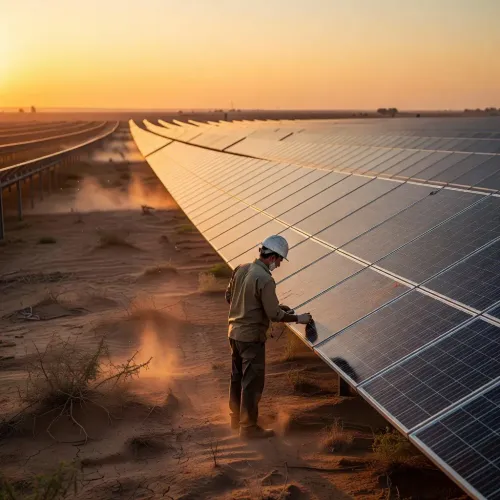
Union Textiles Minister Giriraj Singh on Wednesday, June 17, 2026, shared an opinion piece arguing that solar power holds the key to addressing food security challenges across Sub-Saharan Africa, framing India's renewable energy experience as a replicable model for the continent's smallholder farmers.
Context
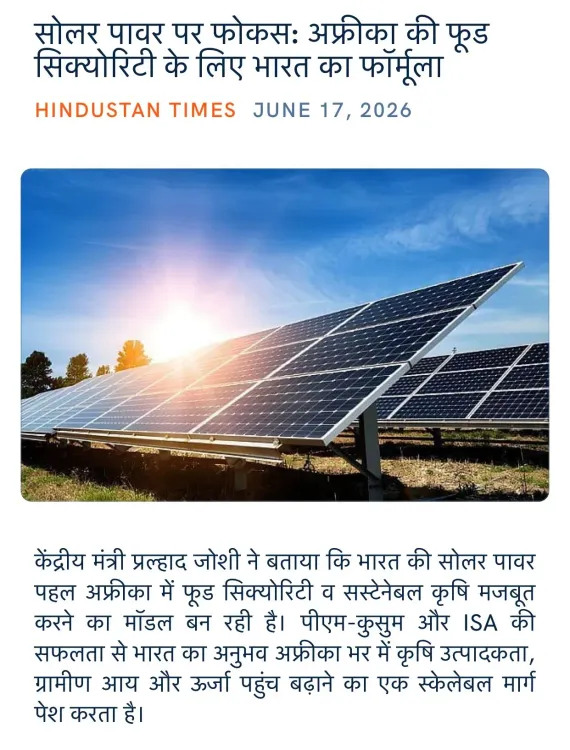
The minister shared the article — headlined 'Solar power par focus: Africa ki food security ke liye Bharat ka formula' (Focus on solar power: India's formula for Africa's food security) — via the NaMo App, amplifying its central argument that India's domestic solar agriculture push offers a transferable blueprint for climate-vulnerable farming systems in Uganda and the broader Sub-Saharan region.
The post arrives as India deepens its development cooperation with African nations, with solar-powered irrigation and agro-processing emerging as flagship areas of engagement. By sharing the piece, Singh signals the ruling establishment's interest in positioning India as a solutions provider, not just a trade partner, for Africa.
Policy Backdrop
India's solar-for-agriculture push in Africa traces its roots to the India-Africa Forum Summit of 2015, which emphasised technology transfer for food security and sustainable agriculture. That same year, the International Solar Alliance (ISA) — an India-led, treaty-based organisation headquartered in Gurugram — was launched with an explicit mandate to mobilise solar finance and projects across member countries, the majority of which are African nations.
Since 2018, Indian Lines of Credit to African nations have expanded significantly, covering solar pumps, mini-grids, and agro-processing units under bilateral mechanisms and the India-UN Development Partnership Fund. Uganda, in particular, has received Indian technical and financial support for solar-powered irrigation and post-harvest infrastructure.
Domestically, India's own experience with solar pumps under schemes such as PM-KISAN and state-level solar irrigation programmes has generated a body of operational knowledge that policymakers now describe as exportable to similarly climate-stressed agricultural economies.
Stakeholders and Impact
The primary beneficiaries envisaged in this model are smallholder farmers in Sub-Saharan Africa, who face compounding pressures from erratic rainfall, limited grid electricity, and post-harvest losses — challenges that solar-powered pumps and cold-storage units are designed to address.
On the Indian side, solar equipment manufacturers and agri-tech exporters stand to gain from expanded African markets, especially as India pushes to diversify its export basket beyond traditional goods. For the International Solar Alliance, a successful India-Africa solar-agriculture corridor would validate the organisation's core mandate and strengthen India's multilateral development credentials ahead of future India-Africa summits.
What's Next
Analysts will watch for concrete follow-up commitments at the next ISA Assembly or a future India-Africa Summit, where solar-agriculture pilots in Uganda and neighbouring countries could be formally announced or scaled. Singh's amplification of the issue through official party channels suggests the government is keen to build a public narrative around India's Africa engagement ahead of any such multilateral moment.
If the model gains traction, it could reshape how India packages its development cooperation — moving from project-by-project lending to a branded, replicable 'Indian formula' that combines affordable solar technology with agricultural productivity, offering New Delhi a stronger soft-power foothold across the continent.
Point of View
Not a casual retweet — it signals that the BJP establishment wants India's Africa solar-agriculture story to gain domestic and diplomatic visibility. The move fits a broader pattern of the Modi government using its ministers as megaphones for India's soft-power narrative, particularly ahead of multilateral gatherings where the 'India as development partner' frame is strategically valuable. For a minister whose core portfolio is textiles, the foray into solar-agriculture diplomacy also underscores how India's Africa engagement is now a whole-of-government talking point rather than the preserve of the External Affairs Ministry. The real test will be whether the rhetoric translates into bankable project announcements at the next ISA Assembly or India-Africa Summit.
NationPress
22 Sept 2026
Frequently Asked Questions
What is India's solar formula for Africa's food security?
India's approach involves deploying solar-powered irrigation pumps, mini-grids, and agro-processing units in African countries — drawing on domestic experience from schemes like PM-KISAN — to help smallholder farmers overcome energy access gaps and reduce post-harvest losses.
What is the International Solar Alliance and how does it relate to Africa?
The International Solar Alliance is an India-led, treaty-based organisation launched in 2015 and headquartered in Gurugram; the majority of its member countries are African nations, making Africa a central focus of its mandate to mobilise solar finance and projects.
Has India funded solar agriculture projects in Uganda?
Yes, Uganda has received Indian Lines of Credit and technical support for solar-powered irrigation and agro-processing projects, part of a broader expansion of Indian concessional finance to Sub-Saharan Africa since 2018.
Why is Giriraj Singh commenting on Africa's food security?
As a senior BJP leader and Union Minister, Giriraj Singh regularly amplifies India's development partnership narrative; his post reflects the government's broader push to position India as a solutions provider for Africa ahead of future India-Africa multilateral events.
What is the India-Africa Forum Summit?
The India-Africa Forum Summit is a multilateral platform that brings together India and African nations; the 2015 edition made key commitments on technology transfer for food security and sustainable agriculture that underpinned subsequent solar cooperation.