Giriraj Singh Hails India as First Major Nation to Industrialise with Solar
Synopsis
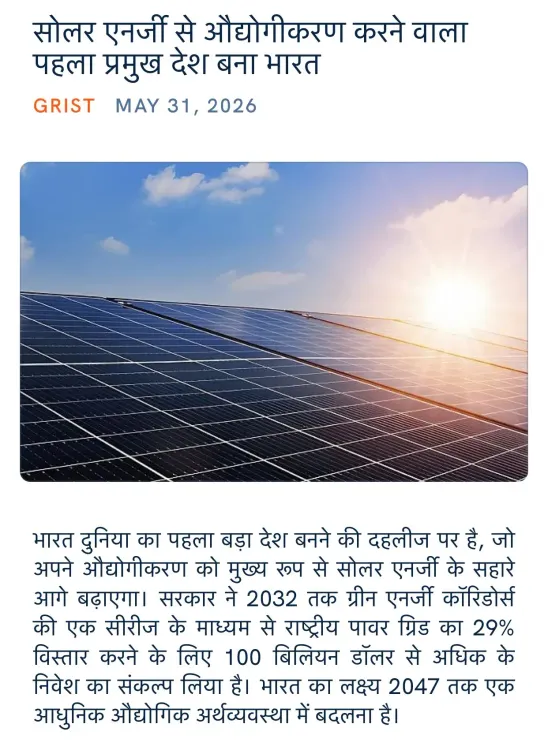
Union Textiles Minister Giriraj Singh on 31 May 2026 highlighted a report claiming India is the first major nation to industrialise with solar energy, citing the country's rapid capacity growth from 2.6 GW in 2014 to over 70 GW, backed by the National Solar Mission, PLI schemes, and a 2030 NDC target of 50 percent non-fossil power.
Key Takeaways
Union Textiles Minister Giriraj Singh shared a report on 31 May 2026 calling India the first major nation to industrialise using solar energy.
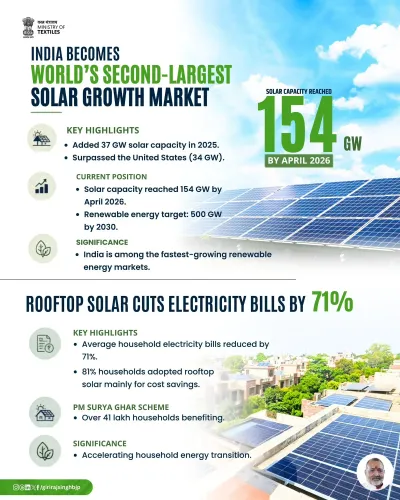
India's solar installed capacity grew from roughly 2.6 GW in 2014 to over 70 GW by early 2024 .
The National Solar Mission (2010) and the PLI scheme for solar PV modules (2021) form the policy backbone of this expansion.
India's updated NDC (2022) targets 50 percent of cumulative electric power from non-fossil sources by 2030 .
The International Solar Alliance , co-founded by PM Modi in 2015 , positions India as a global leader in solar diplomacy.
The solar-industrial narrative has direct implications for energy-intensive sectors like textiles , which could leverage captive solar to cut costs.
Union Textiles Minister Giriraj Singh on Sunday, 31 May 2026, shared a report claiming that India has become the first major nation to pursue industrialisation powered by solar energy, posting the claim via the NaMo App alongside a linked international report.
Context
The minister's post, shared in Hindi, reads: 'Solar energy se audyogikaran karne wala pehla pramukh desh bana Bharat' — 'India has become the first major country to industrialise using solar energy.' The claim references an article from the environment-focused publication Grist, which examined how India's solar expansion is being integrated into its broader industrial growth story.
The post arrives as India's solar installed capacity has grown dramatically — from roughly 2.6 GW in 2014 to over 70 GW by early 2024 — driven by central and state government auctions, falling technology costs, and targeted industrial policy. Singh, who represents Begusarai, Bihar in the Lok Sabha, frequently uses social media to amplify government achievements in infrastructure and energy.
Policy Backdrop
India's solar ambitions trace back to the National Solar Mission, launched in 2010 under the National Action Plan on Climate Change, which initially targeted 20 GW of solar capacity by 2022 before being revised sharply upward. The government followed this with the Production Linked Incentive (PLI) scheme for high-efficiency solar photovoltaic modules, announced in 2021, to build a domestic manufacturing base and reduce import dependence.
India also updated its Nationally Determined Contribution (NDC) in 2022, committing to sourcing 50 percent of cumulative electric power from non-fossil fuel sources by 2030. On the global stage, Prime Minister Narendra Modi co-founded the International Solar Alliance (ISA) in 2015, a treaty-based body designed to mobilise solar investment among sunshine-rich nations.
The framing of solar as an industrial driver — rather than merely a climate measure — has gained traction under the Atmanirbhar Bharat and Make in India initiatives, which position domestic renewable manufacturing as a strategic economic priority.
Stakeholders and Impact
The solar industrialisation narrative carries direct relevance for energy-intensive sectors, including textiles — the very portfolio Singh oversees. Textile manufacturing units, which consume significant power for spinning, weaving, and processing, stand to benefit from captive and rooftop solar installations that lower input costs and reduce carbon footprints.
Renewable energy manufacturers and solar module producers are among the primary stakeholders watching PLI scheme disbursements and capacity utilisation figures. For industrial consumers, the integration of solar into factory operations represents both a cost-reduction lever and a compliance advantage as green supply-chain requirements from global buyers intensify.
What's Next
Analysts and industry bodies will track progress reports on the PLI scheme for solar manufacturing and any new green-energy provisions in the next Union Budget. With COP31 on the horizon, India's ability to demonstrate that solar is genuinely powering its industrial base — and not just its grid — will be closely scrutinised by international partners and climate observers alike.
If the trend holds, India's model of coupling renewable energy targets with domestic manufacturing incentives could serve as a template for other emerging economies seeking to industrialise without deepening fossil fuel dependence.
Point of View
Linking India's renewable energy credentials to its industrial ambitions at a moment when green supply-chain compliance is becoming a trade-policy variable. By sharing this as Textiles Minister, Singh implicitly signals that solar integration is relevant not just to power utilities but to manufacturing sectors under his own watch. The move fits a broader BJP pattern of framing climate action as economic nationalism — Atmanirbhar Bharat and net-zero goals presented as two sides of the same coin. As COP31 approaches, such messaging serves a dual audience: domestic industry and international partners evaluating India's green-transition credibility.
NationPress
19 Sept 2026
Frequently Asked Questions
Is India really the first major country to industrialise with solar energy?
The claim originates in an international environment report shared by Minister Giriraj Singh; it refers to India's distinctive combination of rapid solar capacity addition and simultaneous industrial growth, though independent verification of the 'first major nation' ranking requires scrutiny of the original report's methodology.
How much solar capacity does India have?
India's solar installed capacity grew from roughly 2.6 GW in 2014 to over 70 GW by early 2024 , driven by government auctions, the National Solar Mission, and falling technology costs.
What is India's 2030 renewable energy target?
India's updated Nationally Determined Contribution, submitted in 2022 , targets sourcing 50 percent of cumulative electric power from non-fossil fuel sources by 2030 .
What is the PLI scheme for solar modules?
The Production Linked Incentive (PLI) scheme for high-efficiency solar photovoltaic modules, announced in 2021 , provides financial incentives to domestic manufacturers to build India's solar module production capacity and reduce import dependence.
What is the International Solar Alliance?
The International Solar Alliance (ISA) is an India-led, treaty-based international organisation co-founded by PM Narendra Modi in 2015 to mobilise solar energy investments and technology among sunshine-rich member countries.