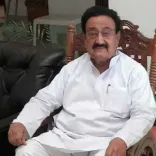
Giriraj Singh Highlights Gujarat's Solar Energy Success Story
Synopsis
Union Textiles Minister Giriraj Singh amplified Gujarat's solar energy success story via the NaMo App on 23 May 2026, spotlighting the state's decade-long leadership in India's renewable energy push and its role as a policy model for the country's 500 GW clean energy target by 2030.
Key Takeaways
Giriraj Singh shared content on 23 May 2026 via the NaMo App highlighting Gujarat 's solar energy leadership.
Gujarat introduced its Solar Power Policy in 2009 , among the earliest state-level renewable energy frameworks in India.
The Jawaharlal Nehru National Solar Mission , launched in 2010 , set an initial target of 20 GW solar capacity, later revised to 100 GW by 2015 .
Gujarat's Charanka Solar Park was one of India's first large-scale utility solar installations and became a national model.
India's current renewable energy target stands at 500 GW of non-fossil capacity by 2030 .
The post was amplified through the NaMo App , linking Gujarat's energy record to PM Narendra Modi 's governance legacy.
Union Textiles Minister Giriraj Singh on Saturday, 23 May 2026, shared an article via the NaMo App praising Gujarat's role as the trailblazer of India's solar energy revolution, calling attention to how the western state wrote the rulebook for the country's renewable energy journey.
Context
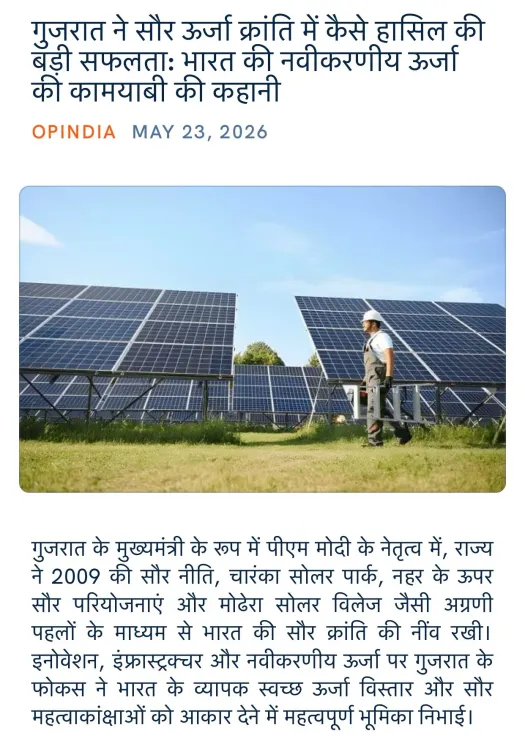
The minister shared a piece headlined — translated from Hindi — 'How Gujarat achieved a major success in the solar energy revolution: The story of India's renewable energy triumph.' The post was amplified through the NaMo App, the digital platform associated with Prime Minister Narendra Modi, signalling the BJP's continued effort to highlight Gujarat's developmental record as a model for national policy.
Gujarat has long been positioned by the BJP as a governance benchmark, and its early adoption of solar energy is a key pillar of that narrative. The state's solar journey predates the central government's own large-scale push, making it a frequently cited case study in India's clean energy discourse.
Policy Backdrop
Gujarat introduced its Solar Power Policy in 2009, one of the earliest state-level frameworks in India offering structured incentives to solar developers. This preceded the Centre's Jawaharlal Nehru National Solar Mission, launched in 2010 with an initial target of 20 GW of solar capacity by 2022 — a target that was later scaled up to 100 GW in 2015.
Gujarat's Charanka Solar Park became one of the earliest and largest utility-scale solar installations in the country, attracting domestic and international investment and demonstrating that large-scale solar generation was commercially viable in Indian conditions. The state's approach — combining land aggregation, grid connectivity, and tariff incentives — became a template replicated by other states.
India has since set an ambitious target of 500 GW of non-fossil fuel capacity by 2030, a commitment tied to its international climate obligations. Gujarat's early-mover advantage gave it a structural head start in contributing to this national goal.
Stakeholders and Impact
The primary beneficiaries of Gujarat's solar push have been renewable energy developers, state power utilities, and industrial consumers seeking affordable and stable electricity. The state's competitive tariff-based bidding rounds attracted private capital and helped drive down the cost of solar power across India.
For the broader BJP political ecosystem, Gujarat's energy record is also a statement about the governance legacy of Narendra Modi, who served as Gujarat Chief Minister from 2001 to 2014 and championed the state's renewable energy policies before bringing a similar orientation to the Centre. Giriraj Singh's amplification of this narrative through the NaMo App reinforces that political messaging ahead of ongoing policy debates around energy transition and industrial competitiveness.
What's Next
India's renewable energy sector is approaching a critical phase as the 2030 non-fossil capacity target of 500 GW draws closer. State-level updates on solar capacity additions, new central incentive schemes, and fresh bidding rounds will determine how evenly the growth is distributed across states.
Gujarat's continued leadership — or any challenge to it from fast-growing states — will be closely watched by developers and policymakers alike. Giriraj Singh's post signals that the BJP intends to keep Gujarat's solar story prominent in its political and policy communication as India navigates its energy transition.
Point of View
And by extension Narendra Modi's chief ministerial legacy, visible in public discourse. The amplification through a party-aligned digital platform signals a deliberate effort to tie India's renewable energy achievements to BJP governance ahead of continued debates on energy transition. It fits a broader pattern in which senior BJP ministers use social media to reinforce state-level success stories as evidence of the party's long-term policy vision. The post adds no new data but serves as a reminder that India's solar story, for the ruling party, begins and ends in Gujarat.
NationPress
21 Oct 2026
Frequently Asked Questions
Why is Gujarat considered a leader in India's solar energy sector?
Gujarat introduced one of India's earliest state solar policies in 2009 and developed the Charanka Solar Park, establishing itself as a benchmark for large-scale solar deployment before the central government's own missions scaled up.
What is the NaMo App and why did Giriraj Singh use it to share this post?
The NaMo App is a digital platform associated with Prime Minister Narendra Modi and the BJP ecosystem; senior party leaders use it to amplify content aligned with the party's governance narrative.
What is India's 2030 renewable energy target?
India has set a target of 500 GW of non-fossil fuel-based electricity capacity by 2030, a commitment made as part of its international climate obligations.
What was the Jawaharlal Nehru National Solar Mission?
The Jawaharlal Nehru National Solar Mission was a flagship central scheme launched in 2010 with an initial target of 20 GW solar capacity by 2022, later revised upward to 100 GW.
What is Giriraj Singh's current role in the Union Cabinet?
Giriraj Singh serves as Union Minister of Textiles in the Indian government and is a senior BJP leader and Lok Sabha MP from Begusarai, Bihar.