Giriraj Singh Hails India's Renewable Energy Revolution

Synopsis
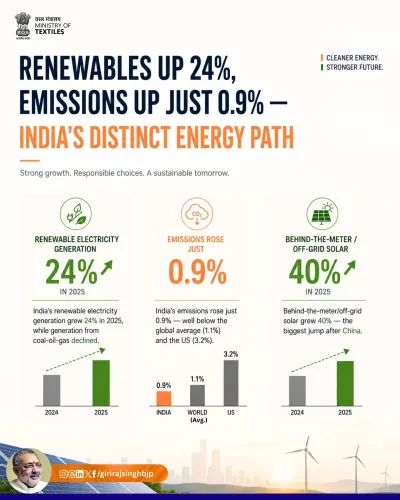
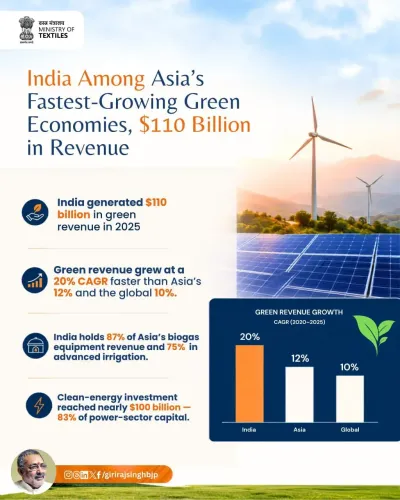
Union Textiles Minister Giriraj Singh on 24 May 2026 shared content describing India as leading the world's renewable energy revolution, amplifying BJP messaging on India's clean energy ambitions and its Panchamrit commitments ahead of COP30.
Key Takeaways
Giriraj Singh , Union Textiles Minister and senior BJP leader, shared a post on 24 May 2026 hailing India's renewable energy leadership.
India's Panchamrit commitments at COP26 in 2021 include achieving 500 GW of non-fossil fuel capacity by 2030 and net-zero by 2070 .
The National Solar Mission , launched in 2010 , originally targeted 20 GW of solar power by 2022 before being revised upward.
India co-founded the International Solar Alliance in 2015 to accelerate global solar deployment among solar-resource-rich nations.
The post was shared via the NaMo App , consistent with BJP ministers' use of the platform to amplify party messaging on climate and energy.
Progress on the 500 GW target will be closely watched ahead of COP30 as a test of India's climate commitments.
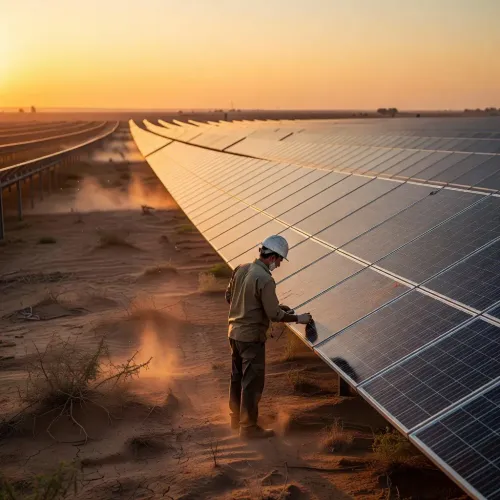
Union Textiles Minister Giriraj Singh on Sunday, 24 May 2026, shared a piece on India's renewable energy journey, describing the country as leading the world toward a sustainable future. The post, shared via the NaMo App, was accompanied by an image and linked to an article titled 'Bharat ki Renewable Energy Kranti: Sustainable Future ki or Duniya ki Aguwai' ('India's Renewable Energy Revolution: Leading the World Towards a Sustainable Future').
Context
Singh's post amplifies a narrative that senior BJP leaders have consistently advanced — that India under Prime Minister Narendra Modi has emerged as a global standard-bearer on clean energy. The headline he shared translates directly to a claim of international leadership in the renewable transition, framing India's domestic energy expansion as a contribution to the world's climate goals.
The post is part of a broader pattern of BJP ministers using the NaMo App and social media to circulate content on India's energy and climate credentials, particularly as the country approaches key international climate milestones.
Policy Backdrop
India's renewable energy ambitions have been built over more than a decade of policy commitments. The National Solar Mission, launched in 2010, set an initial target of 20 GW of solar capacity by 2022 — a figure that was subsequently revised sharply upward as the sector grew faster than anticipated.
At COP26 in 2021, India announced its Panchamrit commitments, including achieving 500 GW of non-fossil fuel-based power capacity by 2030 and reaching net-zero emissions by 2070. India also co-founded the International Solar Alliance in 2015 alongside France, a multilateral body designed to accelerate solar deployment among solar-resource-rich nations.
These commitments are anchored in India's obligations under the Paris Agreement and have been presented by successive administrations as both an industrial-policy imperative and a statement of climate leadership on the world stage.
Stakeholders and Impact
The renewable energy sector's rapid expansion has created significant interests across the economy. Renewable energy developers and solar manufacturers — including a growing domestic manufacturing base supported by production-linked incentive schemes — stand to benefit directly from continued policy momentum.
For ordinary consumers and state electricity distribution companies, the transition carries implications for tariff structures, grid stability, and energy security. India's large population and rising electricity demand make the pace and affordability of the renewable build-out a matter of broad public interest, not merely an environmental one.
What's Next
Attention will now turn to India's progress reports on the 500 GW non-fossil fuel capacity target as the country moves toward COP30. The Ministry of New and Renewable Energy is expected to release periodic capacity-addition updates that will test whether India's actual installation trajectory matches the ambition set at Glasgow.
With senior ministers actively amplifying the renewable energy message, the political signalling ahead of international climate forums suggests the government intends to keep India's clean energy story at the centre of its global diplomatic identity.
Point of View
' the minister is contributing to a carefully constructed diplomatic narrative that serves both domestic and international audiences. The timing, as India approaches COP30 reporting cycles, is unlikely to be coincidental. It reflects a broader party strategy of keeping the renewable energy story visible through ministerial amplification, even when the minister's own portfolio — textiles — is tangential to the subject.
NationPress
27 Oct 2026
Frequently Asked Questions
What did Giriraj Singh post about renewable energy?
On 24 May 2026, Union Textiles Minister Giriraj Singh shared a post via the NaMo App linking to an article titled 'India's Renewable Energy Revolution: Leading the World Towards a Sustainable Future,' describing India as a global leader in clean energy.
What is India's 500 GW renewable energy target?
India committed at COP26 in 2021, as part of its Panchamrit pledges, to achieve 500 GW of non-fossil fuel-based power generation capacity by 2030, a target that underpins its Paris Agreement obligations.
What is the Panchamrit strategy?
Panchamrit refers to India's five-point climate commitment announced at COP26 in Glasgow in 2021, which includes the 500 GW non-fossil capacity target, net-zero emissions by 2070, and other decarbonisation goals.
What is the International Solar Alliance?
The International Solar Alliance is a multilateral organisation co-founded by India and France in 2015 to promote solar energy deployment among countries with abundant solar resources, now with over 100 member nations.
Why is Giriraj Singh posting about renewable energy when he is the Textiles Minister?
Senior BJP ministers frequently share content on national-priority themes such as clean energy and climate leadership as part of coordinated party messaging, regardless of their specific portfolio responsibilities.