Giriraj Singh flags India's solar cell capacity nearing 100 GW
Synopsis
Union Textiles Minister Giriraj Singh shared an MNRE Secretary projection that India's solar cell capacity could cross 100 GW within a year, with wafer and ingot capacity targeted at 80 GW by June 2028 — marking a potential turning point in India's push to reduce solar import dependence.
Key Takeaways
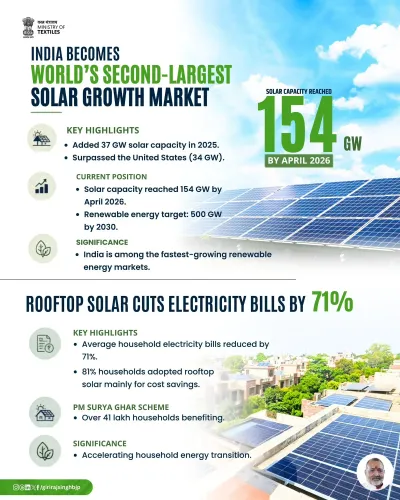
Union Textiles Minister Giriraj Singh shared the MNRE Secretary's projection on August 8, 2026 .
India's solar cell manufacturing capacity is projected to cross 100 GW within one year , per the MNRE Secretary.
Wafer and ingot manufacturing capacity is targeted at 80 GW by June 2028 .
India's original 100 GW installed solar generation target (set for 2022) was later superseded by a 500 GW non-fossil fuel goal by 2030 announced at COP26.
The push for domestic solar cell manufacturing is driven by a strategic need to reduce dependence on imported cells, largely from China .
Specific capacity timelines cited are projections from the MNRE Secretary and have not been independently verified.
India's solar manufacturing ambitions are approaching a landmark moment. Union Textiles Minister Giriraj Singh on Saturday, August 8, 2026, shared a report citing the Ministry of New and Renewable Energy (MNRE) Secretary's projection that India's solar cell manufacturing capacity is expected to cross 100 GW within a year — a milestone that would signal a fundamental shift in the country's clean energy supply chain.
From import dependence to domestic powerhouse
For years, India's solar rollout ran on a paradox: the country was racing to add green energy capacity while remaining heavily reliant on imported cells and modules, predominantly from China. That vulnerability shaped policy. The government pushed domestic manufacturing through production-linked incentives and local content mandates, betting that a homegrown supply chain was not just an economic goal but a strategic necessity.
The MNRE Secretary's projection — solar cell capacity hitting 100 GW in roughly a year, with wafer and ingot capacity targeted at 80 GW by June 2028 — suggests those bets are beginning to pay off. Cell and wafer manufacturing represent the deeper, more technically demanding links in the solar value chain, well beyond the assembly-level work India has historically dominated.
The 100 GW target that kept moving
Context matters here. India originally set a 100 GW installed solar power generation target for 2022 under the National Solar Mission. That deadline slipped. Then, at COP26 in 2021, Prime Minister Modi announced a far more ambitious goal: 500 GW of non-fossil fuel capacity by 2030. Hitting that requires not just building more solar farms, but ensuring India can manufacture the hardware to fill them — without being held hostage to global supply chains or geopolitical friction.
A domestic cell capacity of 100 GW would directly address that vulnerability. Solar manufacturers and renewable energy developers stand to gain the most — reduced import costs, greater supply certainty, and a stronger negotiating position in global clean energy markets.
Why a Textiles Minister is amplifying this
Giriraj Singh's portfolio is textiles, not energy — yet his signal-boost of this projection fits a pattern among senior BJP leaders of championing India's manufacturing resurgence across sectors. The post, shared via the NaMo App, underscores how the ruling party frames industrial capacity milestones as part of a unified national growth narrative.
The road from projection to reality will be watched closely. MNRE's targets have historically been aspirational; execution has often lagged. But if the 100 GW cell capacity mark is achieved on the timeline the Secretary has outlined, India's position in the global solar manufacturing hierarchy changes — not incrementally, but structurally.
Point of View
If achieved, would represent a qualitative leap: India moving from downstream assembly to upstream manufacturing in the solar value chain. That shift directly serves the 2030 non-fossil target, but it also reduces a strategic exposure that policymakers have long flagged. The gap between MNRE projections and on-ground delivery will be the real test — and the one the opposition and industry analysts will scrutinise most closely.
NationPress
22 Sept 2026
Frequently Asked Questions
What is India's solar cell manufacturing capacity target?
The MNRE Secretary has projected that India's solar cell manufacturing capacity will cross 100 GW within one year from mid-2026, signalling rapid expansion of domestic production.
What is the wafer and ingot capacity target for India?
India is targeting solar wafer and ingot manufacturing capacity of 80 GW by June 2028 , representing deeper integration into the solar value chain beyond cell assembly.
Why is India pushing domestic solar manufacturing?
India has historically depended heavily on imported solar cells and modules, particularly from China. Building domestic capacity reduces supply-chain vulnerability and supports the country's 500 GW non-fossil fuel target by 2030 .
What is India's overall renewable energy target?
At COP26 in 2021 , Prime Minister Modi announced a target of 500 GW of non-fossil fuel energy capacity by 2030 , a significant expansion of India's earlier 100 GW solar goal under the National Solar Mission.
Why did Giriraj Singh share a solar energy update?
Although Giriraj Singh is the Union Textiles Minister, senior BJP leaders frequently share manufacturing and infrastructure milestones as part of the government's broader 'Make in India' and energy self-reliance narrative.