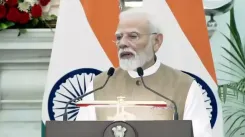
Giriraj Singh: This fight is for India's identity, not power
Synopsis
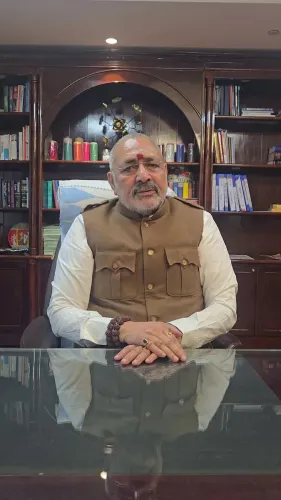
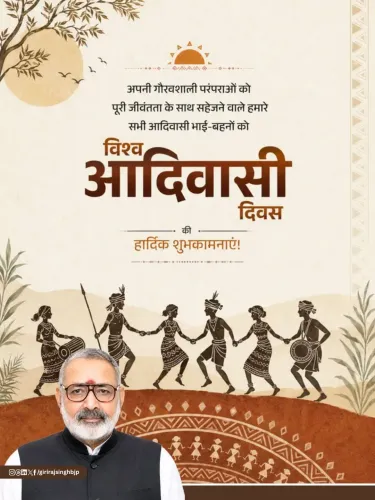
Union Textiles Minister Giriraj Singh declared on X that India's political struggle is not about power but about protecting the country's identity, pride, and Sanatan Dharma, calling unity the only answer to forces he says seek to divide the nation.
Key Takeaways
Union Textiles Minister Giriraj Singh posted on X on 22 October 2026 in Hindi, framing the current political contest as a fight for India's cultural and civilisational identity.
He invoked Sanatan Dharma and asmita (national pride) as the core values at stake, explicitly stating the struggle is 'not about power'.
Singh called unity ( ekjutata ) the sole answer to what he described as conspiracies to divide and weaken India.
The rhetoric aligns with BJP 's long-standing communications strategy, rooted in cultural nationalism, dating back to its 2014 general election campaign.
Singh is a senior BJP leader and Lok Sabha MP from Begusarai, Bihar , with a consistent record of commenting on national identity issues.
India's cultural identity, not electoral arithmetic, is the real battleground — that is the argument Union Textiles Minister Giriraj Singh put squarely before the country on Thursday, 22 October 2026, in a sharply worded post on X that drew a clear line between civilisational duty and the pursuit of office.
Posting in Hindi, Singh wrote: 'यह लड़ाई सत्ता की नहीं, बल्कि भारत की पहचान, अस्मिता और सनातन की रक्षा की लड़ाई है।' — 'This fight is not about power, but about protecting India's identity, pride, and Sanatan [Dharma].' He added that unity alone is the answer to what he described as conspiracies aimed at dividing and weakening the country.
Sanatan as a political rallying cry
The framing is deliberate and deeply familiar in BJP communications. Since the party's landmark 2014 general election campaign, senior leaders have consistently cast political contests not as contests over governance programmes but as struggles over civilisational continuity — asmita (pride or self-respect) and Sanatan Dharma (the eternal Hindu order) serving as the twin anchors of that narrative.
Singh, a Lok Sabha MP from Begusarai, Bihar, has been among the most consistent voices on this theme within the Union Cabinet. His invocation of 'conspiracies to divide India' signals the party's standard counter-framing against opponents who, in the BJP's telling, mobilise caste, regional, and religious identities to fragment the national fabric.
Unity against division: the message behind the post
The second half of Singh's post carries the prescriptive punch: 'एकजुटता' — unity — is the only adequate response to those alleged designs. That word choice places the remedy with ordinary citizens and party workers as much as with leaders, a rhetorical move that turns a political statement into a call to collective action.
The precise political moment that prompted the post on 22 October 2026 has not been independently confirmed, but the language tracks closely with stances BJP leaders have taken ahead of state elections and during periods of heightened inter-community tension — periods when cultural-nationalist messaging tends to get amplified across the party's communication channels.
When a Cabinet minister frames a political struggle in terms of protecting an ancient civilisation rather than winning seats, the subtext is as important as the text: voters are being asked to see the upcoming political contest as something far larger than a ballot. That is an old argument — but in Singh's hands, it still lands with conviction.
Point of View
' he pre-empts the charge that the party is merely seeking votes, repositioning the BJP as a guardian movement rather than a political machine. The invocation of 'conspiracies to divide India' is a recurring BJP device that simultaneously delegitimises opposition coalition-building and consolidates the party's Hindu-majority base. Whether the framing sharpens or blunts in coming weeks will depend on what specific political trigger — a state election, a flashpoint, a policy moment — eventually emerges to contextualise it.
NationPress
22 Oct 2026
Frequently Asked Questions
What did Giriraj Singh say in his October 2026 X post?
Singh wrote in Hindi that the current fight is not about political power but about protecting India's identity, pride, and Sanatan Dharma, and that unity is the only answer to forces trying to divide and weaken the country.
Who is Giriraj Singh?
Giriraj Singh is India's Union Minister of Textiles, a senior BJP leader, and a Lok Sabha Member of Parliament from Begusarai in Bihar. He is known for frequently commenting on cultural and national identity issues.
What does Sanatan Dharma mean in the context of BJP politics?
In BJP political discourse, Sanatan Dharma refers to the eternal Hindu religious and civilisational order. Party leaders regularly invoke it to frame political contests as struggles for the preservation of India's Hindu cultural heritage.
Is the BJP's use of cultural-identity messaging a new development?
No. The BJP has framed political competition in terms of cultural and civilisational preservation since at least its landmark 2014 general election campaign, making it a consistent pillar of the party's communications strategy.
What does Giriraj Singh mean by 'conspiracies to divide India'?
In BJP rhetoric, this phrase typically refers to alleged opposition efforts to mobilise voters along caste, regional, or religious lines in ways the party says fragment national unity. Singh did not name specific actors in this post.