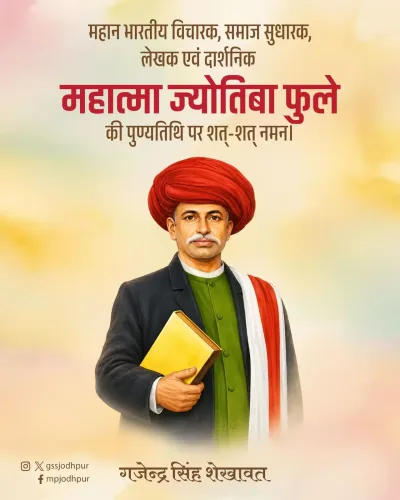
Textiles Minister Giriraj Singh tributes Jyotiba Phule
Synopsis
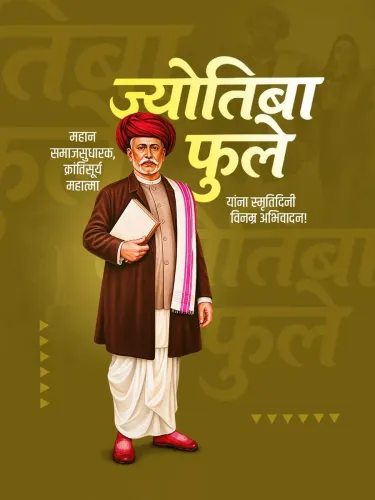
Union Textiles Minister Giriraj Singh paid tribute to Mahatma Jyotiba Phule on his death anniversary, saluting the Maharashtra reformer's work for social equality, education and women's empowerment. Phule founded the Satyashodhak Samaj and helped open girls' schooling in 19th-century Pune.
Key Takeaways
Union Textiles Minister Giriraj Singh paid tribute to Mahatma Jyotiba Phule on his death anniversary.
Singh said Phule's ideas on education, equality and women's empowerment would always inspire society.
Phule was a 19th-century Maharashtra reformer who helped open girls' schooling in Pune in 1848.
He founded the Satyashodhak Samaj in 1873 to challenge caste hierarchy.
Phule died on 28 November 1890; leaders across parties mark the date each year.
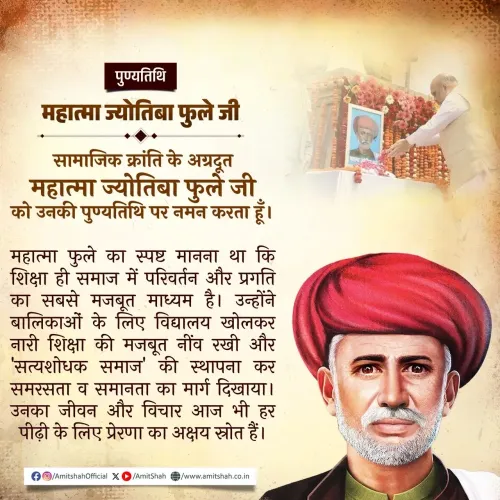
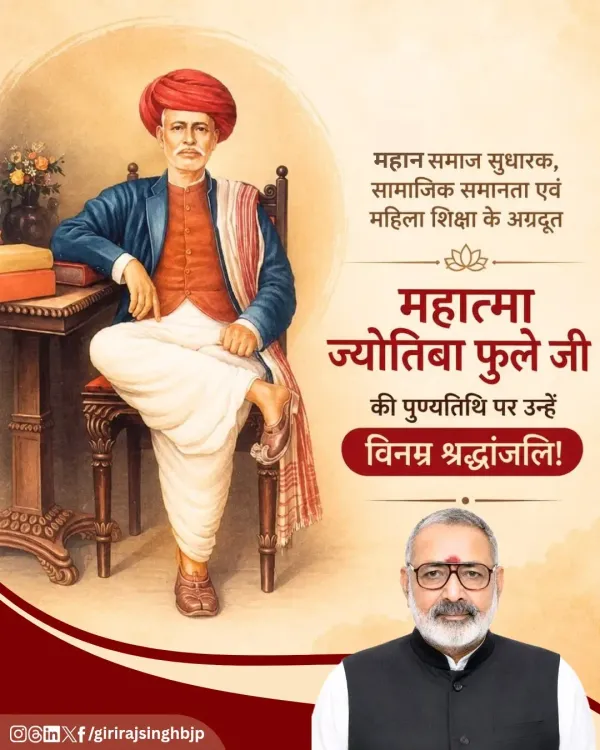
A death anniversary still pulls India's political calendar. On the punyatithi of Maharashtra's 19th-century social reformer, Union Textiles Minister Giriraj Singh offered countless salutations to Mahatma Jyotiba Phule, pioneer of social equality and women's education. The senior BJP leader and Lok Sabha MP from Begusarai marked the day on Saturday with a public tribute.
Writing in Hindi, Singh paid koti-koti naman (countless salutations) and a humble shraddhanjali. 'On the punyatithi of the great social reformer, the pioneer of social equality and women's education, Mahatma Jyotiba Phule, I offer countless salutations and humble tributes,' he wrote. His thoughts and contribution in education, equality and women's empowerment, Singh added, would always continue to inspire society.
The Pune schoolhouse and Satyashodhak Samaj
Phule, born in 1827 in present-day Maharashtra, is remembered for opening formal learning to girls and to communities then shut out of the classroom. With Savitribai Phule, he helped start a girls' school in Pune in 1848, a direct challenge to the social order of the colonial-era Deccan.
In 1873 he founded the Satyashodhak Samaj, which campaigned against caste hierarchy and for the dignity of labouring communities. Those two threads — the schoolhouse and the anti-caste association — explain why his name returns every 28 November, the day of his death in 1890.
Why 28 November still draws political tributes
Leaders across parties routinely issue messages on Phule's death anniversary, treating it as public recognition of colonial-period advocates of education and equality. Singh's note sits in that annual pattern, linking a 19th-century campaign to the contemporary language of women's empowerment.
The reformer's fight was local and concrete: a classroom door in Pune, a samaj that named caste as the problem. The tributes that follow, year after year, keep that door in the national frame.
Point of View
A way for leaders to claim lineage with 19th-century social reform. Giriraj Singh's message follows that script, folding Phule's school and anti-caste campaigns into today's vocabulary of women's empowerment. The political utility is obvious, yet the historical core remains specific: a Pune classroom in 1848 and a samaj that named caste as the problem. How far current education and equality debates still track that original fight is the sharper question the anniversary keeps raising.
NationPress
28 Nov 2026
Frequently Asked Questions
When is Mahatma Jyotiba Phule's punyatithi?
Mahatma Jyotiba Phule's death anniversary is observed on 28 November. He died in 1890, and political leaders across parties routinely issue tributes on this date.
Who was Jyotiba Phule?
Jyotiba Phule was a 19th-century social reformer from Maharashtra. He campaigned for the education of women and lower-caste communities and founded the Satyashodhak Samaj in 1873.
What did Giriraj Singh say on Jyotiba Phule's death anniversary?
Union Textiles Minister Giriraj Singh offered countless salutations and a humble tribute to Mahatma Jyotiba Phule. He said Phule's thoughts on education, equality and women's empowerment would always inspire society.
Why is Jyotiba Phule linked to women's education in India?
Phule, with Savitribai Phule, helped open a girls' school in Pune in 1848. That effort is widely cited as a pioneering step in women's education in the subcontinent.
What is the Satyashodhak Samaj?
The Satyashodhak Samaj is a social reform organisation founded by Jyotiba Phule in 1873. It campaigned against caste hierarchy and for the rights of oppressed communities.