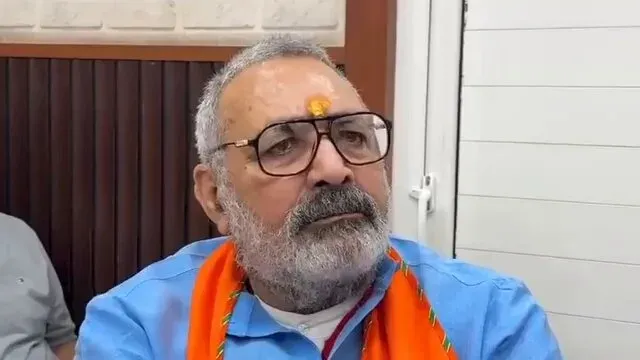
Giriraj Singh warns against using students to destabilise India
Synopsis
Union Textiles Minister Giriraj Singh on 25 July 2026 accused unnamed opposition groups of conspiring to exploit students to destabilise India, drawing parallels with political upheaval in Bangladesh and Nepal, while defending PM Modi's record on student welfare.
Key Takeaways
Giriraj Singh posted on 25 July 2026 accusing opposition actors of plotting to use students to 'destroy the country.' He explicitly compared the alleged destabilisation attempt to recent political upheaval in Bangladesh and Nepal .
Singh stated that Prime Minister Narendra Modi is 'fully sensitive' to students' futures and will continue working in their interest.
The BJP has framed the National Education Policy 2020 as a flagship structural reform benefiting Indian students.
The post continues the BJP's established narrative of portraying opposition parties as exploiting student grievances for political gain rather than offering solutions.
Parliamentary discussions on education budgets and student welfare measures in the upcoming session will be a key indicator of follow-through.
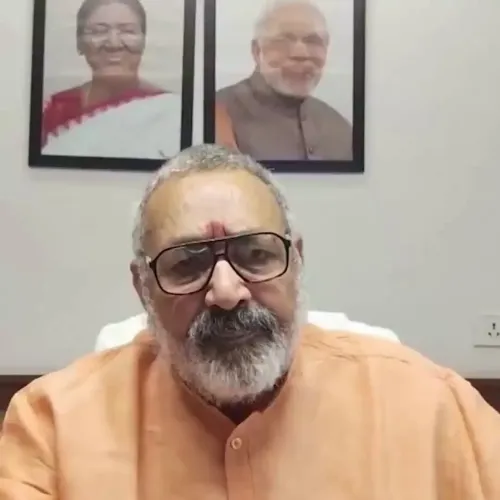
Union Textiles Minister Giriraj Singh on Saturday, 25 July 2026, sharply attacked opposition groups, accusing them of plotting to use students as instruments to create political chaos in India akin to recent upheavals in Bangladesh and Nepal. The senior BJP leader, posting on X, defended Prime Minister Narendra Modi as genuinely committed to student welfare and pledged that such destabilisation attempts would no longer succeed.
Context
In his post, Giriraj Singh wrote in Hindi: 'Chhātron ke kandhe par bandūk rakhkar desh ko tabāh karne kā shaḍyantra ab nahīn chalega' — translated as, 'The conspiracy to destroy the country by placing a gun on the shoulders of students will no longer work.' He directly accused unnamed political actors of seeking to spread the kind of anarchy seen in Bangladesh and Nepal across India, while asserting that those making such attempts had 'never offered any solution' to genuine student concerns.
The post comes amid a broader political climate in which student grievances — over employment, education access, and competitive examinations — have periodically surfaced as flashpoints. While the specific trigger for this July 2026 statement could not be independently verified, the language and framing indicate a response to some form of student-linked political mobilisation.
Policy Backdrop
Bangladesh witnessed major political upheaval in 2024 when student-led protests against government job quota policies escalated into a nationwide movement that destabilised the ruling establishment. Singh's invocation of that episode signals the BJP's intent to frame any comparable student agitation in India as externally inspired or politically manipulated rather than organically driven.
On the domestic policy front, the government has pointed to the National Education Policy (NEP) 2020 as a landmark structural reform aimed at expanding access, equity, and future opportunities for Indian students. Singh reiterated that Prime Minister Modi is 'fully sensitive' to students' futures and is 'continuously working and will continue to work' in their interest — a formulation that positions the government as the credible custodian of youth aspirations.
Stakeholders and Impact
Students form one of the largest and most politically consequential demographic blocs in India, and their mobilisation has historically shaped electoral outcomes. By characterising opposition efforts as exploitative — using students as a 'gun on the shoulder' — Singh is attempting to pre-empt narratives that could galvanise youth discontent ahead of any upcoming electoral cycle.
Opposition parties are implicitly cast as the antagonists in Singh's framing, accused of importing instability rather than offering constructive policy alternatives. This positions the BJP as the party of governance and solutions, contrasting with what Singh describes as a purely disruptive agenda from rivals who have 'never given any solution.'
What's Next
Parliamentary discussions on education budget allocations and new student welfare measures in the upcoming session will be closely watched to see whether the government backs its rhetoric with fresh policy action. Any student-linked political activity in the coming weeks is likely to be met with similar pushback from senior BJP leaders, reinforcing the party's counter-narrative. The invocation of the Bangladesh precedent suggests the government is prepared to frame domestic student unrest, should it materialise, as a law-and-order and national-security concern rather than a purely educational one.
Point of View
Deploying the spectre of the 2024 Bangladesh student uprising to delegitimise any domestic student-led political movement before it gains momentum. By naming Bangladesh and Nepal — both examples of student protests that toppled or destabilised governments — the BJP is signalling it views such mobilisation as an existential rather than merely electoral threat. The framing of opposition parties as having 'never offered any solution' is a long-running BJP rhetorical device designed to collapse the distinction between legitimate protest and manufactured chaos. Anchoring the counter-narrative in PM Modi's personal sensitivity to youth issues also serves a dual purpose: it humanises the government's position while inoculating it against charges of indifference to student concerns.
NationPress
25 Jul 2026
Frequently Asked Questions
Why did Giriraj Singh mention Bangladesh and Nepal in his post about students?
Giriraj Singh invoked Bangladesh and Nepal — both of which experienced significant political instability linked to student protests in recent years — to warn that unnamed opposition groups are allegedly attempting to engineer similar chaos in India by exploiting student grievances.
What did Giriraj Singh say about PM Modi and students?
Singh stated that Prime Minister Narendra Modi is 'fully sensitive' to students' futures and is continuously working in their interest, positioning the government as a credible protector of youth welfare against politically motivated agitation.
Which student-related policy has the BJP government highlighted?
The BJP government has highlighted the National Education Policy 2020 as a major structural reform aimed at improving access, equity, and future opportunities for Indian students.
Who is Giriraj Singh?
Giriraj Singh is the Union Minister of Textiles in the Indian government, a senior BJP leader, and a Lok Sabha Member of Parliament from Begusarai in Bihar.
What does the BJP claim about opposition parties and student protests in India?
The BJP, as reflected in Singh's post, claims that opposition parties — having never offered genuine solutions — are now attempting to exploit student unrest to spread anarchy in India, rather than engaging constructively with youth concerns.