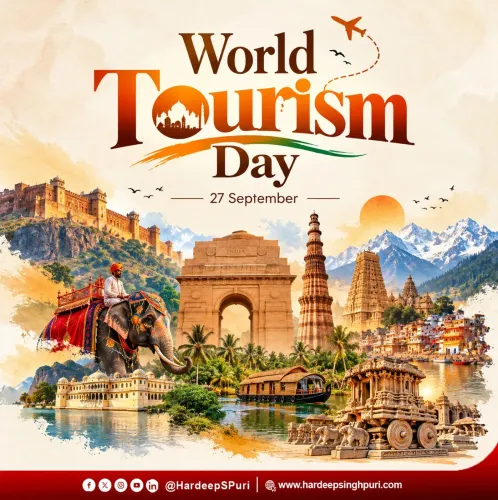
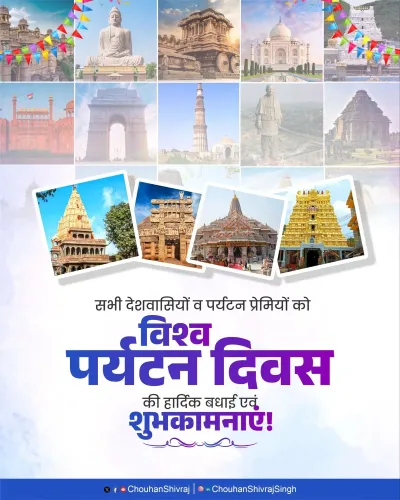
Giriraj Singh marks World Tourism Day, calls for responsible travel
Synopsis
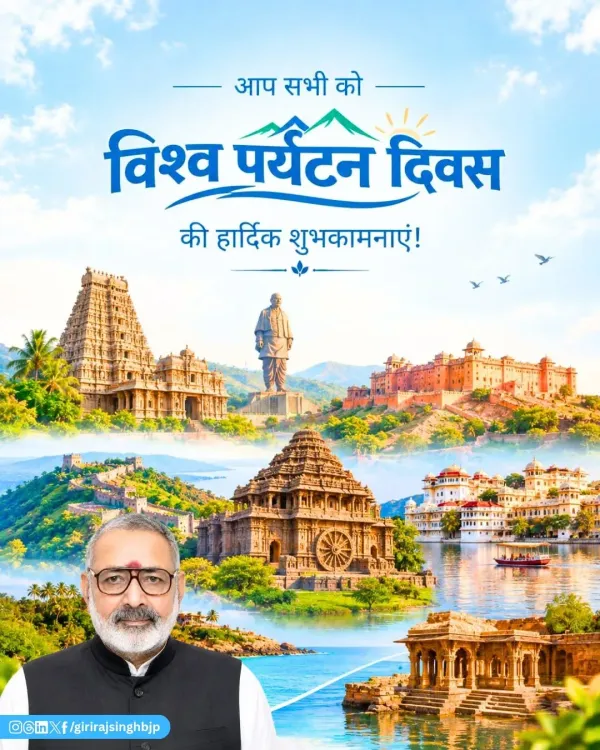
Union Textiles Minister Giriraj Singh marked World Tourism Day on 27 September 2026 by calling tourism a medium to understand cultures and traditions, urging Indians to celebrate the country's heritage and promote travel responsibly.
Key Takeaways
World Tourism Day is observed on 27 September every year under the UNWTO framework to highlight tourism's cultural and economic role.
Union Textiles Minister Giriraj Singh extended greetings and urged responsible promotion of India's cultural and natural heritage.
India's 'Incredible India' campaign, launched in 2002 , was a major international push to showcase the country's heritage assets.
The Swadesh Darshan scheme , introduced in 2014-15 , develops theme-based tourist circuits across Indian states.
Singh framed tourism as a 'beautiful medium for understanding different cultures, traditions, and natural heritage' — beyond simple leisure travel.
On World Tourism Day, 27 September 2026, Union Textiles Minister Giriraj Singh extended greetings to citizens and called for a deeper engagement with India's cultural heritage and natural beauty — framing tourism not as leisure alone, but as a bridge between civilisations.
In his post on X, Singh wrote: 'पर्यटन केवल नई जगहों को देखना नहीं, बल्कि विभिन्न संस्कृतियों, परंपराओं और प्राकृतिक धरोहरों को समझने का एक सुंदर माध्यम है' — 'Tourism is not merely visiting new places; it is a beautiful medium for understanding different cultures, traditions, and natural heritage.' He urged citizens to 'enhance the pride of India's rich cultural legacy and promote tourism responsibly.'
World Tourism Day and India's promotion push
World Tourism Day is observed every year on 27 September under the framework of the United Nations World Tourism Organization (UNWTO), with the aim of spotlighting tourism's social, cultural, and economic dimensions. For a country as geographically and culturally diverse as India, the occasion carries particular resonance — from the Himalayan foothills to the coastal temples of the south, the country's heritage circuit spans thousands of sites.
India's push to leverage this diversity goes back decades. The 'Incredible India' campaign, launched in 2002, was a landmark exercise in projecting the country's cultural and natural assets to international audiences. A decade later, the Swadesh Darshan scheme, introduced in 2014-15, sought to develop theme-based tourist circuits — linking pilgrimage trails, tribal heritage zones, and eco-tourism belts — into cohesive travel experiences for domestic visitors.
Responsible tourism as a recurring national theme
Singh's emphasis on 'responsible tourism' ('जिम्मेदारी के साथ पर्यटन') echoes a broader pattern in Indian public discourse. Successive governments have positioned heritage travel not just as an economic revenue driver but as a vehicle for soft-power projection — making the stewardship of historic sites and natural landscapes a matter of national pride rather than mere footfall management.
For the tourism industry and heritage site managers, such ministerial messaging reinforces policy direction: that growth in visitor numbers must be matched by conservation discipline. Whether fresh guidelines or budget allocations for heritage circuits follow in the next parliamentary session remains the question the sector is watching.
India has the inventory. The challenge — as every World Tourism Day reminds — is making the visit worth having, and leaving the site standing for the next generation.
Point of View
Making such posts as much about domestic optics as international solidarity. Singh's invocation of 'responsible tourism' slots neatly into an ongoing policy push to balance footfall growth with conservation at India's heritage sites. The message also implicitly underscores the Modi government's broader soft-power strategy — projecting India's civilisational depth as a brand asset. With tourism revenue and employment figures closely watched post-pandemic, such ministerial messaging helps sustain political and public attention on the sector between budget cycles.
NationPress
27 Sept 2026
Frequently Asked Questions
When is World Tourism Day celebrated?
World Tourism Day is celebrated every year on 27 September , as designated by the United Nations World Tourism Organization (UNWTO) to promote tourism's social, cultural, and economic significance.
What did Giriraj Singh say on World Tourism Day 2026?
Union Textiles Minister Giriraj Singh extended greetings and stated that tourism is not merely about visiting new places but is 'a beautiful medium for understanding different cultures, traditions, and natural heritage,' urging responsible promotion of India's legacy.
What is the Incredible India campaign?
The 'Incredible India' campaign was launched in 2002 to promote India's cultural heritage and natural sites to international audiences, becoming one of the country's most recognisable tourism branding exercises.
What is the Swadesh Darshan scheme?
The Swadesh Darshan scheme , introduced in 2014-15 , funds the development of theme-based tourist circuits — including pilgrimage, eco-tourism, and tribal heritage routes — across Indian states to boost domestic tourism.
Why do Indian ministers post on World Tourism Day?
Indian ministers use World Tourism Day to reinforce the government's cultural heritage agenda, highlight tourism's role in economic growth, and encourage citizens to explore and responsibly preserve India's natural and historic sites.