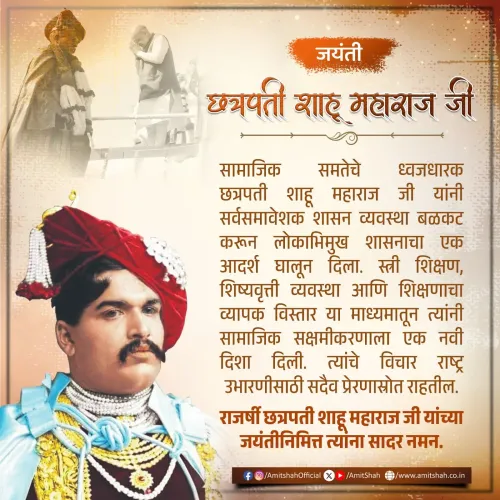
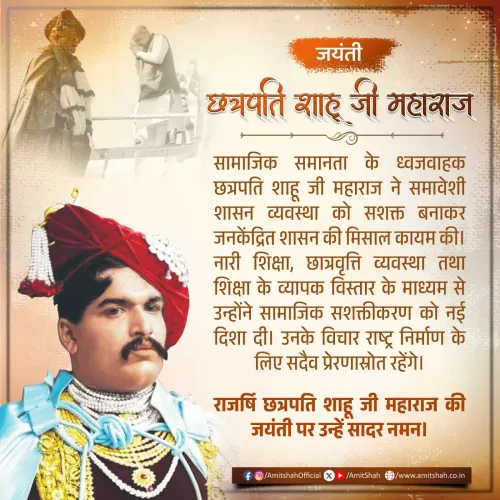
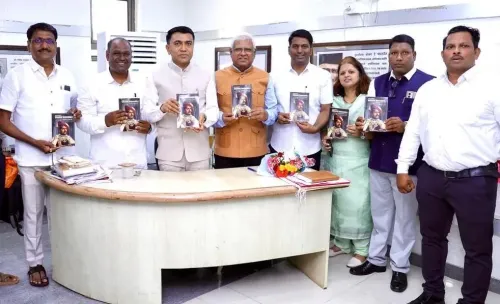
Goa CM Office Pays Tribute to Rajarshi Shahu Maharaj
Synopsis
The Chief Minister's Office of Goa on June 8, 2026, paid tribute to Rajarshi Shahu Maharaj, the Maharaja of Kolhapur (1894-1922), honouring his landmark contributions to reservation, education, women's empowerment, and upliftment of the underprivileged — linking his early 20th-century reforms to contemporary social-justice discourse.
Key Takeaways
The Chief Minister's Office of Goa posted a formal tribute to Rajarshi Shahu Maharaj on June 8, 2026 .
The tribute highlighted Shahu Maharaj's contributions to education, social justice, reservation, women's empowerment , and upliftment of the underprivileged.
Shahu Maharaj, Maharaja of Kolhapur from 1894 to 1922 , issued one of India's earliest reservation orders in 1902 , reserving 50 percent of state posts for backward communities.
The post was tagged with #SocialJustice and #Education , signalling alignment with affirmative-action and inclusive-development values.
Indian state governments frequently invoke Shahu Maharaj's legacy when framing contemporary social-justice and reservation policy messaging.
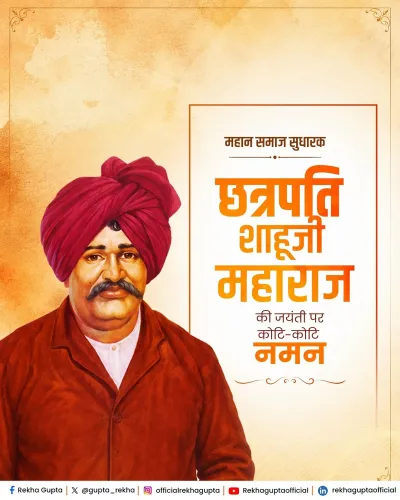
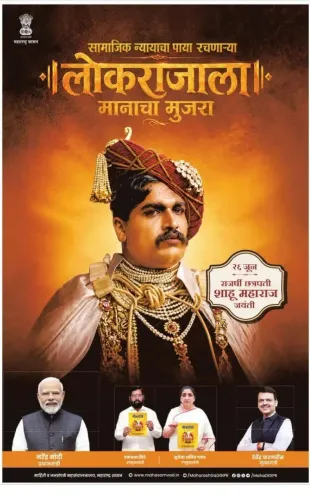
The Chief Minister's Office of Goa on Monday, June 8, 2026 posted a tribute on X honouring Rajarshi Shahu Maharaj, highlighting his historic contributions to education, social justice, reservation, women's empowerment, and the upliftment of the underprivileged.
The post, shared from the official @goacm handle, noted that a speaker — whose identity was not specified in the post — 'highlighted Rajarshi Shahu Maharaj's immense contribution towards education, social justice, reservation, women empowerment and upliftment of the underprivileged.'
Context
Rajarshi Shahu Maharaj was the Maharaja of Kolhapur from 1894 to 1922 and is widely regarded as a pioneering architect of social reform in India. He is remembered for opening educational institutions to all castes and women at a time when such access was severely restricted. His legacy remains a touchstone for social-justice movements across Maharashtra and beyond.Policy Backdrop
One of Shahu Maharaj's most consequential acts was issuing a reservation order in 1902 within the Kolhapur princely state, mandating 50 percent reservation for non-Brahmin backward communities in government jobs and education. This made Kolhapur one of the earliest jurisdictions in the Indian subcontinent to institutionalise affirmative action — predating independent India's constitutional provisions by nearly five decades. Indian state governments and political leaders have periodically invoked Shahu Maharaj's reforms when framing contemporary social-justice messaging, particularly around reservation policy and access to education. The practice links early 20th-century princely-state experiments to present-day welfare and affirmative-action discourse, lending historical legitimacy to current policy positions.Stakeholders and Impact
The tribute resonates most directly with backward classes, women, and underprivileged students — the constituencies Shahu Maharaj's reforms were designed to serve. In the context of Goa, where debates around educational access and social equity continue, invoking his legacy signals the state government's alignment with inclusive development values. The use of hashtags #RajarshiShahuMaharaj, #SocialJustice, and #Education suggests the post was intended to reach a broad audience engaged with affirmative-action and educational-reform conversations on social media.What's Next
The tribute may be a precursor to, or an echo of, a formal government event or policy announcement in Goa centred on social justice or education. Observers will watch for any follow-up statements from the Goa government on new education or social-welfare schemes that explicitly reference Shahu Maharaj's model as a guiding framework. The invocation of his legacy by an official government handle carries institutional weight and could signal a broader policy conversation in the state.Point of View
Tapping into a reform legacy that carries cross-caste and cross-party resonance. Shahu Maharaj's 1902 reservation order is foundational to India's affirmative-action narrative, and state governments that associate themselves with it signal a commitment to backward-class welfare. In the context of Goa's evolving social demographics, the tribute may also be laying ideological groundwork for upcoming education or welfare policy moves. The choice of an official government handle — rather than a party account — lends it institutional rather than purely electoral weight.
NationPress
23 Oct 2026
Frequently Asked Questions
Who was Rajarshi Shahu Maharaj?
Rajarshi Shahu Maharaj was the Maharaja of Kolhapur from 1894 to 1922. He is celebrated for pioneering social reforms in India, including introducing one of the country's earliest reservation orders in 1902 for backward communities and opening educational institutions to all castes and women.
What did Shahu Maharaj do for reservation in India?
In 1902, Shahu Maharaj issued a landmark order in the Kolhapur princely state mandating 50 percent reservation for non-Brahmin backward communities in government jobs and education, making it one of the earliest institutionalised affirmative-action policies in the Indian subcontinent.
Why did the Goa Chief Minister's Office pay tribute to Shahu Maharaj?
The Chief Minister's Office of Goa posted a tribute on June 8, 2026, highlighting Shahu Maharaj's contributions to education, social justice, reservation, and women's empowerment. The specific occasion prompting the tribute was not detailed in the post.
What is Shahu Maharaj's connection to education and women's empowerment?
Shahu Maharaj founded and supported educational institutions in Kolhapur that were open to all castes and to women, at a time when access to education was heavily restricted by caste hierarchy. This made him a foundational figure in India's inclusive-education movement.
How do Indian governments use Shahu Maharaj's legacy today?
Indian state governments and political leaders frequently invoke Shahu Maharaj's reforms to lend historical legitimacy to contemporary social-justice and reservation policies, connecting early 20th-century princely-state experiments to present-day affirmative-action and welfare discourse.