Piyush Goyal Speaks on India's Growth at Kirori Mal College
Synopsis
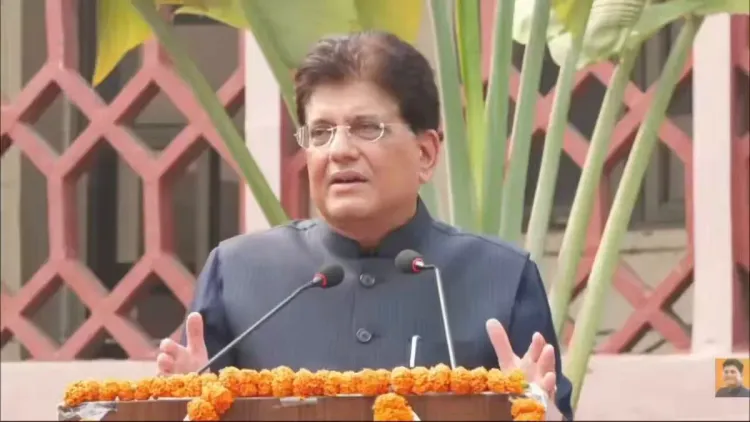
Union Commerce Minister Piyush Goyal visited Kirori Mal College at Delhi University on November 3, 2026 — the alma mater of Amitabh Bachchan — to engage students on India's development journey, declaring that every obstacle in India's path of progress can be overcome.
Key Takeaways
Union Commerce and Industry Minister Piyush Goyal visited Kirori Mal College, Delhi University on November 3, 2026 .
The minister addressed students on India's development journey , framing it as a story of breaking barriers.
Goyal posted on X: 'No matter what wall comes in the way of India's journey of progress, we can break every chain.' The college is the alma mater of Amitabh Bachchan , whom Goyal tagged in his post.
As Leader of the House in the Rajya Sabha , Goyal is one of the ruling BJP's most prominent public communicators.
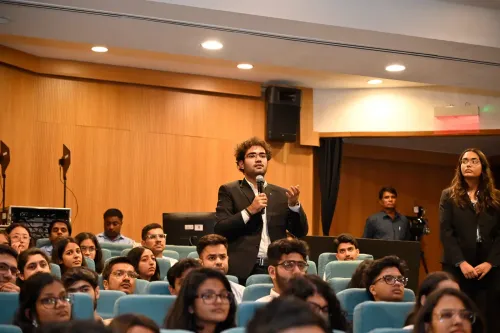
At one of Delhi University's most storied campuses — the alma mater of Amitabh Bachchan — Union Commerce and Industry Minister Piyush Goyal sat down with students on Tuesday, November 3, 2026, to talk about India's development journey, turning a college auditorium into a live classroom for the nation's ambitions.
Goyal framed the session with characteristic urgency, writing on X: 'भारत की प्रगति की यात्रा में चाहे कोई दीवार आये, हम हर ज़ंजीर को तोड़ सकते हैं' — 'No matter what wall comes in the way of India's journey of progress, we can break every chain.' The minister tagged Amitabh Bachchan, invoking the Bollywood legend's connection to the college as a symbolic bridge between the institution's cultural legacy and its current generation of students.
Kirori Mal College and its place in India's public imagination
Kirori Mal College, located on the north campus of Delhi University, is among the most academically competitive colleges in the country. Its alumni include not only Bachchan but a broad cross-section of India's professional and public life, making it a high-visibility venue for a minister seeking to engage directly with young, aspirational India.
The choice of setting — a student body rather than a boardroom — signals a deliberate outreach mode. Goyal's message, stripped of jargon, was essentially a rallying call: India's growth story will face obstacles, but those obstacles can be overcome.
A minister on campus, a message beyond it
As Leader of the House in the Rajya Sabha and a senior BJP figure, Goyal frequently operates at the intersection of policy and public persuasion. Campus visits of this kind serve a dual purpose — putting a human face on economic policy for students who will enter the workforce during India's critical growth decade, and reinforcing a broader narrative of national resilience.
The minister's evocative language — chains broken, walls cleared — gestures at an India that sees its own momentum as unstoppable, even against geopolitical or structural headwinds. Whether that confidence translates into tangible policy outcomes is the question students in rooms like this one will eventually help answer.
Point of View
Bypassing traditional media forums. By choosing Kirori Mal College — laden with cultural resonance through its Bachchan connection — the minister layers a symbolic message of aspiration onto a policy conversation. The 'break every chain' rhetoric echoes the government's broader framing of India as an emerging power confronting legacy constraints in trade, manufacturing, and global positioning. Such engagements also serve as soft political ground-work ahead of any electoral cycle, building affinity with a demographic that will shape India's next decade of growth.
NationPress
3 Nov 2026
Frequently Asked Questions
Why did Piyush Goyal visit Kirori Mal College?
Piyush Goyal visited Kirori Mal College on November 3, 2026 to interact with students about India's development journey and growth story.
What did Piyush Goyal say at Delhi University?
Goyal declared that no matter what obstacles arise in India's journey of progress, the country has the strength to break every chain — a message he posted on X alongside his campus visit.
What is Kirori Mal College known for?
Kirori Mal College is a prestigious college on the north campus of Delhi University and is the alma mater of Bollywood legend Amitabh Bachchan, among many other prominent alumni.
What is Piyush Goyal's role in government?
Piyush Goyal is India's Union Minister of Commerce and Industry and also serves as Leader of the House in the Rajya Sabha, making him one of the senior-most figures in the BJP-led government.
What was the significance of tagging Amitabh Bachchan in Goyal's post?
Goyal tagged Amitabh Bachchan because Kirori Mal College is Bachchan's alma mater, using the cultural connection to amplify the resonance of the student interaction.