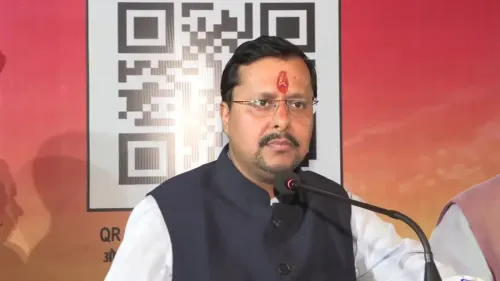
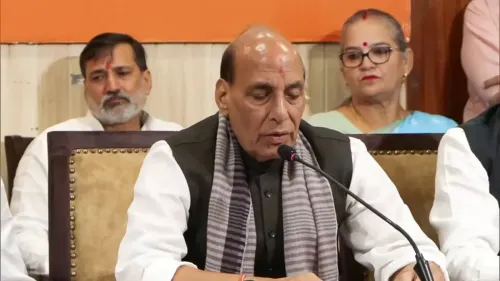
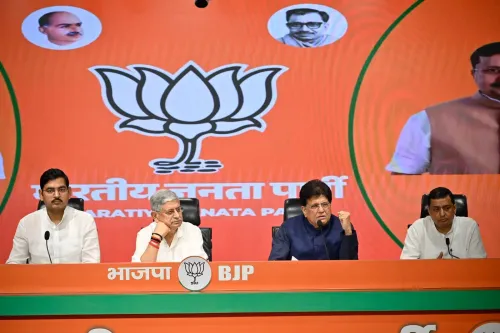
Goyal fires back at Kharge: 'India is a democracy, not Congress's darbaar'
Synopsis
Commerce Minister Piyush Goyal hit back at Congress president Mallikarjun Kharge on October 25, calling India 'a democracy, not Congress's darbaar', defending PM Modi's vision and invoking voter judgment as the ultimate verdict on the ruling government.
Key Takeaways
Piyush Goyal , Union Commerce Minister and Rajya Sabha Leader of the House, directly rebuked Mallikarjun Kharge on October 25, 2026 .
Goyal called India 'a democracy, not the darbaar of the Congress', invoking dynastic-court imagery against the opposition party.
Kharge serves as Congress president and Leader of the Opposition in the Rajya Sabha , making the two leaders direct institutional counterparts.
Goyal defended PM Narendra Modi's record by centering the electorate: 'The people see through your web of deceit.' The exchange follows a well-established BJP pattern of deflecting opposition attacks by appealing to the democratic mandate won since 2014 .
The precise Kharge statement that prompted the reply has not been independently verified.
A sharp volley of political words landed on Sunday evening when Union Commerce and Industry Minister Piyush Goyal took direct aim at Congress president Mallikarjun Kharge, rejecting what he framed as contempt for the Indian voter and asserting that Prime Minister Narendra Modi alone holds the vision for a future-ready India.
Goyal's post on X on October 25, 2026 was pointed and brief: 'India is a democracy, Kharge ji, not the darbaar of the Congress where entitled leaders abuse at will. Stop mocking the farsightedness of our nation's voters.' He closed with an unambiguous counter-claim — that it is Modi who is 'building the Bharat of the future.'
Goyal vs Kharge: the fault line in plain sight
The exchange crystallises a recurring fault line in Indian politics. Kharge, who leads the Congress as its national president and also serves as Leader of the Opposition in the Rajya Sabha, has frequently deployed sharp language against the ruling government — a posture his party argues is the rightful job of the opposition. Goyal, who is himself Leader of the House in the Rajya Sabha, is well placed to return fire in that precise arena.
The word 'darbaar' — a royal court — carries deliberate weight here. By invoking it, Goyal reaches for a well-worn BJP critique: that the Congress operated for decades as a dynasty-driven court rather than a democratic party, with loyalty to a family trumping accountability to voters. It is a charge Congress firmly disputes.
Voter judgment as the ultimate arbiter
Goyal's framing places the electorate at the centre of the argument. 'The people see through your web of deceit,' he wrote, invoking voter intelligence as both shield and sword — defending the BJP's electoral mandate while questioning the credibility of the opposition's critique. This has been a consistent rhetorical thread for BJP leaders: when political attacks mount, redirect the argument to the verdict already delivered by hundreds of millions of Indians at the ballot box.
Such exchanges tend to intensify around state election campaigns and parliamentary sessions, when both parties sharpen their contrasts for public consumption. The research notes that the precise Kharge statement that triggered Goyal's reply has not been independently verified, so the full context of the back-and-forth remains partial.
The 'Bharat of the future' pitch
Goyal's closing line — that Modi is 'building the Bharat of the future' — is more than a slogan. It is a compact statement of the BJP's central governing argument since 2014: that transformative infrastructure, economic ambition, and global positioning under Modi represent a break from Congress-era governance. Whether that argument persuades swing voters or merely consolidates the base is the question every election cycle tries to answer.
As both parties gear up for the next round of political contests, exchanges like this one signal that the volume — and the stakes — are only going up.
Point of View
Invokes the dynastic-court critique that has dogged Congress for a generation, and then pivots to Modi's forward-looking mandate as the positive close. The choice of the word 'darbaar' is deliberate — it ties the Congress's present leadership to a past the party has struggled to fully shed in public perception. As Rajya Sabha counterparts, Goyal and Kharge are locked in an institutional as well as political rivalry, meaning these social-media exchanges are previews of floor battles. The post tells us the BJP intends to keep voter-trust and democratic legitimacy as its primary terrain ahead of the next political cycle.
NationPress
25 Oct 2026
Frequently Asked Questions
Why did Piyush Goyal target Mallikarjun Kharge on X?
Goyal responded to what he described as Kharge mocking Indian voters, accusing the Congress leader of behaving like an entitled ruler rather than a democratic opposition chief. The specific Kharge statement that triggered the reply has not been independently verified.
What does 'darbaar of the Congress' mean in Goyal's post?
The word ' darbaar ' means a royal court. Goyal used it to revive the BJP's longstanding charge that Congress functioned as a dynasty-driven, closed court for decades rather than as an accountable democratic party.
Who is Mallikarjun Kharge?
Mallikarjun Kharge is the president of the Indian National Congress and serves as Leader of the Opposition in the Rajya Sabha, making him the principal opposition voice in the upper house of Parliament.
What is Piyush Goyal's role in the Rajya Sabha?
Piyush Goyal is the Leader of the House in the Rajya Sabha on behalf of the ruling BJP-led government, placing him in direct institutional opposition to Kharge as Leader of the Opposition.
Is this BJP-Congress social media clash connected to any election?
The research indicates such exchanges typically intensify during state election campaigns or parliamentary sessions. No specific 2026 election context has been independently verified in relation to this post.