Piyush Goyal spotlights Ladakh's GI-tagged Sea Buckthorn as global wellness superfruit
Synopsis
A cabinet minister's X post has put one of the world's most nutrient-dense berries back in the spotlight. Ladakh's GI-tagged Sea Buckthorn — with 20 times the Vitamin C of an orange and all four Omega fatty acids — covers 13,000 hectares across the union territory yet remains largely absent from global markets. That gap, and the political will to close it, is now the story.
Key Takeaways
Union Minister Piyush Goyal promoted Ladakh's Sea Buckthorn on 20 October 2026 , calling it a 'golden treasure of India's natural heritage.' The berry received its Geographical Indication (GI) tag in 2023 but remains underrepresented in global markets.
Sea Buckthorn contains up to 20 times more Vitamin C than oranges and all four Omega fatty acids — Omega-3, 6, 7, and 9.
Ladakh accounts for 64%–70% of India's total Sea Buckthorn area, covering roughly 13,000 hectares across Leh, Nubra, Kargil, and Zanskar.
A Centre of Excellence for Sea Buckthorn has been set up at Nimoo to modernise farming and value chain development.
Local women-led enterprises process the berry into juices, jams, teas, nutraceuticals, and cosmetics.
Union Minister Piyush Goyal on Tuesday, 20 October 2026, drew national attention to Ladakh's Sea Buckthorn — locally known as 'Tsesta Lulu' or the Ladakh Berry — calling it a 'golden treasure of India's natural heritage' and underscoring its exceptional nutritional value and potential to transform livelihoods in the union territory.
What Goyal Said
In a post on his X handle, Goyal described the GI-tagged Seabuckthorn of Ladakh as 'a remarkable gift of nature, known for its exceptional vitamin content and rich nutritional profile,' adding that it is 'empowering local livelihoods and advancing global wellness.' The minister's remarks come as the berry — awarded its Geographical Indication (GI) tag in 2023 — remains largely underexposed in global markets despite its nutritional credentials.
Why Sea Buckthorn Stands Apart
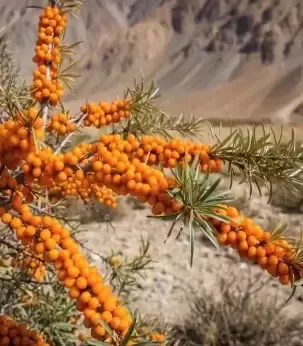
Sea Buckthorn is one of the most nutrient-dense wild berries known to science. It contains up to 20 times more Vitamin C than oranges and is one of the few plant-based foods that provides all four Omega fatty acids — Omega-3, 6, 7, and 9. In total, it is reportedly packed with over 190 nutrients, including flavonoids, beta-carotene, antioxidants, amino acids, and fat-soluble vitamins A, E, and K. Medicinally, it has been referenced in ancient records as the 'Sanjeevani Booti' and has long been used in traditional Tibetan and Ladakhi medicine for immunity and digestion.
The plant is hardy beyond comparison — surviving temperatures ranging from minus 30 degrees to 30 degrees Celsius and growing wild at altitudes exceeding 3,000 metres. Its deep root systems also serve as a vital soil conservation and land-degradation control mechanism, giving it ecological significance beyond its nutritional profile.
Ladakh's Dominant Role in India's Supply
Ladakh accounts for roughly 64% to 70% of India's total Sea Buckthorn cultivation and wild growth area, spanning Leh, Nubra, Kargil, and Zanskar along riverbanks including the Indus and Shyok. The union territory holds approximately 13,000 hectares of Sea Buckthorn coverage. The berries are hand-picked once a year, with harvests peaking between August and October — primarily in September and October.
From Wild Shrub to Value Chain
The Ladakh UT Administration has inaugurated a dedicated Centre of Excellence for Sea Buckthorn at Nimoo, aimed at modernising farming practices, training local producers, and developing the value chain. Women-led enterprises and startups across the region are already processing the berry into pulp concentrates, juices, jams, teas, chutneys, nutraceuticals, facial serums, and cold-pressed oils.
Notably, despite receiving the GI tag in 2023 — which recognises its unique regional authenticity and high bioactive concentration — the berry has yet to achieve significant penetration in international markets. The Union Minister's public endorsement is expected to accelerate both domestic awareness and export ambitions.
What Comes Next
With a senior cabinet minister now amplifying the Sea Buckthorn story, industry observers expect increased interest from wellness brands, nutraceutical companies, and export-oriented agri-businesses. The convergence of the GI tag, the Centre of Excellence, and ministerial visibility positions Ladakh's Sea Buckthorn as a flagship product in India's push to commercialise high-altitude, region-specific superfoods on the global stage.
Point of View
But ministerial social media endorsements have a short shelf life without a follow-through procurement or export mechanism. The GI tag was awarded in 2023 — over two years ago — and the berry is still not meaningfully present in global wellness markets. The Centre of Excellence at Nimoo is the right structural move, but it needs a demand-side counterpart: a credible export promotion programme, shelf space in international retail, and a branding campaign that positions Ladakh Sea Buckthorn alongside Manuka honey and Himalayan pink salt as a premium global superfood. Without that, the 'golden treasure' framing risks being just another hashtag.
NationPress
20 Oct 2026
Frequently Asked Questions
What is Ladakh's Sea Buckthorn and why is it called a superfruit?
Ladakh's Sea Buckthorn, locally called 'Tsesta Lulu' or the Ladakh Berry, is a wild high-altitude berry shrub that contains over 190 nutrients, including up to 20 times more Vitamin C than oranges and all four Omega fatty acids (Omega-3, 6, 7, and 9). Its extraordinary nutrient density — spanning antioxidants, flavonoids, beta-carotene, and fat-soluble vitamins A, E, and K — is why it is widely referred to as a superfruit.
When did Ladakh's Sea Buckthorn receive its GI tag?
Ladakh's Sea Buckthorn was officially awarded a Geographical Indication (GI) tag in 2023, recognising its unique regional authenticity and high bioactive concentration. Despite receiving the tag over two years ago, the berry remains underexposed in global markets.
How much of India's Sea Buckthorn grows in Ladakh?
Ladakh accounts for roughly 64% to 70% of India's total Sea Buckthorn cultivation and wild growth area, covering approximately 13,000 hectares across Leh, Nubra, Kargil, and Zanskar, along riverbanks like the Indus and Shyok.
What is the Centre of Excellence for Sea Buckthorn at Nimoo?
The Centre of Excellence for Sea Buckthorn at Nimoo is a facility inaugurated by the Ladakh UT Administration to modernise farming techniques, provide training to local producers, and develop the berry's value chain. It supports local women-led enterprises and startups that process Sea Buckthorn into juices, jams, teas, nutraceuticals, and cosmetics.
Why did Union Minister Piyush Goyal highlight Sea Buckthorn?
Goyal posted on X describing the GI-tagged Sea Buckthorn as a 'golden treasure of India's natural heritage,' praising its nutritional profile and its role in empowering local livelihoods in Ladakh. The endorsement is seen as part of the government's broader push to bring high-altitude regional superfoods into global wellness markets.