Goyal: India's FTAs to give Rajasthan's crafts global stage
Synopsis
Commerce Minister Piyush Goyal posted a video on 6 August 2026 explaining how FTAs signed under PM Modi — including the India-UAE CEPA and India-Australia ECTA — are set to open new global markets for Rajasthan's traditional crafts, textiles, and jewellery sectors.
Key Takeaways
Piyush Goyal shared a video on 6 August 2026 outlining FTA gains for Rajasthan's traditional export sectors.
The India-UAE CEPA (February 2022) reduced or eliminated tariffs on over 80 percent of Indian products in the UAE market.
The India-Australia ECTA (April 2022) provides tariff concessions on Indian handicrafts, apparel, and leather goods.
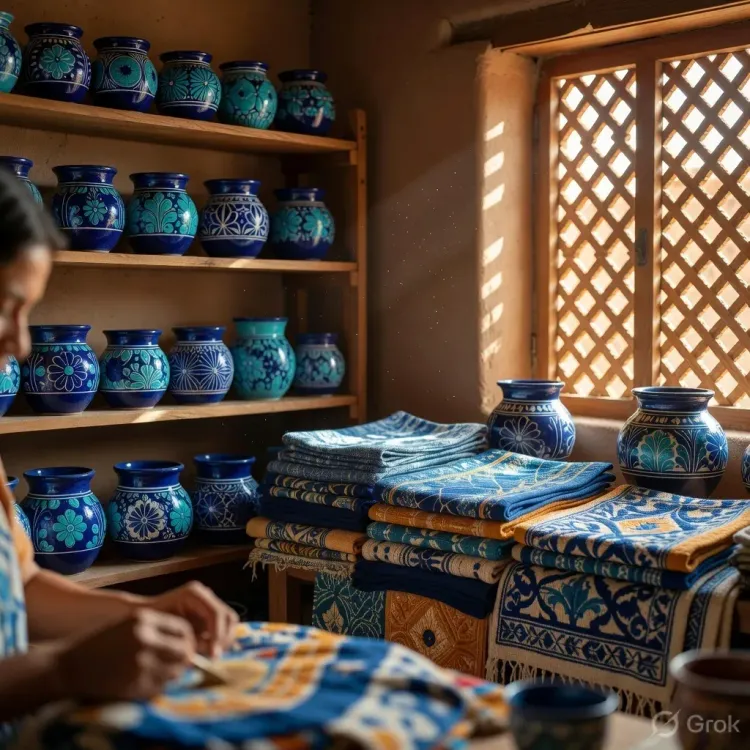
Rajasthan's bandhani textiles, blue pottery, silver jewellery, and gems are identified as key beneficiaries.
The Commerce Ministry's state-level outreach is part of the broader Foreign Trade Policy 2023–28 strategy for export diversification.
State-wise export data in coming quarters will be the real measure of whether FTA benefits are reaching artisans and MSME exporters .
Rajasthan's bandhani textiles, blue pottery, and silver jewellery have long carried the weight of centuries-old craft traditions — and now, Union Commerce and Industry Minister Piyush Goyal says a new generation of free trade agreements is about to carry them to markets they have never reached before. In a post on X on Thursday, 6 August 2026, Goyal shared a video explaining how the FTAs signed under Prime Minister Narendra Modi's leadership stand to benefit Rajasthan's traditional export sectors.
Goyal wrote that Rajasthan already holds a special place for its traditional products, and that the trade agreements concluded under PM Modi's government are now set to give this heritage 'a new identity across the world' — 'दुनियाभर में नई पहचान' [a new recognition worldwide].
Which agreements are doing the heavy lifting
Two deals form the backbone of this push. The India-UAE Comprehensive Economic Partnership Agreement (CEPA), signed in February 2022, eliminated or reduced tariffs on over 80 percent of Indian products entering the UAE market — a critical gateway for gems, jewellery, and textiles. The India-Australia Economic Cooperation and Trade Agreement (ECTA), signed in April 2022, opened the Australian market with tariff concessions on Indian handicrafts, apparel, and leather goods.
Both agreements directly target the labour-intensive, artisan-driven sectors where Rajasthan punches well above its weight. The state's MSME exporters and craft clusters — from Jaipur's gem-cutters to Jodhpur's textile weavers — are among the stakeholders the Commerce Ministry has identified as primary beneficiaries.
State-specific outreach from the Commerce Ministry
Goyal's video post is part of a broader pattern: the Commerce Ministry has been conducting state-level outreach to translate the abstract language of trade policy into concrete, ground-level gains. India's Foreign Trade Policy 2023–28 explicitly emphasised leveraging FTAs for export diversification, and Rajasthan — with its dense concentration of traditional craft clusters — is a natural showcase.
The pitch is straightforward: preferential tariff access means Rajasthan's exporters can undercut competitors in key markets, while non-tariff barrier reductions ease the compliance burden on small artisans who previously found foreign certification requirements prohibitive.
What the numbers will eventually tell
The real test will come in Rajasthan's state-wise export data over the coming quarters. If the FTA benefits are flowing as promised, shipments of traditional products to the UAE and Australia should show a measurable uptick. Analysts are also watching whether the state government announces dedicated FTA facilitation cells to help small exporters actually claim the preferential rates on offer — because a tariff concession that an artisan cannot navigate paperwork to access is no concession at all.
India's accelerated FTA strategy since 2021 has been one of the Modi government's most consequential economic pivots. Rajasthan's craft economy is now being positioned as Exhibit A for why that strategy matters at the village level — not just in trade ministry briefings.
Point of View
Constituency-level storytelling that resonates with artisans and small exporters. Positioning Rajasthan as a showcase beneficiary is politically astute: the state's craft clusters are visible, vote-rich, and emotionally resonant. The real question is whether facilitation infrastructure — export cells, certification support, logistics — will catch up to the tariff wins before the political narrative runs ahead of ground reality. If Rajasthan's export numbers move in the right direction over the next two to three quarters, the template will almost certainly be replicated across other craft-heavy states.
NationPress
20 Sept 2026
Frequently Asked Questions
How will India's FTAs benefit Rajasthan's traditional products?
The India-UAE CEPA and India-Australia ECTA reduce or eliminate tariffs on Indian handicrafts, textiles, gems, and leather goods, making Rajasthan's traditional exports more price-competitive in those markets. Commerce Minister Piyush Goyal shared a video on 6 August 2026 detailing these benefits specifically for Rajasthan.
What is the India-UAE CEPA and when was it signed?
The India-UAE Comprehensive Economic Partnership Agreement was signed in February 2022. It eliminated or reduced tariffs on over 80 percent of Indian products entering the UAE market, benefiting sectors like gems, jewellery, and textiles where Rajasthan is a major producer.
What is the India-Australia ECTA?
The India-Australia Economic Cooperation and Trade Agreement was signed in April 2022. It provides tariff concessions on Indian handicrafts, apparel, and leather goods exported to Australia — sectors in which Rajasthan has significant production clusters.
Which Rajasthan products are expected to gain from India's free trade agreements?
Bandhani textiles, blue pottery, silver jewellery, gems, leather products, and marble are among the traditional Rajasthan products identified as potential beneficiaries of India's FTAs with the UAE and Australia.
What is India's Foreign Trade Policy 2023-28?
India's Foreign Trade Policy 2023-28 is a five-year framework that emphasises leveraging free trade agreements to diversify Indian exports beyond traditional markets, with a focus on labour-intensive and artisan-driven sectors like those concentrated in Rajasthan.