Goyal: 9 FTAs under Modi to boost India's toys sector
Synopsis
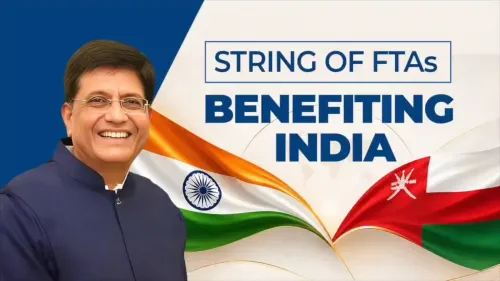
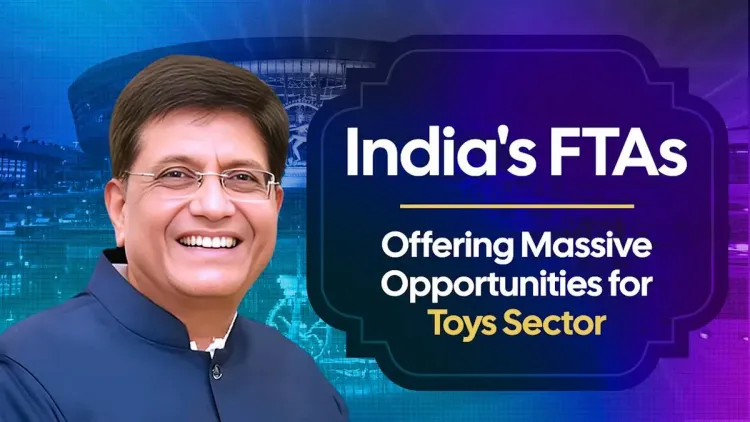
Commerce Minister Piyush Goyal has said nine free trade agreements concluded under PM Modi's leadership will unlock unprecedented export opportunities for India's toys sector, urging manufacturers to treat the world as their stage.
Key Takeaways
Union Commerce Minister Piyush Goyal made the statement on 4 July 2026 , targeting toy manufacturers and exporters.
He cited 9 FTAs concluded under PM Narendra Modi 's leadership as the foundation for new global market access.
Key agreements in India's FTA network include the India-UAE CEPA (2022) and the India-Australia ECTA (2022).
The toys sector has been a priority under Make in India , with policy aimed at cutting import dependence and raising exports.
Small and medium toy manufacturers in clusters across Uttar Pradesh, Karnataka and Rajasthan are among the primary intended beneficiaries.
Actual export gains will depend on industry uptake of FTA tariff concessions and compliance with rules-of-origin requirements.
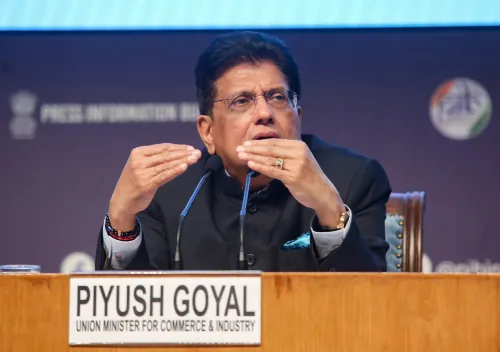
Union Commerce and Industry Minister Piyush Goyal on Saturday, 4 July 2026 said that nine free trade agreements concluded under Prime Minister Narendra Modi's leadership would open unprecedented export opportunities for India's toys sector, signalling a push to position domestic manufacturers as global suppliers.
Context
Posting on X, Minister Goyal declared, 'The world is your stage! The 9 FTAs concluded under PM Modi ji's leadership will offer unprecedented opportunities to the toys sector.' The statement is directed squarely at toy manufacturers and exporters, urging them to leverage the preferential market access that these agreements provide.
The message comes as India's trade policy establishment has been actively promoting labour-intensive sectors — toys among them — as priority beneficiaries of its expanding FTA network. The government has in recent years also sought to reduce the country's dependence on imported toys, particularly from China, while scaling up domestic production.
Policy Backdrop
India's FTA agenda accelerated sharply after 2014. Among the agreements cited in the broader policy push are the India-Mauritius Comprehensive Economic Cooperation and Partnership Agreement (CECPA) concluded in 2021, the India-UAE Comprehensive Economic Partnership Agreement (CEPA) signed in February 2022, and the India-Australia Economic Cooperation and Trade Agreement (ECTA) signed in April 2022. These deals grant Indian exporters duty-free or preferential tariff access in partner markets across the Gulf, the Indo-Pacific, and beyond.
The FTA strategy sits alongside domestic support measures such as the Make in India initiative and production-linked incentive schemes, which together aim to integrate Indian manufacturing into global value chains. For the toys sector specifically, policy has combined import restrictions with export promotion to build a competitive domestic industry.
Stakeholders and Impact
Indian toy manufacturers and exporters stand to gain directly if they can utilise the tariff concessions embedded in the concluded agreements. Markets such as the UAE and Australia — both now linked to India through preferential trade pacts — represent meaningful demand centres where reduced duties could make Indian toys price-competitive against established exporters.
Small and medium enterprises that form the backbone of India's toy manufacturing clusters in states such as Uttar Pradesh, Karnataka, and Rajasthan are among the primary intended beneficiaries. For them, awareness of FTA provisions and the capacity to meet partner-country standards and rules-of-origin requirements will be critical to translating policy intent into actual export growth.
What's Next
Attention will now turn to the roll-out of tariff concessions under each concluded FTA and whether toys exporters can demonstrate measurable gains in shipments to partner markets. Industry bodies are expected to work with the Commerce Ministry to map specific tariff lines where Indian toys can become more competitive.
Minister Goyal's public communication suggests the government intends to keep the toys sector at the centre of its export-diversification narrative, with the FTA network serving as the primary instrument to achieve that goal.
Point of View
The Commerce Ministry is signalling that the FTA network is now large enough to be marketed as a systemic advantage rather than a bilateral arrangement. The toys sector is symbolically important — it is one of the few manufacturing categories where India has visibly reduced Chinese import dominance in recent years. Whether exporters can convert preferential access into actual shipment volumes will be the real test of this policy narrative.
NationPress
3 Oct 2026
Frequently Asked Questions
How many FTAs has India signed under PM Modi?
Minister Piyush Goyal stated on 4 July 2026 that 9 FTAs have been concluded under PM Modi's leadership, though the complete list of all nine agreements was not specified in the post.
How will India's FTAs help the toys sector?
The free trade agreements grant Indian toy exporters preferential or duty-free access to partner markets, making Indian toys more price-competitive and opening new sales channels abroad.
Which FTAs are most relevant for Indian toy exporters?
The India-UAE CEPA (signed February 2022) and the India-Australia ECTA (signed April 2022) are among the concluded agreements that provide preferential market access relevant to goods including toys.
What is India's policy on the toys sector?
India has pursued a dual strategy of restricting toy imports to reduce dependence — particularly on Chinese goods — while promoting domestic manufacturing through Make in India and now leveraging FTAs to drive exports.
Who benefits from India's FTA network in the toys industry?
Toy manufacturers and exporters, especially small and medium enterprises in clusters in Uttar Pradesh, Karnataka and Rajasthan , are the primary intended beneficiaries of the preferential access created by the FTAs.