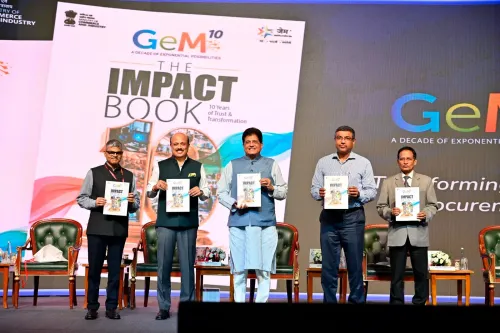
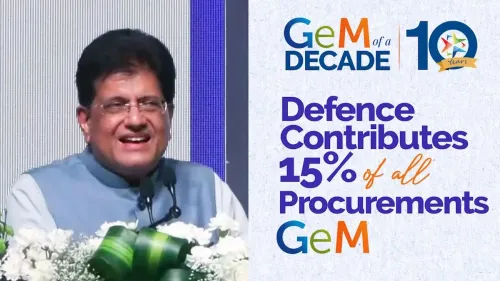
Goyal maps 5 priorities for GeM's next decade

Synopsis
Union Commerce and Industry Minister Piyush Goyal has outlined five priorities for GeM over the next decade: district-level reach, AI integration, a unified national ecosystem, faster and sustainable payments, and linkages with universities and colleges.
Key Takeaways
Five-point agenda: Minister Goyal listed district reach, AI integration, a seamless national ecosystem, faster payments with sustainable procurement, and university linkages as GeM's decade-ahead priorities.
Platform history: GeM was launched in August 2016 as a digital replacement for manual government tendering.
MSME focus: Expanding to every district would bring millions of small and micro-enterprise suppliers into the formal public procurement marketplace.
University connect: Linking GeM with colleges and universities signals intent to embed procurement literacy and open the platform to student-run startups.
Payment reform: Faster payment cycles are a critical relief measure for small vendors dependent on government contracts.
Sustainability angle: Pairing procurement with sustainability criteria aligns the platform with India's broader climate and green-economy commitments.
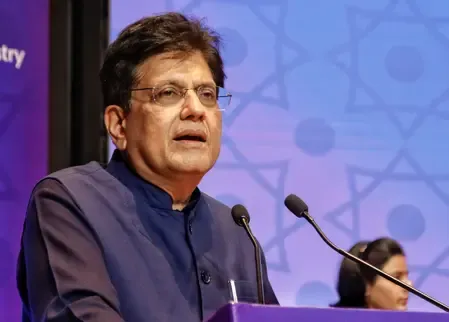
A decade into transforming how India buys, Union Commerce and Industry Minister Piyush Goyal has set out five clear priorities to take the Government e-Marketplace (GeM) into its next chapter — and the ambition stretches from village-level reach to artificial intelligence.
Posting on 10 August 2026, Goyal listed the five-point agenda: reaching every district, deeper AI integration, building a seamless national procurement ecosystem, faster payments with sustainable procurement, and connecting GeM with universities and colleges across the country.
From a 2016 pilot to a national procurement backbone
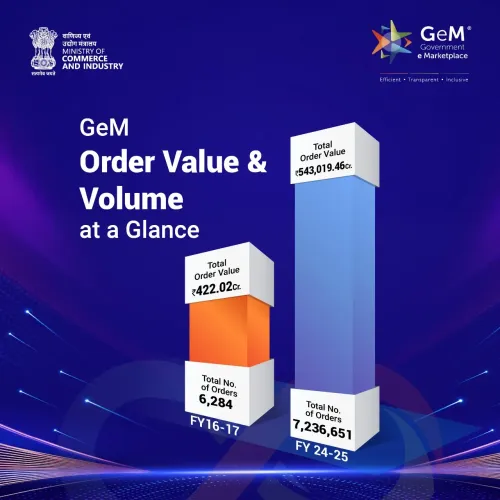
GeM was launched in August 2016 as a digital alternative to manual tendering — a direct response to the opacity and delays that plagued government purchasing for decades. What began as a pilot has grown into the central artery of public procurement, connecting government buyers with suppliers ranging from large manufacturers to small artisans. The platform sits at the heart of India's push to digitise governance and cut leakages from the public exchequer. Successive administrations have doubled down on the platform, and Goyal's five-priority framework signals that the next phase is less about building the foundation and more about deepening its roots — geographically, technologically, and institutionally.District reach, AI, and the university link
The first two priorities — district-level penetration and AI integration — address the platform's twin gaps: physical reach and smart automation. Millions of potential MSME suppliers in smaller towns and rural districts remain outside GeM's orbit; a district-by-district expansion push would bring them into a formal, transparent marketplace. Layering AI onto procurement decisions could sharpen price discovery, flag anomalies, and reduce the cycle time between order and delivery. The fifth priority — connecting GeM with universities and colleges — is arguably the most forward-looking. It signals an intent to embed procurement literacy into institutions that train India's next generation of administrators, entrepreneurs, and public-sector managers. Campuses that transact through GeM would also become organic feeders of student-run startups and research-linked suppliers into the public marketplace.Faster payments and the sustainable procurement push
The fourth priority — faster payments paired with sustainable procurement — addresses a persistent pain point for small vendors, for whom delayed government payments can be existential. Tying payment speed to sustainability criteria could simultaneously solve a cash-flow problem and steer public spending toward greener supply chains, a direction consistent with India's broader climate commitments. Goyal's roadmap, if executed, would shift GeM from a procurement portal into something closer to a national economic infrastructure — one that touches every district, learns from every transaction, and trains every institution that interacts with it. The real test will come in the budget cycles and ministry reviews ahead, where timelines and resources get attached to vision.Point of View
Suggesting the government wants procurement reform to become self-reinforcing through education. The pairing of faster payments with sustainable procurement is politically astute: it addresses a genuine MSME grievance while advancing a green-economy narrative. Taken together, the roadmap positions GeM not merely as an efficiency tool but as a structural pillar of India's public-sector economy for the 2030s.
NationPress
11 Aug 2026
Frequently Asked Questions
What is GeM and who uses it?
GeM, or Government e-Marketplace, is India's national online portal for government procurement of goods and services, used by government buyers at the central and state level and by suppliers ranging from large firms to small MSME vendors.
What are Piyush Goyal's five priorities for GeM?
Minister Goyal outlined: reaching every district, deeper AI integration, a seamless national procurement ecosystem, faster payments with sustainable procurement, and connecting the platform with universities and colleges.
When was GeM launched?
GeM was launched in August 2016 as a pilot to replace manual tendering with an end-to-end digital procurement platform.
How does GeM help MSME suppliers?
GeM gives MSME suppliers direct, transparent access to government buyers without intermediaries, and faster payment cycles — when implemented — reduce the cash-flow risk that small vendors face on government contracts.
What does connecting GeM with universities mean?
It signals an intent to bring educational institutions onto the platform as buyers and potentially as feeders of student startups and research-linked suppliers, while also building procurement literacy among future administrators and entrepreneurs.