Piyush Goyal pitches India to Ontario Teachers' Pension Plan CEO
Synopsis
Commerce Minister Piyush Goyal met Ontario Teachers' Pension Plan CEO Jo Taylor to discuss investments in India's infrastructure, renewables, healthcare, technology, and digital economy, highlighting India's growth potential and manufacturing partnership opportunities.
Key Takeaways
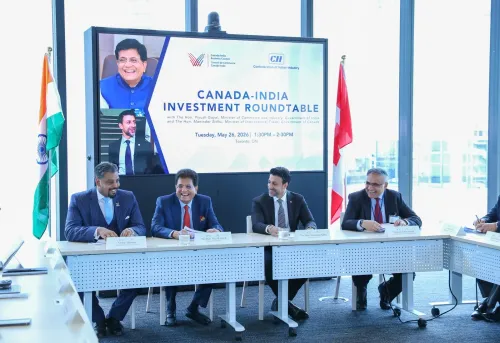
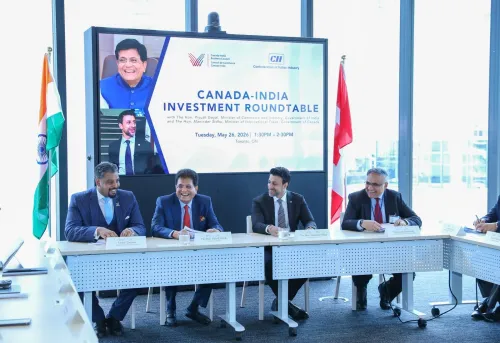
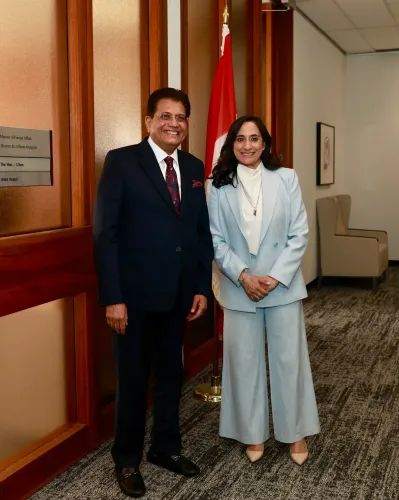
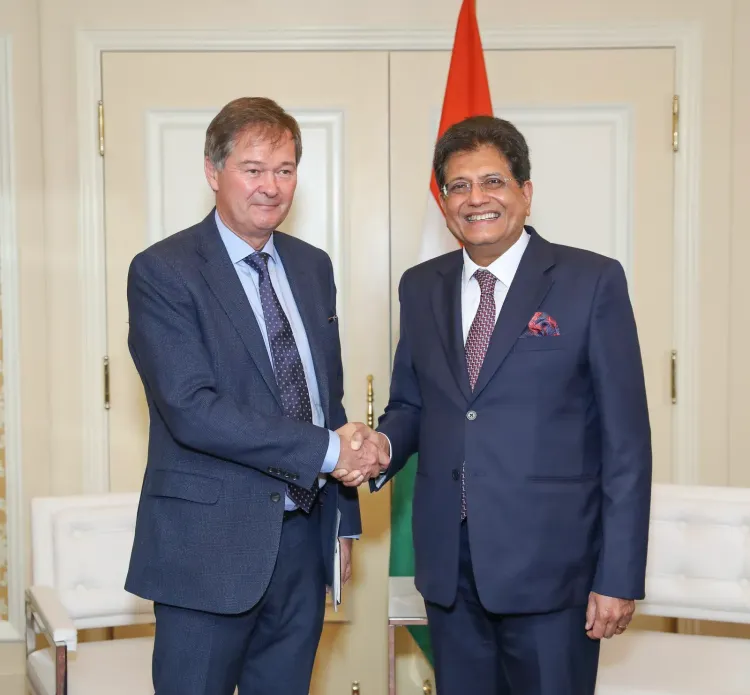
Union Commerce Minister Piyush Goyal held a meeting with Jo Taylor , President and CEO of Ontario Teachers' Pension Plan .
Discussions covered six sectors : infrastructure, renewables, financial services, healthcare, technology, and the digital economy.
Ontario Teachers' Pension Plan manages over C$200 billion in assets and has prior exposure to Indian infrastructure and renewables.
Goyal emphasised India's 'strong growth potential' and opportunities for partnerships with Indian enterprises, including in manufacturing.
The bilateral investment framework is supported by the Canada-India Foreign Investment Promotion and Protection Agreement of 2007 .
The meeting is part of India's broader strategy to attract long-term institutional capital to fund its infrastructure pipeline and green transition.
Union Commerce and Industry Minister Piyush Goyal met Jo Taylor, President and CEO of the Ontario Teachers' Pension Plan (OTPP), to discuss investment opportunities across key sectors of the Indian economy. The two leaders explored potential partnerships in infrastructure, renewables, financial services, healthcare, technology, and the digital economy. The meeting underscores India's continued push to attract long-term institutional capital from global pension funds.
Context
Minister Goyal highlighted India's 'strong growth potential' and the scope for OTPP to forge partnerships with Indian enterprises, including in manufacturing. He also stressed the importance of supporting sustainable growth — a priority that aligns with the pension fund's own environmental, social, and governance mandates. The meeting reflects a broader diplomatic and economic effort by New Delhi to position India as the preferred destination for patient, long-term foreign capital.
Ontario Teachers' Pension Plan manages over C$200 billion in assets and has a global mandate to deploy capital in high-growth markets. The fund has previously allocated capital to Indian infrastructure and renewables, making it a familiar institutional partner for Indian policymakers. Jo Taylor has led the organisation as President and CEO, steering its international diversification strategy.
Policy Backdrop
India's outreach to pension and sovereign funds is rooted in a series of structural reforms that began with the Make in India programme launched in September 2014, which sought to raise manufacturing's share of GDP and ease foreign direct investment norms. Subsequent FDI policy revisions between 2016 and 2020 opened 100% automatic routes in several sectors, including single-brand retail and insurance — categories directly relevant to large institutional investors.
The bilateral investment framework between the two countries is underpinned by the Canada-India Foreign Investment Promotion and Protection Agreement of 2007, which provides legal certainty for cross-border capital flows. Production-linked incentive schemes and improving ease-of-doing-business rankings have further encouraged Canadian funds to incrementally raise their India exposure in recent years.
Stakeholders and Impact
For Indian infrastructure developers and renewable energy companies, sustained interest from a fund of OTPP's scale signals continued access to low-cost, long-duration capital that domestic markets alone cannot supply. Indian manufacturers stand to benefit from potential joint ventures and technology partnerships that a fund-backed entry can facilitate. Healthcare and digital economy startups are also cited as areas of mutual interest, reflecting the broadening of India's investment pitch beyond traditional hard infrastructure.
From Canada's perspective, India's demographic dividend and projected GDP trajectory make it one of the few markets capable of absorbing large-ticket, long-horizon allocations at scale. OTPP's beneficiaries — Ontario's retired teachers — gain portfolio diversification and exposure to one of the world's fastest-growing major economies.
What's Next
The next round of India-Canada bilateral trade talks will be closely watched for any follow-on investment commitments or formal joint venture announcements stemming from this engagement. Minister Goyal's active outreach to institutional investors suggests that formalising partnership frameworks — particularly in renewables and manufacturing — remains a near-term priority for the Commerce Ministry. Any concrete allocation or deal announcement from OTPP would mark a significant milestone in deepening the bilateral economic relationship.
Point of View
Long-duration capital rather than purely speculative FDI. By spanning six sectors — from renewables to digital economy — the pitch signals that India is marketing itself as a full-spectrum investment destination, not just an infrastructure play. The explicit mention of manufacturing partnerships aligns with the Production-Linked Incentive push and the broader 'China-plus-one' narrative that Indian officials have been advancing with Western institutional investors. Whether this engagement translates into fresh allocations will depend on bilateral diplomatic momentum and the pace of on-ground regulatory simplification.
NationPress
22 Oct 2026
Frequently Asked Questions
Who is Jo Taylor and why did Piyush Goyal meet him?
Jo Taylor is the President and CEO of the Ontario Teachers' Pension Plan , one of Canada's largest institutional investors managing over C$200 billion in assets. Minister Goyal met him to discuss investment opportunities for the fund across India's infrastructure, renewables, healthcare, technology, financial services, and digital economy sectors.
What is the Ontario Teachers' Pension Plan's connection to India?
Ontario Teachers' Pension Plan has previously allocated capital to Indian infrastructure and renewables projects. It is a major global institutional investor with a mandate to deploy long-term capital in high-growth markets, making India a strategically relevant destination.
What sectors did Piyush Goyal highlight for Canadian investment?
Minister Goyal highlighted infrastructure, renewables, financial services, healthcare, technology, and the digital economy as key areas for investment, and also stressed opportunities for partnerships in manufacturing while supporting sustainable growth.
What is the legal framework for Canada-India investments?
The Canada-India Foreign Investment Promotion and Protection Agreement , signed in 2007 , provides the bilateral legal framework that underpins institutional investments between the two countries, offering protections and certainty for cross-border capital flows.
How does this meeting fit into India's broader FDI strategy?
India has been actively courting pension and sovereign funds as part of a strategy to finance its national infrastructure pipeline and green energy transition with stable, long-term foreign capital. FDI policy reforms between 2016 and 2020 opened 100% automatic routes in several sectors to make India more attractive to large institutional investors like OTPP .