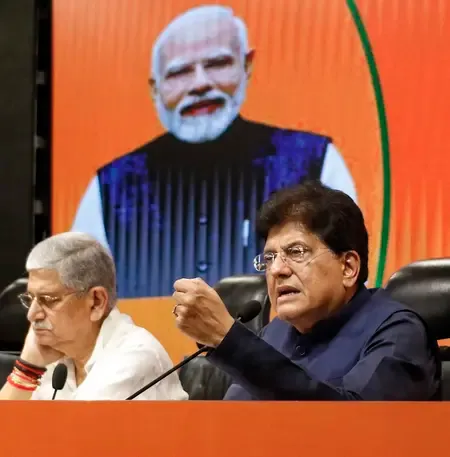
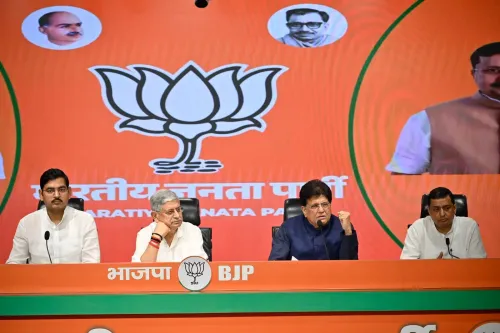
Piyush Goyal accuses Opposition of plotting Bangladesh-style regime change
Synopsis
Union Minister Piyush Goyal on October 16, 2026 accused opposition figures of openly seeking Bangladesh-style regime change in India, alleging they admitted as much at press conferences and publicly vowed to topple the elected government.
Key Takeaways
Piyush Goyal , Union Commerce Minister and Rajya Sabha Leader of the House, posted a sharply worded political attack on October 16, 2026 .
He alleged opposition leaders publicly cited the Bangladesh 2024 political upheaval as inspiration for 'regime change' in India.
A second leader, he claimed, openly declared an intent to bring down the government — डंके की चोट पर ('to the beat of a drum').
Goyal accused these actors of seeking to 'demolish democratic institutions and set the country on fire.' The post frames the Opposition's moves as targeting India's youth as 'pawns in the politics of anarchy.' No specific individuals were named, suggesting the BJP intends the charge to apply broadly across opposition ranks.
A sharp political alarm was sounded on Friday, October 16, 2026, when Union Commerce and Industry Minister Piyush Goyal accused opposition figures of openly plotting to topple the elected government — drawing an explicit parallel to the student-led upheaval that ousted Bangladesh's Sheikh Hasina administration in 2024.
Posting in Hindi on X, Goyal wrote: 'देश के नौजवानों को अराजकता की राजनीति का मोहरा बनाने की कोशिश की जा रही है' — 'An attempt is being made to use the country's youth as pawns in the politics of anarchy.' He alleged that opposition leaders have stated at press conferences that they drew inspiration from Bangladesh for 'regime change', and that another leader has publicly proclaimed an intent to bring down the government 'to the beat of a drum' (डंके की चोट पर).
The Bangladesh comparison at the centre of the charge
The Bangladesh reference is politically loaded. The July–August 2024 protests in Dhaka — led largely by students — culminated in the fall of Prime Minister Sheikh Hasina's government and her departure from the country. Goyal's post implies that invoking that episode as 'inspiration' for Indian politics amounts to a direct threat to constitutional order, not legitimate dissent.
By naming 'regime change' — a phrase with strong foreign-policy connotations — Goyal frames the Opposition's stated goal not as electoral competition but as an attempt to subvert democratic institutions from outside the ballot box.
Goyal's 'demolish democratic institutions' warning
The minister did not name specific individuals in his post, but the language was pointed. He declared: 'It is clear that their only agenda is to demolish democratic institutions and set the country on fire.' The phrase 'देश में आग लगाना' — literally 'to set the country ablaze' — signals that the BJP intends to make this a central campaign-trail accusation heading into the political season.
As Leader of the House in the Rajya Sabha, Goyal is among the government's most senior parliamentary voices. His interventions on X frequently carry the weight of an official party position, making this post more than a personal opinion — it lands as a coordinated political message.
Youth, anarchy, and the BJP's political counter-narrative
The post's most deliberate framing targets the youth angle. By alleging that young Indians are being used as 'pawns', the BJP seeks to pre-empt any student-mobilisation narrative the Opposition might build — casting it as manufactured agitation rather than organic democratic energy. It is a direct rhetorical counter to the visual of youthful street politics that carried enormous symbolic power in Dhaka.
The absence of named targets in Goyal's post keeps the attack broad enough to cover multiple Opposition actors, while the press-conference detail suggests he is referencing statements that the ruling party believes are on the public record and will be surfaced in coming days.
Whether the BJP can make the Bangladesh analogy stick — or whether the Opposition reframes it as a government attempt to criminalise protest — will define one of the sharpest fault lines of the political season ahead.
Point of View
The BJP attempts to neutralise any street-mobilisation strategy before it gathers momentum. The youth-as-pawns framing is particularly deliberate: it is an effort to peel young voters away from agitation narratives by positioning them as victims of manipulation rather than agents of change. How the Opposition responds — whether it embraces or distances itself from the Bangladesh comparison — will set the terms of the political debate in the weeks ahead.
NationPress
16 Oct 2026
Frequently Asked Questions
What did Piyush Goyal say about Bangladesh and regime change in India?
On October 16, 2026, Goyal alleged that opposition leaders publicly admitted at a press conference that they drew inspiration from Bangladesh's 2024 political upheaval for a 'regime change' effort in India, and that another leader openly vowed to topple the elected government.
Who is Piyush Goyal and what is his political position?
Piyush Goyal is India's Union Minister of Commerce and Industry, a senior BJP leader, and the Leader of the House in the Rajya Sabha — one of the most senior parliamentary spokespersons for the ruling party.
What happened in Bangladesh that Goyal is referencing?
In July–August 2024, student-led protests in Dhaka escalated into a political crisis that ended Prime Minister Sheikh Hasina's government and forced her to leave Bangladesh. The episode has since become a reference point in regional political discourse.
Did Goyal name specific opposition leaders in his post?
No. Goyal's post did not name specific individuals, keeping the accusation broad and applicable to multiple opposition figures, while referencing press-conference statements he claims are on the public record.
What does 'डंके की चोट पर' mean in Goyal's post?
The Hindi phrase means 'to the beat of a drum' — an idiom for doing something openly and without any shame or hesitation. Goyal used it to allege that an opposition leader brazenly and publicly declared intent to bring down the government.