How Will the Indigenous GSAT-7R Satellite Enhance Indian Navy’s Communications?
Synopsis
The upcoming launch of GSAT-7R by ISRO marks a significant advancement in the Indian Navy's communication capabilities. This indigenously developed satellite promises to enhance maritime operations with robust connectivity and advanced technology. Stay tuned for more updates on this critical mission that strengthens India's security framework.
Key Takeaways
GSAT-7R enhances Indian Navy's maritime communications.
Satellite weighs 4,400 kg , the heaviest yet.
Multi-band communication for voice, data, and video.
Strengthens operational reach across Indian Ocean Region .
Represents India's commitment to Aatmanirbharta .
New Delhi, Nov 2 (NationPress) The Indian Space Research Organisation (ISRO) is set to launch the Indian Navy’s GSAT-7R (CMS-03) communication satellite from the Satish Dhawan Space Centre in Sriharikota, Andhra Pradesh this Sunday. This satellite aims to enhance the Navy’s space-based communications and maritime domain awareness capabilities.
As reported by the Defence Ministry, this satellite represents the most advanced communication system developed for the Indian Navy to date.
Designed and built in India, the satellite will be launched from the renowned Satish Dhawan Space Centre.
Weighing approximately 4,400 kg, this is the heaviest communication satellite from India, featuring cutting-edge components tailored to meet the operational needs of the Indian Navy.
The GSAT-7R will offer extensive telecommunication coverage across the Indian Ocean Region. Its payload comprises transponders capable of facilitating voice, data, and video communications across various bands.
This satellite will significantly bolster connectivity with high-capacity bandwidth, ensuring secure communication links among ships, aircraft, submarines, and the Indian Navy’s Maritime Operations Centres.
In light of evolving security challenges, the GSAT-7R symbolizes the Indian Navy's commitment to safeguarding national maritime interests through advanced technology and the initiative of Aatmanirbharta.
ISRO stated, "CMS-03 is a multi-band communication satellite that will provide services over a vast oceanic area, including the Indian landmass."
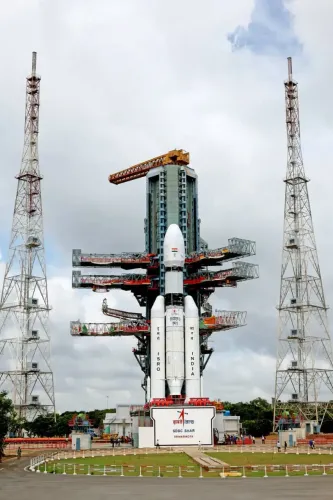
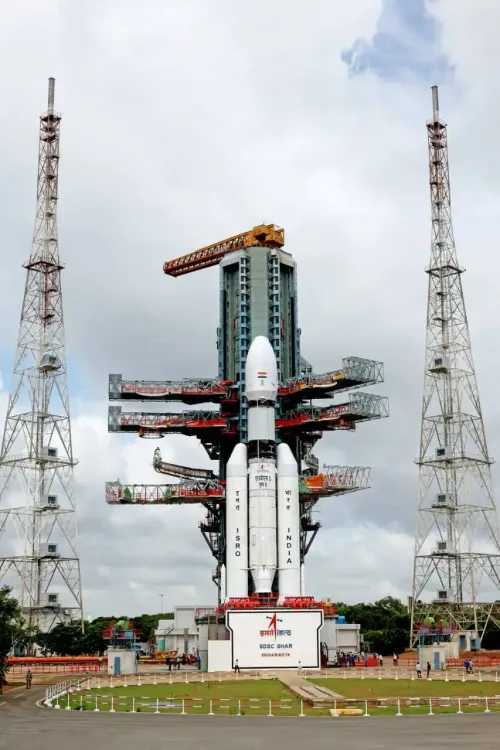
The LVM3 rocket, recognized as India's most powerful launch vehicle, can transport up to 4,000 kg into space and has successfully carried out missions like Chandrayaan-3, making India the first nation to land near the lunar south pole. The upcoming mission designated as LVM3-M5 will mark its fifth operational flight.
According to ISRO, the launch vehicle has been fully assembled, integrated with the spacecraft, and was transported to the launch pad on October 26 for final pre-launch preparations.
Exclusively designed for the Indian Navy, the GSAT-7R will replace the GSAT-7 Rukmini satellite launched in 2013. With enhanced payloads, GSAT-7R is tailored to expand secure, multi-band communications for the Navy, thus reinforcing its operational capabilities across vital maritime regions.
The CMS-03 payload includes transponders for voice, data, and video communications over C, extended C, and Ku bands.
Point of View
The launch of the GSAT-7R satellite is a testament to India's commitment to enhancing its maritime security through advanced technology. This initiative not only showcases our self-reliance in defense capabilities but also strengthens our strategic position in the Indian Ocean Region.
NationPress
30 Sept 2026
Frequently Asked Questions
What is the purpose of the GSAT-7R satellite?
The GSAT-7R satellite is designed to enhance the Indian Navy's space-based communication capabilities and maritime domain awareness.
When will the GSAT-7R satellite be launched?
The GSAT-7R satellite is scheduled for launch on Sunday from the Satish Dhawan Space Centre in Sriharikota, Andhra Pradesh.
What is the weight of the GSAT-7R satellite?
The GSAT-7R satellite weighs approximately 4,400 kg, making it India's heaviest communication satellite to date.
What are the key features of the GSAT-7R satellite?
The GSAT-7R features advanced transponders for voice, data, and video communication across multiple bands, significantly enhancing connectivity for the Indian Navy.
How does GSAT-7R contribute to national security?
GSAT-7R strengthens India's maritime security by ensuring robust and secure communication links among naval forces, thereby enhancing operational capabilities.