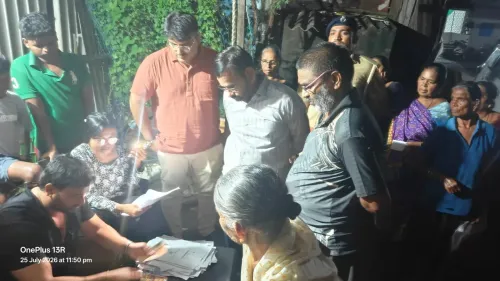
CM Bhupendra Patel Leads Gujarat's Disaster Readiness Drive

Synopsis
The Chief Minister's Office of Gujarat on 24 July 2026 spotlighted CM Bhupendra Patel's disaster preparedness drive, emphasising sensitivity and readiness to protect citizens during natural calamities under the 'Gujarat Always Ahead' banner.
Key Takeaways
The Chief Minister's Office of Gujarat posted on 24 July 2026 highlighting the state's disaster preparedness under CM Bhupendra Patel .
The post emphasised twin pillars of sensitivity and preparedness in protecting citizens during natural calamities.
Gujarat's disaster management institutional framework was built after the 2001 Bhuj earthquake , which killed over 20,000 people .
The Gujarat State Disaster Management Authority (GSDMA) coordinates preparedness, mitigation, and relief across the state.
Coastal districts including Kutch and Saurashtra face heightened risk during the active monsoon season.
The communication is part of the ongoing #અગ્રેસર_ગુજરાત ('Gujarat Always Ahead') campaign by the state government.
The Chief Minister's Office of Gujarat on Friday, 24 July 2026 highlighted the state government's commitment to citizen safety during natural disasters, spotlighting Chief Minister Bhupendra Patel's leadership in combining sensitivity and preparedness in disaster management.
The post, shared under the hashtag #અગ્રેસર_ગુજરાત ('Gujarat Always Ahead'), stated: 'Always progressive Gujarat! Let us know the news of Gujarat, committed to protecting citizens during natural calamities with sensitivity and preparedness under the leadership of Chief Minister Shri Bhupendrabhai Patel.'
Context
Gujarat sits at the intersection of seismic risk and coastal vulnerability, making disaster preparedness a perennial governance priority. The post arrives during the active monsoon season, when the state's western and coastal districts face heightened risk from flooding and cyclonic activity.
The official communication frames the state's approach around two pillars — સંવેદનશીલતા ('sensitivity') and સજ્જતા ('preparedness') — signalling that the administration views disaster response as both a technical and a humanitarian responsibility.
Policy Backdrop
Gujarat's institutional focus on disaster management traces directly to the 2001 Bhuj earthquake, one of India's deadliest, which killed over 20,000 people and reshaped how the state organised emergency response. The Gujarat State Disaster Management Authority (GSDMA) was established in the aftermath to coordinate preparedness, mitigation, and relief across departments.
Through the 2010s, the state layered early warning systems and community-based preparedness programmes onto its coastal districts, building a model that has since been studied by other Indian states. The current government under Bhupendra Patel, who has served as Chief Minister since 2021, has continued to invest in this institutional architecture.
Stakeholders and Impact
The communities most directly affected by these preparedness measures are Gujarat's coastal populations — spread across districts such as Kutch, Saurashtra, and the Gulf of Khambhat coastline — who face recurring threats from cyclones and storm surges during the June-to-September monsoon window.
Inland agricultural communities in flood-prone river basins also fall within the state's disaster response framework. Effective early warning and evacuation coordination can be the difference between manageable disruption and large-scale loss of life and livelihoods for these groups.
What's Next
State-level reviews of monsoon preparedness plans are standard practice in this period, and the post signals that the CMO Gujarat intends to keep public communication active around disaster readiness through the season. Coordination with the National Disaster Management Authority (NDMA) at the central level remains a key variable in how effectively state-level plans translate into on-ground response.
As the monsoon intensifies across western India, the administration's ability to operationalise its stated sensitivity-and-preparedness framework will be closely watched by both citizens and policy observers tracking Gujarat's governance model.
Point of View
Timed to the monsoon season when disaster response credibility is most publicly tested. By invoking both 'sensitivity' and 'preparedness,' the messaging positions the Bhupendra Patel administration as administratively competent and humanistically grounded — a dual framing that has become standard in Indian state-level disaster governance. Gujarat's post-Bhuj institutional legacy gives this communication a substantive policy spine that many comparable state messages lack. The broader pattern suggests the ruling dispensation is keen to keep the 'Gujarat model' of governance visible through official digital channels ahead of any future electoral cycle.
NationPress
22 Oct 2026
Frequently Asked Questions
What did the Gujarat CMO post about on 24 July 2026?
The Chief Minister's Office of Gujarat posted about the state's commitment to protecting citizens during natural disasters, highlighting CM Bhupendra Patel's leadership in combining sensitivity and preparedness in disaster management.
Who is Bhupendra Patel and what is his role in Gujarat's disaster management?
Bhupendra Patel has been the Chief Minister of Gujarat since 2021 and oversees the state's administrative and disaster response framework, including the Gujarat State Disaster Management Authority.
What is the Gujarat State Disaster Management Authority?
The Gujarat State Disaster Management Authority (GSDMA) is a state-level body established after the 2001 Bhuj earthquake to coordinate disaster preparedness, mitigation, and relief operations across Gujarat.
Why is Gujarat's disaster preparedness considered a model for other states?
Gujarat developed robust early warning systems and community-based preparedness programmes following the 2001 Bhuj earthquake, building an institutional framework that has been studied and referenced by other Indian states.
Which parts of Gujarat are most at risk during the monsoon season?
Coastal districts including Kutch and Saurashtra, as well as communities along the Gulf of Khambhat coastline, face the highest risk from cyclones, storm surges, and flooding during the June-to-September monsoon period.