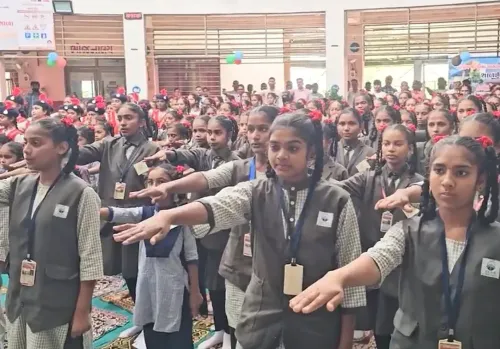
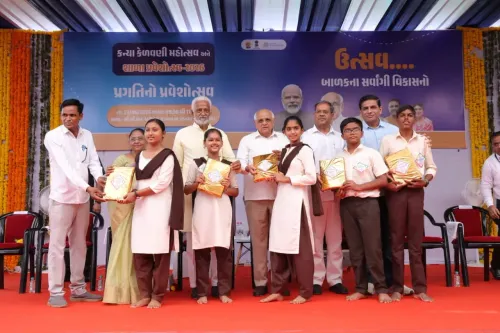
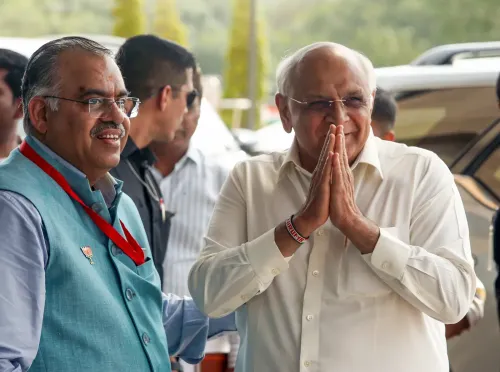
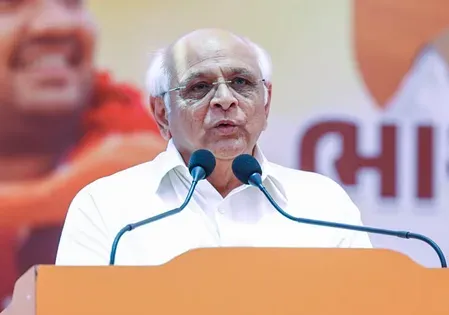
Gujarat CM Bhupendra Patel pushes for 100% school enrolment at Shala Praveshotsav 2026
Synopsis
Gujarat's annual school admission drive has entered its 24th year — and this time, it comes with three new policy launches. CM Bhupendra Patel's push for 100% enrolment is backed by a data-mapped identification of out-of-school children, a new quality assessment framework for all schools, and a three-year foundational learning programme. With the dropout rate already near 1%, the state is now pivoting from access to quality.
Key Takeaways
Gujarat CM Bhupendra Patel called for 100% school enrolment at a guidance meeting in Gandhinagar on 17 June 2026 .
The state launched the NEP 2020-based State Curriculum Framework (SCF) , the School Quality Assessment and Assurance Framework (SQAAF) , and the Nipun Gujarat Programme (2026-27 to 2028-29).
Gujarat's school dropout rate has declined to approximately one per cent ; around 6.5 lakh dropped-out children were traced and re-enrolled in the previous session.
Gujarat ranked first nationally in the Swachh and Harit Vidyalaya Rating , with Rajkot district placed seventh in the top 10 districts nationally.
Authorisation letters were issued for 5 of 298 secondary schools approved in the 2026-27 state budget .
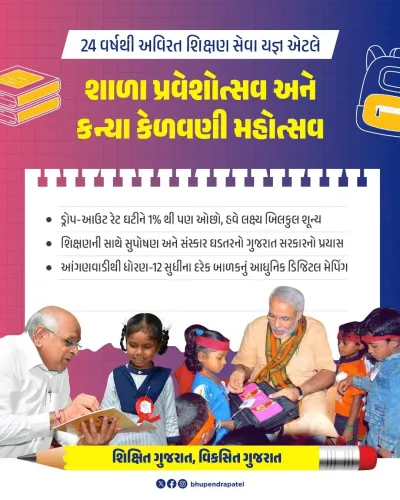
The Shala Praveshotsav initiative, originally launched by PM Modi in 2003 , has now completed 24 years .
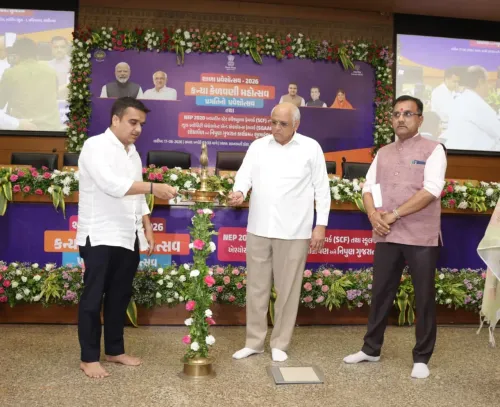
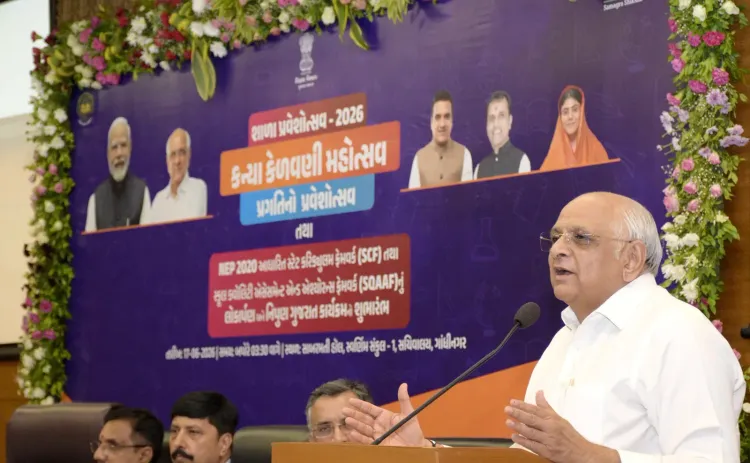
Gujarat Chief Minister Bhupendra Patel on Wednesday, 17 June 2026 called for 100 per cent school enrolment across the state, directing officials to ensure no child is excluded from the education system as Gujarat gears up for Shala Praveshotsav and Kanya Kelavani Mahotsav 2026. Patel made the appeal while addressing a guidance meeting in Gandhinagar ahead of the state's annual school admission drive.
Chief Minister's Directive to Officials
Addressing education officials and administrators, Patel stressed that Gujarat must retain its leading position in education by enrolling every eligible child before the new academic session begins. He urged officials participating in the campaign to engage directly with parents and communicate the value of education in children's holistic development.
'We will move ahead with clear goals and a vision regarding what needs to be done and how it should be done to achieve 100 per cent school enrolment of children. If we explain this to parents, not a single child will remain deprived of school admission,' Patel said.
The Chief Minister noted that the education outreach initiative — originally launched by Prime Minister Narendra Modi in 2003, when he served as Gujarat's Chief Minister — had now entered its 24th year. He said the programme had evolved through sustained efforts to improve both educational access and outcomes.
Key Launches: NEP 2020 Framework and Nipun Gujarat
During the event, Patel launched three significant education initiatives. The first was the National Education Policy (NEP) 2020-based State Curriculum Framework (SCF), which sets a new pedagogical direction for Gujarat's schools. The second was the School Quality Assessment and Assurance Framework (SQAAF), which will apply uniform quality benchmarks across government and private schools, with results to be made public. The third was the Nipun Gujarat Programme, a three-year initiative running from 2026-27 to 2028-29, aimed at strengthening foundational learning — reading, writing, and numeracy — in primary education.
State Education Minister Dr Pradyuman Vaja described these launches as the beginning of a new phase, noting that Gujarat had already achieved universal enrolment and improved school infrastructure. 'The state's focus was now shifting towards improving educational quality,' he said. Vaja also announced that Gujarat had secured first place nationally in the Swachh and Harit Vidyalaya Rating, with 15 schools from the state earning recognition, and that Rajkot district had been ranked seventh among the country's top 10 districts.
Dropout Rate and Re-enrolment Efforts
Patel highlighted that Gujarat's school dropout rate had declined to approximately one per cent, crediting sustained enrolment efforts for the achievement. Deputy Chief Minister Harsh Sanghavi commended the Education Department for tracing and re-enrolling around 6.5 lakh children who had dropped out during the previous academic session. He expressed confidence that continued societal and governmental efforts could bring the dropout ratio to zero.
Sanghavi urged officials to treat the three-day enrolment campaign as a social responsibility rather than a routine administrative exercise, and called on teachers and parents to work together in building healthy habits and values among students from an early age.
Data-Driven Approach and Administrative Push
Principal Secretary of the Education Department Milind Torawane said Shala Praveshotsav 2026 was not merely an admission drive but a broader movement to connect every child with mainstream education. He noted that data-based mapping of students from Balvatika to Class 12 had been completed to identify children outside the education system, and that the Education Department had integrated data from multiple departments — including health services — to reach children requiring support.
Chief Secretary M.K. Das referenced a recent NITI Aayog meeting chaired by the Prime Minister, where nutrition, education, and health were identified as key national priorities. He underscored that enrolment and regular attendance were essential to further reduce dropout rates.
During the event, authorisation letters were handed over to District Education Officers for five of the 298 secondary schools approved in the 2026-27 state budget. Collectors, district development officers, and education officials from across Gujarat participated virtually.
What Comes Next
With the Nipun Gujarat Programme now formally launched, Gujarat's education machinery will focus on measurable foundational learning outcomes over the next three academic years. Scientific school assessments under SQAAF — based on standards prepared by the Gujarat Council of Educational Research and Training (GCERT) — are expected to be conducted and made public, marking a shift from access-focused metrics to quality-driven accountability.
Point of View
But the harder test begins now. Launching three policy frameworks — SCF, SQAAF, and Nipun Gujarat — in a single event risks diluting accountability; each requires distinct implementation machinery and timelines. The shift from enrolment metrics to learning outcomes is the right pivot, but India has seen quality frameworks announced and quietly shelved before. The decision to make SQAAF results public is the most consequential detail in today's announcements — if enforced, it creates a transparency mechanism that could hold both government and private schools accountable in ways that Gujarat's education system has not faced before.
NationPress
19 Sept 2026
Frequently Asked Questions
What is Shala Praveshotsav and Kanya Kelavani Mahotsav 2026?
Shala Praveshotsav and Kanya Kelavani Mahotsav is Gujarat's annual school enrolment drive, now in its 24th year, originally launched by Prime Minister Narendra Modi in 2003 when he was the state's Chief Minister. The campaign mobilises officials, teachers, and parents to enrol every eligible child — with particular focus on girls' education — before the academic session begins.
What is the Nipun Gujarat Programme?
The Nipun Gujarat Programme is a three-year initiative running from 2026-27 to 2028-29, aimed at strengthening foundational learning — reading, writing, and numeracy — in primary education. It was launched by Chief Minister Bhupendra Patel on 17 June 2026 as part of Gujarat's shift from universal enrolment to improving learning quality.
What is the current school dropout rate in Gujarat?
Gujarat's school dropout rate has declined to approximately one per cent, according to state officials. Around 6.5 lakh children who had dropped out during the previous academic session were traced and re-enrolled by the Education Department.
What is the School Quality Assessment and Assurance Framework (SQAAF)?
SQAAF is a new framework that establishes uniform quality benchmarks for both government and private schools in Gujarat. Schools will undergo scientific assessments based on standards prepared by the Gujarat Council of Educational Research and Training (GCERT), and results will be made public.
How did Gujarat rank in the Swachh and Harit Vidyalaya Rating?
Gujarat secured first place nationally in the Swachh and Harit Vidyalaya Rating, with 15 schools from the state earning recognition. Rajkot district was ranked seventh among the country's top 10 districts in the same assessment.