Gujarat's Shala Praveshotsav turns 23: CM Patel on education reforms
Synopsis
Gujarat's school enrolment campaigns — launched in 2003 when a 37% dropout rate threatened a generation — have now drawn ₹326 crore in community contributions and spawned India's first AI-driven school monitoring system. At 23, Shala Praveshotsav is less a government scheme and more a template for state-led social mobilisation on education.
Key Takeaways
Shala Praveshotsav and Kanya Kelavani Rath Yatra completed 23 years on 23 June 2025 , launched in 2003 under then CM Narendra Modi .
Gujarat's school dropout rate stood at over 37 per cent in 2001-02 ; the campaigns targeted both enrolment and girls' education specifically.
Community contributions over 23 years have reached approximately ₹326 crore ; School Management Committees now have 75% parental participation and 50% women's representation .
Girls in Classes 9–12 receive up to ₹50,000 under Namo Lakshmi Yojana ; science students in Classes 11–12 get up to ₹25,000 under Namo Saraswati Vigyan Sadhana Yojana .
The Vidya Samiksha Kendra is described as India's first AI-driven school monitoring system, with real-time dropout early-warning capability.
Gunotsav 2.0 (GSQAC) now evaluates schools against 211 standards aligned with NEP 2020 .
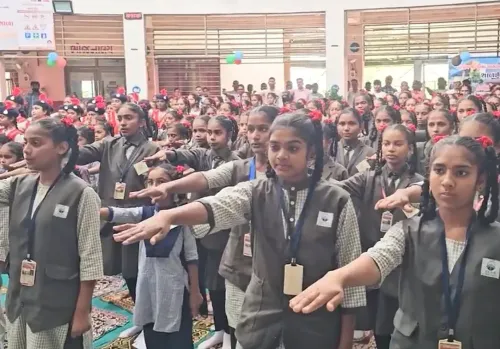
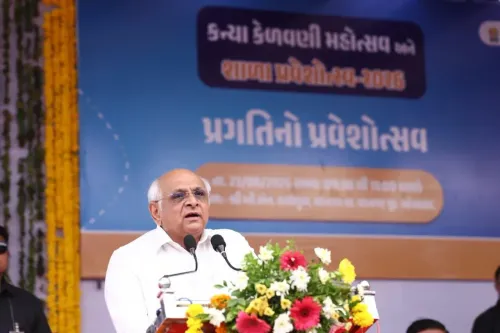
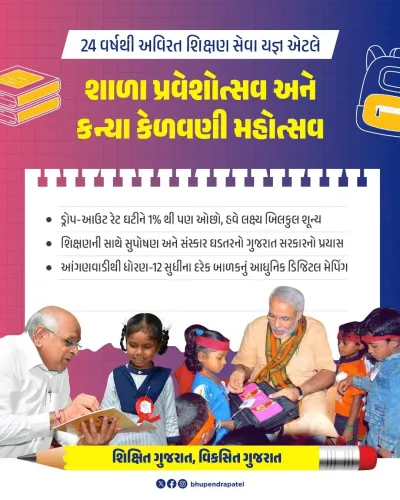
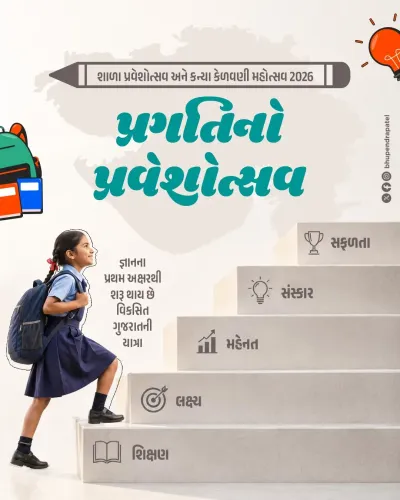
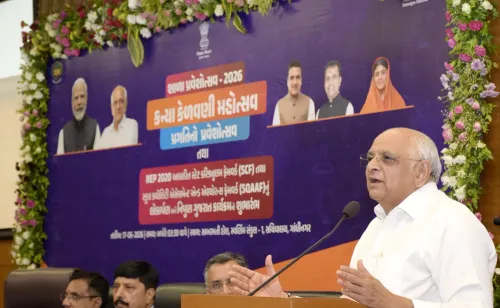
Gujarat's twin school enrolment drives — Shala Praveshotsav and Kanya Kelavani Rath Yatra — marked 23 years on 23 June 2025, with Chief Minister Bhupendra Patel describing the campaigns as a transformation from state-run programmes into a statewide social movement that has fundamentally widened access to education across Gujarat.
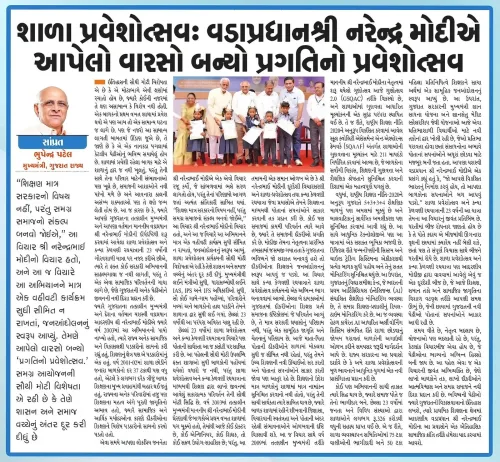
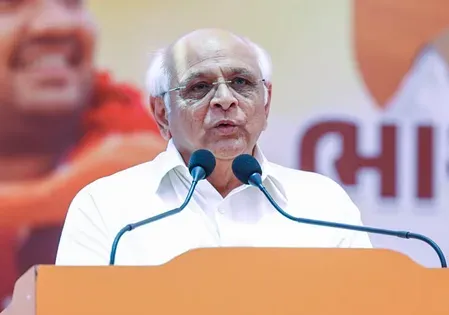
In a written piece released to mark the occasion, Patel traced the origins, milestones, and structural reforms that have defined Gujarat's education landscape over two decades.
From Crisis to Campaign: The 2003 Starting Point
Patel noted that when the campaigns were launched in 2003 under then Chief Minister Narendra Modi, Gujarat was grappling with a severe dropout crisis. The state's school dropout rate in 2001-02 stood at more than 37 per cent — meaning nearly one in three children was leaving the educational mainstream before completing basic schooling.
Girls faced compounded barriers, including social prejudice, economic hardship, and deep-rooted structural obstacles. The founding premise of the initiative, according to Patel, was that education could not remain a government obligation alone — it had to become a collective societal commitment.
Ministers, legislators, and officers from the IAS, IPS, and IFS services were mobilised to travel to villages, engage families, and personally accompany children to schools. 'For 23 years, this unique tradition has continued uninterrupted, reflecting a sustained commitment to ensuring that every child receives the opportunity to learn,' Patel wrote.
Girls' Education and Shifting Social Attitudes
The Kanya Kelavani Rath Yatra was integrated into the broader campaign specifically to ensure that every girl child entered the education system. Patel credited the initiative with driving a measurable shift in how families across Gujarat view daughters' education.
'Today, families do not view a daughter's education as an exception or aspiration alone; they actively seek to ensure that she moves from school to higher education and beyond,' he wrote.
To reinforce this momentum, the state government has introduced targeted financial support. Under the Namo Lakshmi Yojana, girls studying in Classes 9 to 12 receive financial assistance of up to ₹50,000. The Namo Saraswati Vigyan Sadhana Yojana provides up to ₹25,000 over two years to students in Classes 11 and 12 pursuing science education.
Quality Reforms: Gunotsav, NEP, and AI Monitoring
Beyond enrolment, Patel highlighted a parallel push on educational quality. The Gunotsav programme, launched in 2009 under Modi's tenure as Chief Minister, has since evolved into Gunotsav 2.0 (GSQAC), which incorporates the School Quality Assessment and Assurance Framework (SQAAF). The framework is aligned with the National Education Policy (NEP) 2020 and sets out 211 standards for evaluating school quality.
Gujarat has also adopted the NEP's 5+3+3+4 academic structure and universally implemented Balvatika at the foundational stage. Digital birth registration and child-tracking systems are in place to ensure continuous enrolment support.
Patel pointed to the Vidya Samiksha Kendra, which he described as 'India's first AI-driven educational monitoring system.' The platform enables real-time tracking of educational progress and includes an AI-based early warning system designed to identify potential dropouts and trigger timely intervention.
Community Participation and Financial Inclusion
Community ownership has been a defining feature of the campaigns. Patel said contributions from citizens, institutions, and organisations over the past 23 years have cumulatively reached approximately ₹326 crore.
School Management Committees now record 75 per cent parental participation and 50 per cent representation of women, according to Patel, making schools more community-driven institutions. Scholarship programmes — including the Mukhyamantri Gyan Sadhana Scholarship and the Gyan Setu Merit Scholarship — provide additional support to meritorious students facing financial constraints.
Patel closed his article by quoting Prime Minister Narendra Modi's vision: 'If we aim to build a Viksit Bharat, then it must begin by empowering the dreams of our children.' He described the 23-year journey as 'a living reflection of this belief' and predicted that future generations would view the campaigns not merely as policy interventions but as efforts that helped reshape Gujarat's educational foundation.
Point of View
Let alone span multiple decades. Yet the article released by CM Patel is largely self-referential, citing the campaign's own milestones without independent verification of current dropout rates or learning outcomes. The ₹326 crore in community contributions is a striking number, but its composition — who gave, under what circumstances — is unaddressed. More critically, Gujarat's AI monitoring system and 211-standard quality framework are promising architectures, but the gap between infrastructure and actual learning levels remains the harder metric. The real test of 23 years of Shala Praveshotsav is not enrolment — it is whether those enrolled children are learning at grade level, a question the article does not answer.
NationPress
22 Sept 2026
Frequently Asked Questions
What is Shala Praveshotsav and when was it launched?
Shala Praveshotsav is Gujarat's flagship school enrolment campaign, launched in 2003 under then Chief Minister Narendra Modi to address a dropout rate exceeding 37 per cent. It mobilises government officials, ministers, and legislators to visit villages and accompany children to school at the start of each academic year.
What is the Kanya Kelavani Rath Yatra?
Kanya Kelavani Rath Yatra is a companion initiative integrated with Shala Praveshotsav, focused specifically on promoting girls' education in Gujarat. It has been credited with shifting social attitudes towards educating daughters and encouraging families to support girls through higher education.
What financial support does Gujarat offer girls under these schemes?
Under the Namo Lakshmi Yojana, girls in Classes 9 to 12 receive financial assistance of up to ₹50,000. The Namo Saraswati Vigyan Sadhana Yojana provides up to ₹25,000 over two years to girls in Classes 11 and 12 who are pursuing science education.
What is the Vidya Samiksha Kendra?
The Vidya Samiksha Kendra is described by CM Bhupendra Patel as India's first AI-driven educational monitoring system. It enables real-time tracking of school-level progress and uses an AI-based early warning system to identify students at risk of dropping out so that timely intervention can be made.
How much have communities contributed to Gujarat's school campaigns over 23 years?
According to CM Patel, cumulative contributions from citizens, institutions, and organisations to the campaigns over 23 years have reached approximately ₹326 crore. School Management Committees now record 75 per cent parental participation and 50 per cent women's representation.