Gujarat cuts carbon emissions by 49.79 mn tonnes in FY2025-26, leads India in green energy
Synopsis
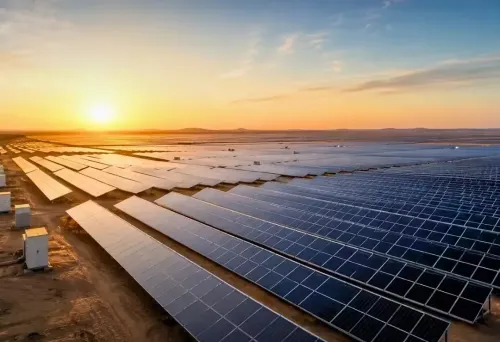
Gujarat slashed carbon emissions by nearly 50 million tonnes in a single financial year — a figure that would rank it among the more consequential sub-national climate actors in Asia. With 52 GW of renewable capacity already installed and a 100 GW target by 2030, the state is rewriting what an Indian industrial economy's energy transition can look like.
Key Takeaways
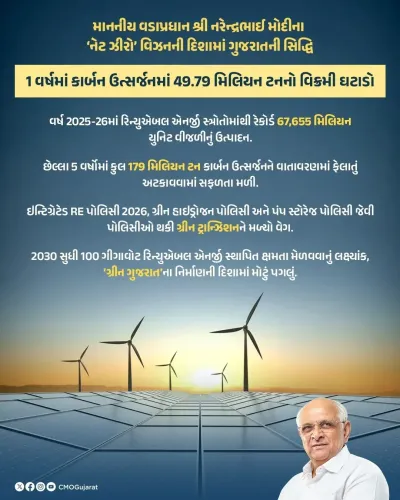
Gujarat reduced carbon emissions by 49.79 million tonnes in FY2025-26 , ranking first among Indian states.
The state generated 67,655 million units of green electricity in the same period.
Cumulative emission reductions over the past five years stand at 179 million tonnes , according to estimated state data.
Gujarat currently produces 52 GW of renewable energy and is targeting 100 GW by 2030 .
PM Surya Ghar: Muft Bijli Yojana and PM-KUSUM Yojana have been central to driving household and farm-level solar adoption.
The state's push is anchored by the Integrated Renewable Energy Policy-2026 and a Green Hydrogen Policy .
Gujarat has reduced carbon emissions by 49.79 million tonnes in the 2025-26 financial year, generating 67,655 million units of green electricity in the same period — making it the country's top-ranked state in renewable energy output, according to state government data. The achievement is being positioned as a key milestone in India's push toward net-zero emissions by 2070.
Five-Year Emission Reduction Record
According to estimated data released by state authorities, Gujarat has cumulatively reduced carbon emissions by 179 million tonnes over the past five years. Officials attribute the sustained gains to a combination of aggressive renewable energy targets, green investment incentives, and the coordinated rollout of central and state-level schemes under Chief Minister Bhupendra Patel.
The state currently produces 52 gigawatts (GW) of renewable energy, according to Shalini Agrawal, Managing Director of Gujarat Urja Vikas Nigam Limited (GUVNL). 'Initiatives such as renewable energy, green energy, and hydrogen are being implemented on a large scale across Gujarat. As a result, Gujarat currently ranks first in India in the renewable energy sector,' she said.
Key Schemes Driving the Transition
Two centrally-sponsored programmes have played a significant role in Gujarat's green energy scale-up. The PM Surya Ghar: Muft Bijli Yojana incentivises citizens to install rooftop solar panels, while the PM-KUSUM Yojana encourages farmers to adopt solar-powered pumps. Both schemes offer subsidies that have made adoption economically viable for households and agricultural users alike.
Beneficiary Bharatbhai Padhiyar, who installed a rooftop solar system under PM Surya Ghar, said his monthly electricity bill — previously between ₹6,000 and ₹7,000 — has dropped to zero after availing a 50 per cent subsidy. The system now powers his home appliances and charges his electric vehicle. Another beneficiary, Khalpabhai Chaudhary, said a solar pump has ensured uninterrupted water supply to his farm, removing the burden of electricity costs.
Policy Framework and Institutional Push
Gujarat's energy transition is underpinned by the state's Integrated Renewable Energy Policy-2026 and its Green Hydrogen Policy. Institutions including GUVNL, the Gujarat Energy Development Agency (GEDA), and the Gujarat Power Corporation Limited (GPCL) are coordinating implementation. The state has set a target of 100 GW of renewable energy capacity by 2030.
Gujarat Energy Minister Rishikesh Patel confirmed the figures, telling reporters that the state reduced carbon emissions by 49.80 million tonnes in 2025-26 and generated an additional 67,655 million units of electricity from clean sources during the period.
National and Climate Context
This comes amid India's broader commitment under the Paris Agreement to reduce the emissions intensity of its GDP and achieve net-zero by 2070. Gujarat's performance, if sustained, positions it as a template for other large industrial states that have struggled to balance economic growth with decarbonisation. Notably, Gujarat is also home to significant petrochemical and heavy industry, making the scale of its emission cuts more consequential than the headline number alone suggests.
With the 100 GW target for 2030 still some distance away from the current 52 GW installed base, the pace of capacity addition in the coming years will be the real test of the state's green energy ambitions.
Point of View
But it needs scrutiny: the state has not disclosed the methodology behind the estimate, and 'carbon emission reduction' figures from renewable generation can vary significantly depending on the grid emission factor used. The more durable signal is the installed capacity — 52 GW is real and verifiable. The harder question is whether Gujarat's model, built partly on central subsidies and a favourable coastal geography for wind, is genuinely replicable in landlocked or coal-dependent states like Jharkhand or Chhattisgarh. India's net-zero journey will be decided there, not in Gujarat.
NationPress
9 Oct 2026
Frequently Asked Questions
How much did Gujarat reduce carbon emissions by in 2025-26?
Gujarat reduced carbon emissions by 49.79 million tonnes in the 2025-26 financial year, according to state government data. In the same period, the state generated 67,655 million units of green electricity.
What is Gujarat's total renewable energy capacity?
Gujarat currently produces 52 gigawatts of renewable energy, making it the top-ranked state in India in the renewable energy sector, according to GUVNL Managing Director Shalini Agrawal. The state is targeting 100 GW of renewable capacity by 2030.
Which schemes helped Gujarat achieve its green energy targets?
The PM Surya Ghar: Muft Bijli Yojana, which subsidises rooftop solar installations, and the PM-KUSUM Yojana, which supports solar pump adoption by farmers, have been key drivers. Both offer subsidies that have made clean energy economically accessible to households and agricultural users.
What is Gujarat's cumulative carbon emission reduction over five years?
According to estimated data from state authorities, Gujarat has reduced total carbon emissions by 179 million tonnes over the past five years. The figures cover the period of expanded renewable energy deployment under the state's energy policies.
How does Gujarat's green push connect to India's climate goals?
India has committed to achieving net-zero emissions by 2070 under the Paris Agreement. Gujarat's renewable energy scale-up — backed by the Integrated Renewable Energy Policy-2026 and a Green Hydrogen Policy — is being positioned as a model contribution toward that national target.